
Choosing a plant for a cat home is not about memorizing a long list of names. It is about learning one repeatable habit: check the exact plant before it comes home. Most mistakes do not happen because the owner did not care. They happen because a common name misled, a label was missing, or a plant only looked safe.
The Short Answer
How to choose cat safe plants comes down to one habit: before you buy, find the plant’s botanical name on the label.
If the label gives no botanical name, the seller cannot confirm the species, or the plant is not listed, do not buy it until the identity is confirmed. That two-minute check is the whole skill behind how to choose cat safe plants well. For a ready-made starting list, see 15 Cat-Safe Houseplants for a Greener, Pet-Friendly Home.
Step 1: Read the Label — Start With the Common Name
Learning how to choose cat safe plants starts with the tag, not the plant. Every plant in a shop has a common name on its tag: “palm,” “fern,” “lily,” “ivy,” “succulent.” Common names are a starting point, not a safety check.
A “palm” could be a non-toxic parlor palm or a highly toxic sago palm — see Are Sago Palms Toxic to Cats? A Serious Plant Safety Warning. A “lily” could be a true lily, a peace lily, or a Peruvian lily — three very different risks.
A good tag carries the common name and the botanical name in italics. If the tag gives only a common name, ask before you pay. That is why how to choose cat safe plants always starts with the label, not the look of the plant.
Step 2: Find the Botanical Name
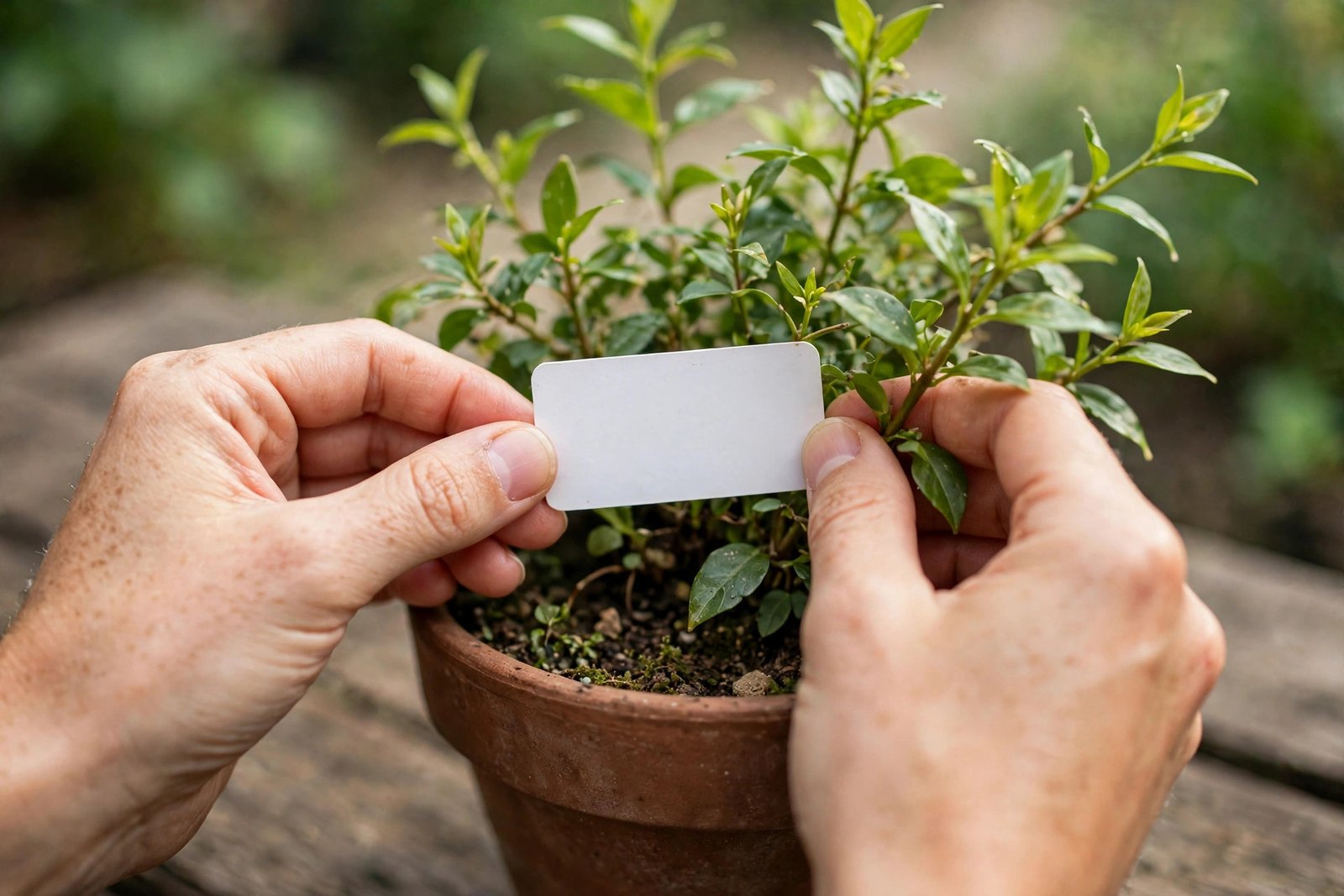
The botanical name — also called the scientific name — is the two-part Latin name that identifies a plant exactly, such as Chlorophytum comosum for the spider plant.
Look for italics on the tag or pot: the botanical name is usually printed in smaller italic type under the common name. If nobody in the shop can tell you the botanical name, do not buy the plant — that rule alone answers most of how to choose cat safe plants safely.
Ask the seller directly: “What is the botanical name of this plant?” Note the botanical name on your phone before you leave. Getting the name right is the middle step of how to choose cat safe plants with confidence.
Step 3: Check the ASPCA Database
Once you have the botanical name, search it on the ASPCA Animal Poison Control plant database, which keeps toxic and non-toxic lists for cats. It is the first place to check when you are learning how to choose cat safe plants. Search the botanical name, not the common name.
Read the entry fully. Check that the entry covers cats, not dogs only.
Non-toxic means no compounds known to poison cats were found. Listed as toxic means do not bring it home, or keep it only in a room the cat cannot enter. No entry means unknown, not safe: the ASPCA says its list is not all-inclusive. A missing entry is a gap in the list, not a verdict — and knowing that is part of how to choose cat safe plants without guessing.
Step 4: Remember What “Non-Toxic” Really Means
One of the most misunderstood parts of how to choose cat safe plants is the word non-toxic itself. The ASPCA states that eating any plant material may cause vomiting and stomach upset. Non-toxic means no compounds known to poison cats have been found — but a cat that eats a lot of any plant material, even a spider plant or Boston fern, can still get stomach upset.
Protect even the safest plants from grazing and cover the soil. Remember that how to choose cat safe plants well also means planning where each plant will live.
The Look-Alike Traps: Three Families That Cause the Most Mistakes
This is where how to choose cat safe plants gets practical.
The Lily Family
The word “lily” is the most dangerous common name in a cat home. True lilies — Lilium species such as Asiatic, Easter, Stargazer, and Oriental lilies — can cause severe kidney injury in cats. Daylilies (Hemerocallis species) carry the same kidney risk. Even the vase water and pollen licked off fur can cause kidney injury — a nibble is not the only risk.
Other lilies are toxic in different ways. The peace lily (Spathiphyllum species) contains insoluble calcium oxalate crystals; it is very rarely life-threatening, but it is still toxic. The calla lily (Zantedeschia aethiopica) is not a true lily and is toxic through the same crystals. Lily of the valley (Convallaria species) contains cardiac glycosides and can cause serious poisoning.
The Peruvian lily (Alstroemeria species) is common in bouquets, yet it causes only stomach upset: the ASPCA says it is not expected to cause life-threatening injury. That is exactly how to choose cat safe plants around lilies: check the botanical name every time. For the full guide, see Are Lilies Toxic to Cats? Types, Exposure Risks, and Urgent Steps.
The Palm Family

True palms are in the family Arecaceae, and several are non-toxic, including the parlor palm (Chamaedorea elegans) and the areca palm (Dypsis lutescens). See Are Parlor Palms Safe for Cats? Benefits, Risks, and Care Tips.
But many plants sold as “palms” are not palms at all. The sago palm (Cycas revoluta) is a cycad: it contains cycasin, all parts are toxic, and the seeds are the most toxic part. The cardboard palm (Zamia species) is also a toxic cycad. The ponytail palm (Beaucarnea recurvata) is not a true palm either, though the ASPCA lists it as non-toxic.
The family name on the tag will tell you whether a “palm” is a true palm or a cycad. Telling them apart is how to choose cat safe plants in the palm aisle.
The Fern Family and the Trailing Vines

A Boston fern (Nephrolepis exaltata) is listed as non-toxic — see Are Boston Ferns Safe for Cats? A Complete Plant Guide — while an asparagus fern (Asparagus densiflorus) is not a true fern and the ASPCA lists it as toxic.
Trailing vines cause the same problem. A heartleaf philodendron, a pothos, and a wax plant can look almost identical, and only the wax plant (Hoya carnosa) is safe: philodendron and pothos both contain insoluble calcium oxalate crystals and are toxic. When two plants look alike, the botanical name is the only reliable way to tell them apart — which is why how to choose cat safe plants means checking names, not shapes.
| Common name on the tag | What it might actually be | ASPCA listing for cats |
|---|---|---|
| Lily | True lily (Lilium spp.) | Toxic — kidney failure risk |
| Lily | Peace lily (Spathiphyllum spp.) | Toxic — calcium oxalate crystals |
| Lily | Peruvian lily (Alstroemeria spp.) | Stomach upset only, not life-threatening |
| Palm | Parlor palm (Chamaedorea elegans) | Non-toxic |
| Palm | Sago palm (Cycas revoluta) | Toxic — cycasin, liver failure risk |
| Fern | Boston fern (Nephrolepis exaltata) | Non-toxic |
| Fern | Asparagus fern (Asparagus densiflorus) | Toxic |
| Ivy | English ivy (Hedera helix) | Toxic |
| Ivy | Swedish ivy (Plectranthus australis) | Non-toxic |
| Trailing vine | Philodendron (Philodendron spp.) | Toxic — calcium oxalate crystals |
| Trailing vine | Wax plant (Hoya carnosa) | Non-toxic |
What to Do When a Plant Has No Label
Unlabelled plants are common: a cutting from a friend or a plant from a market stall. The rule is strict: do not bring the plant into the cat’s space until you know what it is. That is the first rule of how to choose cat safe plants from cuttings and market stalls.
First, try to identify it: ask the giver for the name, photograph the plant, and use an identification app to suggest a botanical name, then search it on the ASPCA list. If any candidate is toxic, treat the plant as toxic.
Second, quarantine it in a room the cat cannot enter (see How to Introduce New Houseplants to a Home With Cats).
Third, if you cannot confirm the identity, give the plant away or keep it permanently out of the cat’s reach. Knowing when to walk away is part of how to choose cat safe plants.
What to Do When a Plant Has No ASPCA Entry

Sometimes you will do everything right — find the botanical name, search the ASPCA database — and find no entry at all. The ASPCA says its list covers the most frequently encountered plants and is not all-inclusive, so a missing entry is a gap in the list, not a verdict. Learning how to choose cat safe plants includes knowing what to do with that gap.
Do not assume the plant is safe. Check Pet Poison Helpline next. If you still cannot find an authoritative answer, treat the plant as unverified and keep it out of the cat’s reach, or ask your veterinarian. When sources disagree, go with the more cautious reading — that is how to choose cat safe plants when the database has no answer.
Gift Plants: The Unlabelled Arrival
Gift plants arrive without any of the checks you would do in a shop, and a gifted bouquet often has no label. Cut flowers are the highest-risk version: true lilies are common in bouquets.
When a gift plant arrives, photograph it, identify it, and keep it in a room the cat cannot enter until the check is done. If it is a true lily or lily of the valley, keep it out of the home entirely. Gifts are the one place where how to choose cat safe plants has to happen after the plant arrives, not before.
A Quick Checklist Before Any Plant Comes Home
This checklist sums up how to choose cat safe plants in seven steps. Use it every time, in order.
- Read the tag. Note the common name and look for the botanical name in italics.
- Find the botanical name. Ask the seller if it is not on the tag. If nobody can tell you, walk away.
- Search the ASPCA list by botanical name.
- Check for look-alikes. If it resembles a toxic plant, confirm the species, not just the shape.
- Remember “non-toxic” is not “edible.” Plan placement and soil cover.
- Quarantine new plants. Keep a new plant in a cat-free room for one to two weeks.
- Keep a plant list. Note each plant’s botanical name on your phone.
What to Do If Your Cat Chews a Plant
If your cat chews a plant and you are not sure what it is, treat it as an exposure and act promptly. Move the plant out of reach and call your veterinarian or poison control right away — the ASPCA Animal Poison Control Center at (888) 426-4435, or Pet Poison Helpline at (855) 764-7661.
If you kept a plant list, tell the veterinarian the botanical name at once, because knowing how to choose cat safe plants also means knowing exactly what your cat was exposed to. For a fuller emergency guide, see What to Do If Your Cat Eats a Toxic Plant: A Safety Guide.
Do not try a home remedy, and do not give milk, oil, food, or activated charcoal, or try to make your cat vomit. Cornell warns not to induce vomiting unless a veterinarian specifically directs you to.
Frequently Asked Questions
How do I check if a plant is safe for my cat?
Find the botanical name, then search it on the ASPCA plant list for cats. If it is listed as non-toxic, it is a reasonable choice. The short version of how to choose cat safe plants is: name first, database second, buy third.
What is a botanical name, and why does it matter?
The botanical name is the two-part Latin name that identifies a plant exactly. Safety listings follow the botanical name, not the common name. That is the detail that makes how to choose cat safe plants work at all.
Is the ASPCA plant list complete?
No. The ASPCA says its list covers the most frequently encountered plants and is not all-inclusive. A plant that is not listed is unknown, not safe. Check Pet Poison Helpline as a second source. That second check is part of how to choose cat safe plants when the first list has no answer.
Can I trust a plant tag that says “pet friendly”?
Not on its own. “Pet friendly” has no standard definition, and a tag can carry the claim while the plant is listed as toxic.
What should I do with a gift plant that has no label?
Keep it away from your cat until you identify it. Photograph it, ask the giver what it is, and check the likely botanical name on the ASPCA list. If it is a true lily or lily of the valley, keep it out of the home entirely. If you cannot identify it, give it away.
Does “non-toxic” mean my cat can eat the plant?
No. The ASPCA states that eating any plant material may cause vomiting and gastrointestinal upset. “Non-toxic” means the plant has no compounds known to poison cats.
Conclusion
How to choose cat safe plants comes down to one habit: verify the exact plant before it comes home. Read the label, find the botanical name, search it on the ASPCA list, and watch for look-alikes.
Start with your next plant purchase. Once it becomes a habit, how to choose cat safe plants will feel automatic.
Disclaimer: This article is for general information only and does not replace advice from a veterinarian. Plant safety listings can change, and individual cats can react differently. If your cat eats a plant and seems unwell, contact your veterinarian or an animal poison control service promptly.
Sources
- ASPCA Animal Poison Control Center. “Toxic and Non-Toxic Plant List — Cats.” The searchable database for checking listings. ASPCA Toxic and Non-Toxic Plant List — Cats
- ASPCA Animal Poison Control Center. “Toxic and Non-Toxic Plants.” The database index. ASPCA Toxic and Non-Toxic Plants
- ASPCA Animal Poison Control Center. “Which Lilies Are Toxic to Pets?” True lilies and daylilies can cause severe kidney injury. ASPCA: Which Lilies Are Toxic to Pets?
- Cornell University College of Veterinary Medicine, Cornell Feline Health Center. “Common Cat Hazards.” Call a veterinarian immediately after a suspected toxic ingestion. Cornell Feline Health Center: Common Cat Hazards
1 thought on “How to Choose Cat Safe Plants: Names, Labels, and Verification”