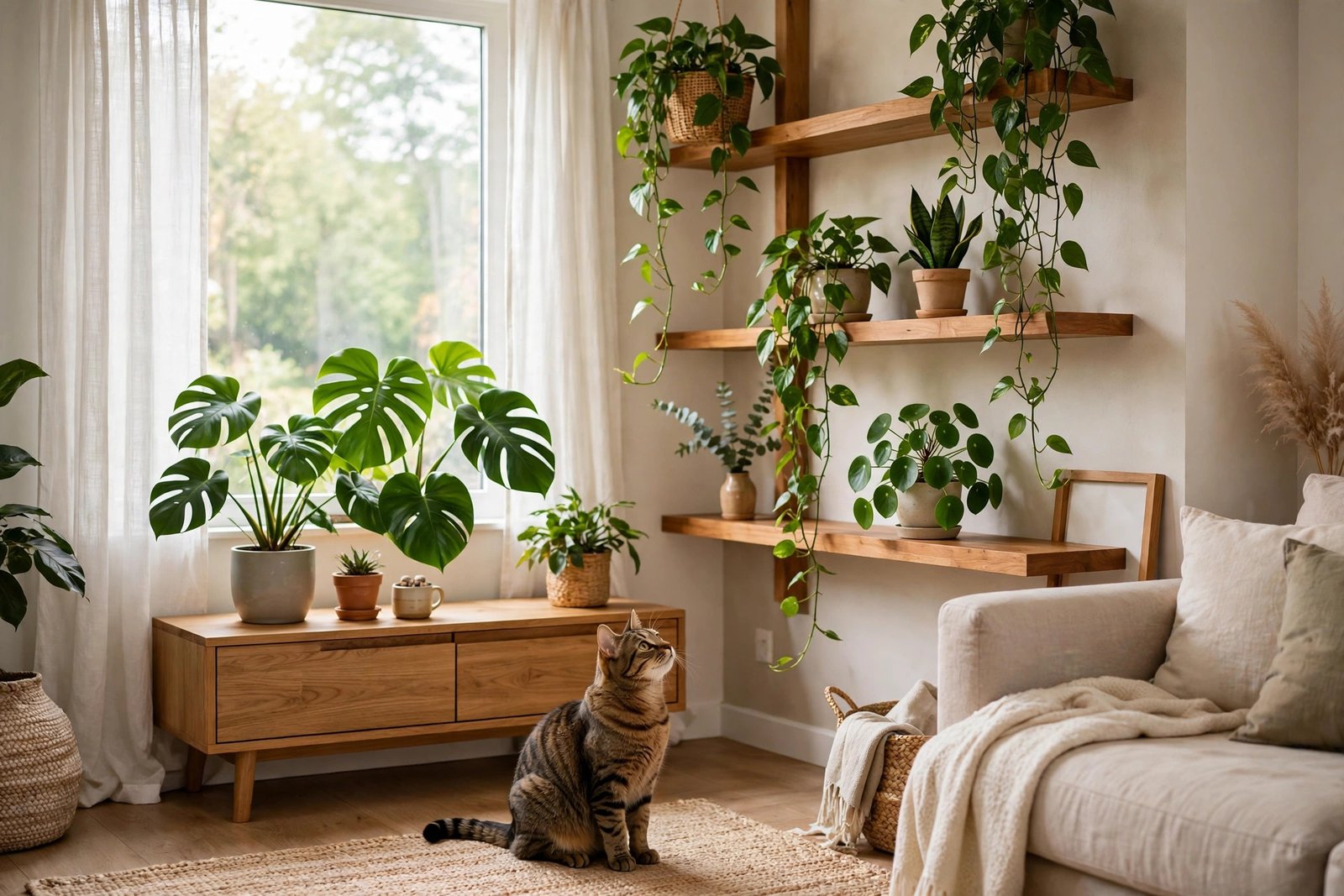
Many of the most popular houseplants sold in the United States are houseplants toxic to cats. Pothos, monstera, snake plants, peace lilies, aloe vera, and jade plants all appear on the ASPCA Animal Poison Control Center’s toxic list for cats. True lilies can cause life-threatening kidney failure after even a tiny exposure. This guide names the houseplants toxic to cats that show up most often in American homes, and shows you safer plants to grow instead.
If your cat has already chewed a plant on this list, contact your veterinarian or poison control right away.
Why So Many Popular Houseplants Are Toxic to Cats
Cats explore with their mouths, and houseplants sit at exactly the height a cat can reach. Plants defend themselves with chemicals, and those chemicals can hurt a cat that chews a leaf or stem.
Insoluble calcium oxalate crystals, found in pothos, monstera, and other aroids, pierce the mouth and throat when chewed. Saponins, found in snake plants, dracaenas, and English ivy, irritate the stomach and gut. Other plants carry their own toxins, such as cycasin in sago palm and bufadienolides in kalanchoe. For true lilies, the substance that damages a cat’s kidneys has not been identified yet.
“Toxic” does not automatically mean a single nibble will be fatal. Some houseplants toxic to cats usually cause a sore mouth and vomiting, while others can cause organ failure. Non-toxic does not mean safe to eat either: the ASPCA notes that eating any plant material may cause vomiting and stomach upset.
The Most Dangerous Houseplants for Cats
Two plants sit at the top of the risk list: keep them out of the house. True lilies and daylilies can destroy a cat’s kidneys, and sago palm can destroy a cat’s liver. Removal is the right answer for both.
True Lilies and Daylilies: The Emergency
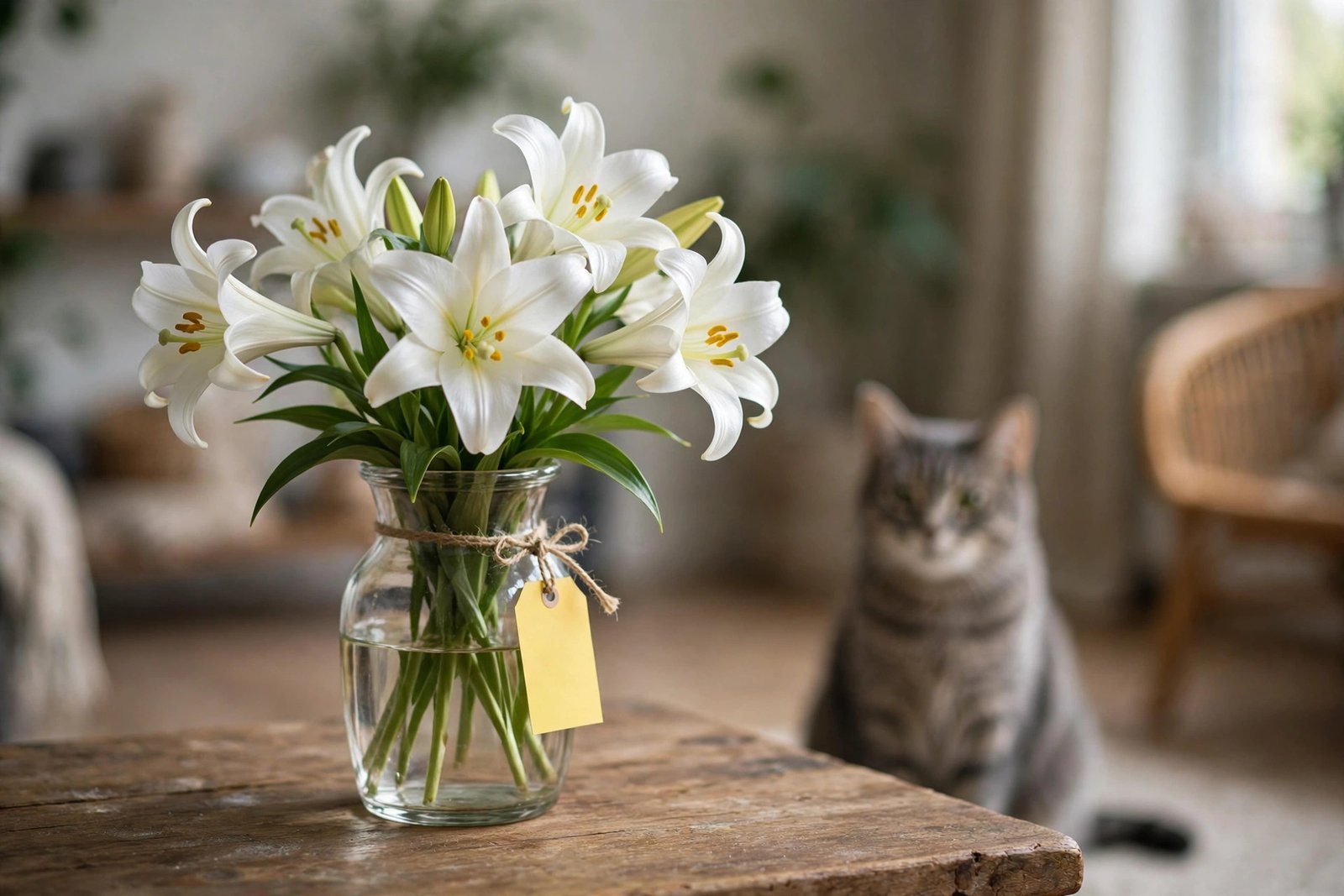
True lilies (Lilium species) and daylilies (Hemerocallis species) are the most dangerous houseplants toxic to cats. The ASPCA lists lilies as toxic to cats, and Cornell’s Feline Health Center states they can cause life-threatening kidney failure if eaten even in tiny amounts. Every part of the plant counts: leaves, petals, stems, pollen, and the water in the vase. For the full picture on lilies, read are lilies toxic to cats.
Common types include Easter, tiger, Asiatic, Oriental, and stargazer lilies, plus garden daylilies. The U.S. Food and Drug Administration notes that if treatment is delayed by 18 hours or more, the kidney damage is usually irreversible.
There is no safe amount of a true lily for a cat, and “pollen-free” lilies are still unsafe. Do not bring true lilies or daylilies into a home with a cat, and check every bouquet first.
A cat that brushes past a lily can pick up pollen on its fur and swallow it while grooming, so treat any contact as urgent and call your veterinarian at once.
Sago Palm: Every Part Is Toxic
The sago palm (Cycas revoluta) is not a true palm. It is a cycad with stiff, glossy, feather-like fronds growing from a thick, rough trunk. The ASPCA lists it as toxic to cats, dogs, and horses. All parts contain cycasin, a toxin that damages the liver, and the seeds carry the highest concentration.
The ASPCA lists vomiting, bloody stool, jaundice, liver damage, liver failure, and death among the signs. Liver-related signs can follow days later, even after the cat seems to have recovered. It is one of the deadliest houseplants toxic to cats.
Calcium Oxalate Plants: Painful Mouth Irritation
These plants contain insoluble calcium oxalate crystals, which pierce the mouth and throat when chewed. The result is pain, drooling, pawing at the mouth, swelling, vomiting, and difficulty swallowing.
This is the largest group of houseplants toxic to cats in American homes, and a bad reaction still deserves a call to a veterinarian.
Pothos and Philodendron

Pothos (Epipremnum aureum), also called golden pothos or devil’s ivy, is probably the most common of the houseplants toxic to cats in American homes. The ASPCA lists it as toxic to cats, with oral irritation, drooling, vomiting, and difficulty swallowing as the signs. Our guide on are pothos plants toxic to cats covers identification and signs in more detail.
Philodendrons (Philodendron species) carry the same risk. A safer trailing alternative is the spider plant (Chlorophytum comosum).
Monstera
Monstera (Monstera deliciosa), the plant with big, glossy leaves cut with slits and holes, is listed by the ASPCA as toxic to cats with the same signs. A parlor palm (Chamaedorea elegans) is a safer swap. See our guide on are monstera plants toxic to cats for the full rundown.
Peace Lily
The peace lily (Spathiphyllum species) is not a true lily, but it is still one of the houseplants toxic to cats. It contains the same calcium oxalate crystals, and the ASPCA lists the same signs.
Dieffenbachia, ZZ Plant, and Calla Lily
Dieffenbachia (Dieffenbachia species), also called dumb cane, contains calcium oxalate crystals in very high concentration, and the ASPCA lists it as toxic to cats. Chewing can cause intense mouth pain and swelling, drooling, vomiting, and difficulty swallowing. Call a veterinarian if your cat chews it.
The ZZ plant (Zamioculcas zamiifolia) is a popular low-light plant, and the ASPCA lists it among the houseplants toxic to cats. Chewing can cause mouth irritation, drooling, and vomiting. The calla lily (Zantedeschia species) is another “lily” that is not a true lily, and the ASPCA lists it as toxic to cats. Check the label before you bring one home.
Saponin Plants: Stomach Upset and Vomiting
A second group contains saponins, which irritate the digestive tract. A cat that chews one of these houseplants toxic to cats may drool, vomit, or develop diarrhea within a few hours. Most cases stay mild, but a cat that vomits repeatedly, becomes lethargic, or stops eating still needs veterinary advice.
Snake Plant (Mother-in-Law’s Tongue)

The snake plant is listed by the ASPCA under the name mother-in-law’s tongue (Sansevieria trifasciata), the name most plant labels still use. Botanists have moved it into the genus Dracaena, so it is also sold as Dracaena trifasciata. It has tall, stiff, upright leaves, usually dark green banded with lighter green or edged in yellow. The ASPCA lists it among the houseplants toxic to cats, with nausea, vomiting, and diarrhea as the signs. Our guide on are snake plants toxic to cats covers symptoms and safer alternatives in more detail.
A safer upright alternative is a parlor palm (Chamaedorea elegans).
Dracaena and English Ivy
Dracaenas (Dracaena species) include the corn plant and the Madagascar dragon tree. The ASPCA lists dracaenas among the houseplants toxic to cats. They contain saponins, and the ASPCA lists vomiting, depression, loss of appetite, drooling, and dilated pupils in cats as signs.
English ivy (Hedera helix) is grown indoors as a trailing plant and outdoors as a ground cover. The ASPCA lists it among the houseplants toxic to cats. It contains triterpenoid saponins, and the ASPCA lists vomiting, abdominal pain, drooling, and diarrhea as signs.
Aloe Vera and Jade Plant: Familiar Plants With Real Risks
Aloe vera (Aloe barbadensis) is a familiar plant that many people keep for its soothing gel. For cats, the risk sits in the latex, the bitter yellow sap just under the leaf skin. The ASPCA lists aloe among the houseplants toxic to cats, with saponins and anthraquinones as the toxic principles and vomiting, lethargy, and diarrhea as the signs. A cat that chews an aloe leaf still deserves a call to a veterinarian.
The jade plant (Crassula ovata) is a succulent with thick, fleshy, oval leaves on woody stems. The ASPCA lists it among the houseplants toxic to cats, with vomiting, depression, and incoordination as the signs. The substance responsible has not been identified. A safer succulent alternative is Haworthia (Haworthia species).
Spring Bulbs and Flowering Plants
Tulips (Tulipa species) and daffodils (Narcissus species) are both listed among the houseplants toxic to cats by the ASPCA, and for both, the bulb holds the most toxin. Tulips contain tulipalins A and B, and the ASPCA lists vomiting, depression, diarrhea, and drooling. Daffodils contain lycorine and other alkaloids, and the ASPCA lists vomiting, drooling, and diarrhea as signs, with heart rhythm changes possible after a large ingestion, especially of the bulb. Keep bulbs and potted spring flowers out of the house if you have a cat.
Kalanchoe (Kalanchoe species, including the florist’s kalanchoe Kalanchoe blossfeldiana) is a popular flowering succulent. The ASPCA lists it among the houseplants toxic to cats. It contains bufadienolides, which can affect the heart, and the ASPCA lists vomiting, diarrhea, and abnormal heart rhythm in rare cases as signs.
“Lily” in the Name Does Not Always Mean the Same Danger
True lilies (Lilium) and daylilies (Hemerocallis) can cause kidney failure in cats, and every part is dangerous, including pollen and vase water. Peace lilies (Spathiphyllum), calla lilies (Zantedeschia), and lily of the valley (Convallaria majalis) are not true lilies. Peace lilies and calla lilies contain calcium oxalate crystals, while lily of the valley contains cardiac glycosides that affect the heart. All three are still toxic to cats, but they do not cause the kidney failure that makes true lilies the most feared houseplants toxic to cats.
Check the botanical name: Lilium or Hemerocallis means keep it out of the house entirely.
What to Do If Your Cat Eats a Toxic Plant
Watch for drooling, pawing at the mouth, vomiting or diarrhea, loss of appetite, lethargy, mouth swelling, difficulty swallowing, unsteady walking, and yellowing of the gums. A cat that has chewed a true lily or a sago palm may look fine at first, so do not use “looks fine” as a reason to wait. If you know which of the houseplants toxic to cats your cat ate, say so in the first sentence of the call. Our guide on what to do if a cat eats a toxic plant walks through the first steps in order.
- Stay calm and move the cat away from the plant.
- Call your veterinarian, an emergency veterinary clinic, or an animal poison control service right away. In the United States, call the ASPCA Animal Poison Control Center at (888) 426-4435 or Pet Poison Helpline at (855) 764-7661. Both are available 24 hours a day. Do not wait for symptoms to appear.
- Identify the plant. Take a clear photo of the plant, its pot, and its label.
- Follow the advice you are given.
- Do not try home treatment. Do not induce vomiting unless a veterinarian or poison control adviser tells you to.
A true lily or daylily exposure is an emergency even if the cat seems fine: bring the cat and the plant, or a photo of it, to a veterinarian immediately.
Safer Alternatives to Toxic Indoor Plants for Cats
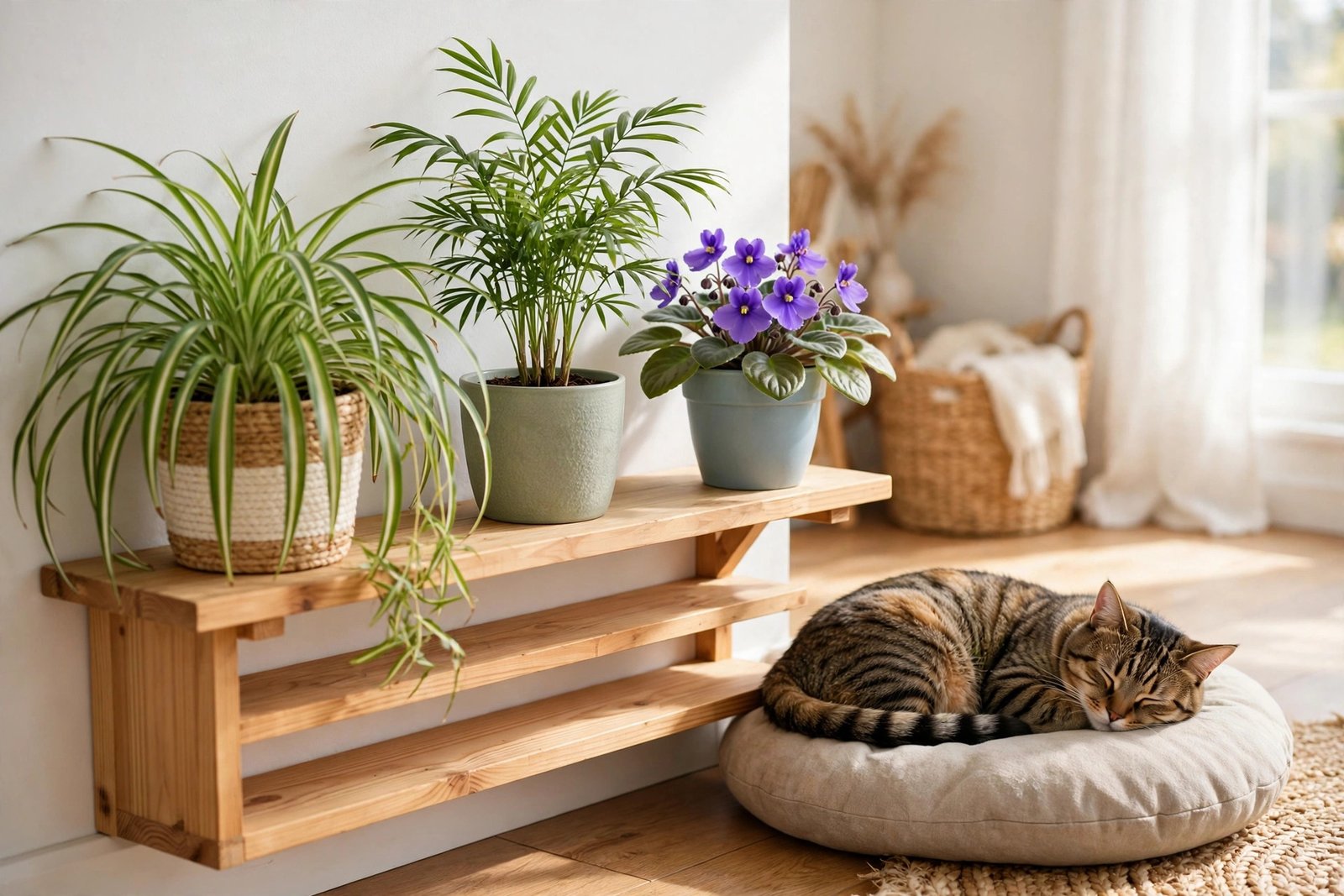
Many attractive plants are listed as non-toxic to cats by the ASPCA. They are safe swaps for the plants to avoid with cats. Swapping out houseplants toxic to cats is the simplest step in this whole guide.
| Instead of this toxic plant | Try this non-toxic alternative |
|---|---|
| Pothos or philodendron (trailing) | Spider plant (Chlorophytum comosum) |
| Monstera (large leaves) | Parlor palm (Chamaedorea elegans) or areca palm (Dypsis lutescens) |
| Snake plant (upright) | Parlor palm (Chamaedorea elegans) |
| Peace lily (white flowers) | African violet (Saintpaulia species) or Phalaenopsis orchid (Phalaenopsis species) |
| Aloe vera or jade plant (succulent) | Haworthia (Haworthia species) or Echeveria (Echeveria species) |
They still need sensible placement, since a cat that knocks a pot off a shelf can be hurt by the fall.
Frequently Asked Questions
Which houseplant is the most toxic to cats?
True lilies and daylilies are among the most poisonous plants for cats: they can cause life-threatening kidney failure in cats even in tiny amounts, and every part is toxic, including pollen and vase water. Sago palm (Cycas revoluta) can cause liver failure, so contact a veterinarian immediately after any exposure. Both should stay out of a cat home for good.
Are pothos plants toxic to cats?
Yes, pothos (Epipremnum aureum) is listed among the houseplants toxic to cats by the ASPCA. It contains insoluble calcium oxalate crystals, and chewing can cause oral irritation, drooling, and vomiting. A safer trailing alternative is the spider plant (Chlorophytum comosum), which the ASPCA lists as non-toxic to cats.
Is a peace lily as dangerous as a true lily?
No, but it is still one of the houseplants toxic to cats: a peace lily (Spathiphyllum species) is not a true lily. It contains calcium oxalate crystals that irritate the mouth, but it does not cause the kidney failure true lilies cause.
My cat only took one bite of a snake plant. Should I worry?
A single bite of one of the houseplants toxic to cats usually causes mouth irritation, nausea, vomiting, or diarrhea rather than severe poisoning, according to the ASPCA listing. Even so, call your veterinarian or poison control for advice.
What should I do first if my cat eats a toxic plant?
Move the cat away from the plant and call your veterinarian or poison control right away: ASPCA (888) 426-4435 or Pet Poison Helpline (855) 764-7661. Do not wait for symptoms.
Can I keep any of these plants if I hang them out of reach?
Hanging helps, but it is not a guarantee. Cats climb, jump, and bat at trailing vines. True lilies, daylilies, and sago palm should leave the house no matter where you hang them. For the rest, a high spot plus a safe swap is the better plan.
A Safer Home Starts With One Check
Most houseplants toxic to cats are ordinary houseplants, and they are only a problem when a cat can chew them. Know which ones are risky, keep true lilies, daylilies, and sago palm out of the house, and swap the rest for plants the ASPCA lists as non-toxic to cats. Start today: list every plant in your home with its botanical name, and check each one in the ASPCA database.
Disclaimer: This article is general information only and does not replace advice from a veterinarian. Toxicity varies with the species, part eaten, amount, and cat. If your cat has eaten a toxic plant, contact your veterinarian or poison control promptly.
Sources and References
- ASPCA Animal Poison Control Center, Toxic and Non-Toxic Plants database — https://www.aspca.org/pet-care/animal-poison-control/toxic-and-non-toxic-plants
- ASPCA, “Do You Know Which Flowers and Plants are Toxic to Pets? Our Experts Explain!” — https://www.aspca.org/news/do-you-know-which-flowers-and-plants-are-toxic-pets-our-experts-explain
- ASPCA, “Tips for a Pet-Safe Yard and Garden” — https://www.aspca.org/news/tips-pet-safe-yard-and-garden
- Cornell Feline Health Center, Common Cat Hazards (fact sheet) — https://www.vet.cornell.edu/sites/default/files/CatConLA-FactSheet1.pdf
- Cornell University College of Veterinary Medicine, “Easter Peril: Look Out for Lilies and Other Items” — https://vet.cornell.edu/departments-centers-and-institutes/cornell-feline-health-center/health-information/cat-health-news/easter-peril-look-out-lilies-and-other-items
- U.S. Food and Drug Administration, “Lovely Lilies and Curious Cats: A Dangerous Combination” — https://www.fda.gov/animal-veterinary/animal-health-literacy/lovely-lilies-and-curious-cats-dangerous-combination
- Pet Poison Helpline, lily poisoning in cats — https://www.petpoisonhelpline.com/poison/lilies/
22 thoughts on “Common Houseplants That Are Toxic to Cats: What to Avoid”