
You turn around, and your cat is sitting in a potted plant, soil on its paws and a chewed leaf in its mouth. If you are wondering how to keep cats out of houseplants without scaring or hurting your cat, the answer is simpler than it looks.
Work with your cat’s instincts instead of against them. This guide shows you how to keep cats out of houseplants with a layered approach: safety first, then placement, barriers, soil covers, and cat grass.
Why Cats Target Houseplants
Cats do not chew plants to annoy you. Cornell notes that cats that chew houseplants are usually indoor cats with little access to grass, and they may chew from curiosity, play, or a craving for vegetable matter.
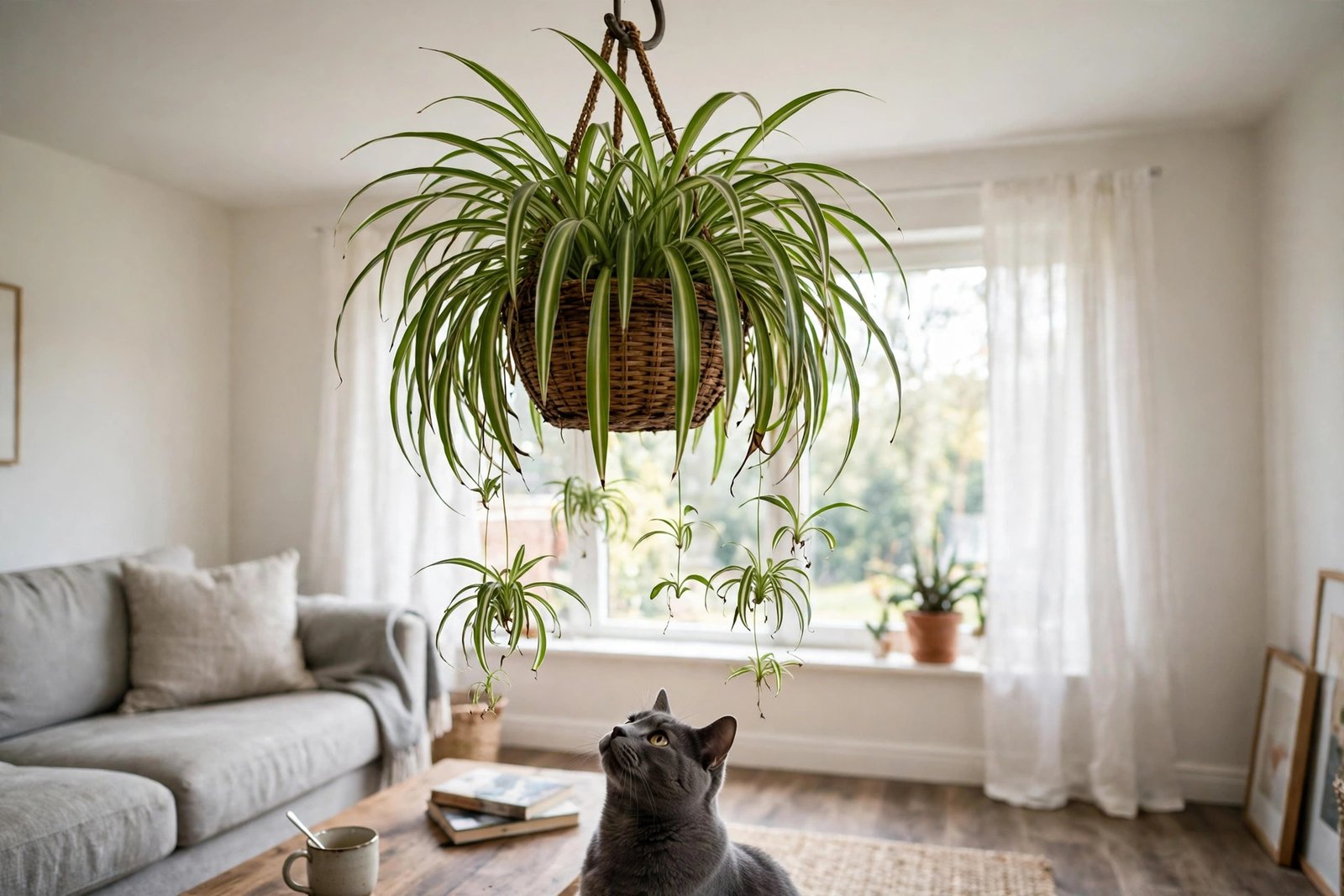
A dangling leaf is hard for a cat to ignore. A spider plant’s dangling plantlets are one of the first things many cats bat at and chew, even though the ASPCA lists the spider plant as non-toxic.
Boredom is another common reason: a cat with nothing to do will find its own fun, and a leafy plant on a low table is an easy target. Loose, damp soil can also feel like a litter box, which is why some cats dig in pots.
Once you know the reason, the fix gets clearer. A bored cat needs play, a cat that craves greens needs a safe plant of its own, a cat that digs needs covered soil, and a climber needs the plant moved out of reach. That is the starting point for how to keep cats out of houseplants: match the fix to the reason.
Start With Safety, Not Just Protection
Before you buy a barrier, do a safety check: no placement trick or cover makes a toxic plant safe. True lilies (Lilium species) and daylilies (Hemerocallis species) can be extremely dangerous to cats, and even pollen or vase water can be a risk. Do not keep lilies in a home with cats.
Other common toxic houseplants include pothos (Epipremnum aureum), monstera (Monstera deliciosa), philodendron, peace lily (Spathiphyllum), snake plant (Dracaena trifasciata), aloe vera, and jade plant (Crassula ovata). If you are not sure a plant is non-toxic, check its botanical name in the ASPCA Toxic and Non-Toxic Plants database.
For a full list, read Common Houseplants That Are Toxic to Cats: What to Avoid. For lilies, read Are Lilies Toxic to Cats? Types, Exposure Risks, and Urgent Steps. For safe choices, read 15 Cat-Safe Houseplants for a Greener, Pet-Friendly Home.
| Common Toxic Houseplant | Botanical Name | Why It Matters |
|---|---|---|
| True lily and daylily | Lilium spp. and Hemerocallis spp. | Kidney failure risk; treat as an emergency |
| Pothos | Epipremnum aureum | Mouth and stomach irritation |
| Monstera | Monstera deliciosa | Mouth and stomach irritation |
| Philodendron | Philodendron spp. | Mouth and stomach irritation |
| Peace lily | Spathiphyllum spp. | Mouth and stomach irritation |
| Snake plant | Dracaena trifasciata | Nausea and vomiting |
| Aloe vera | Aloe vera | Vomiting and diarrhea |
| Jade plant | Crassula ovata | Vomiting; slow heart rate |
Remember that “non-toxic” does not mean “safe to chew or eat”: the ASPCA notes that eating any plant material may cause vomiting and stomach upset. If your cat has chewed an unknown or toxic plant, contact your veterinarian or poison control promptly. That is why safety comes first in how to keep cats out of houseplants.
How to Keep Cats Out of Houseplants: A Layered Approach
No single trick keeps every cat out of every plant. The best way to learn how to keep cats out of houseplants is to layer small changes: make the plant harder to reach, cover the soil, and give your cat a better option nearby.
1. Move Plants to Places Cats Cannot Easily Reach
Placement is the simplest form of protection: cats can jump onto windowsills, bookcases, and counters, so a plant on a low table is an invitation, while a plant on a high shelf with no landing space nearby is much less interesting.
Put small plants on narrow wall-mounted shelves, away from furniture your cat uses as a launch pad, and keep trailing vines trimmed short. Our guide on where to place plants with cats covers room-by-room placement.
Placement alone is not enough for a determined climber. Think of it as the first layer of how to keep cats out of houseplants, not the whole plan.
2. Use Barriers That Protect the Plant Without Trapping the Cat
A barrier should make the plant harder to reach, not make the cat uncomfortable. Avoid anything sharp, sticky enough to pull fur, or anything that could fall on your cat. A stable, ventilated plant cabinet is one of the most reliable options.
A tall, heavy pot with a narrow opening also helps, and a wire cloche or mesh cover can stop chewing while letting air and light through. Check barriers weekly, because cats will test any weak spot. A good barrier is a quiet part of how to keep cats out of houseplants: it works while you are not watching.
3. Stop Cats Digging in Houseplant Soil
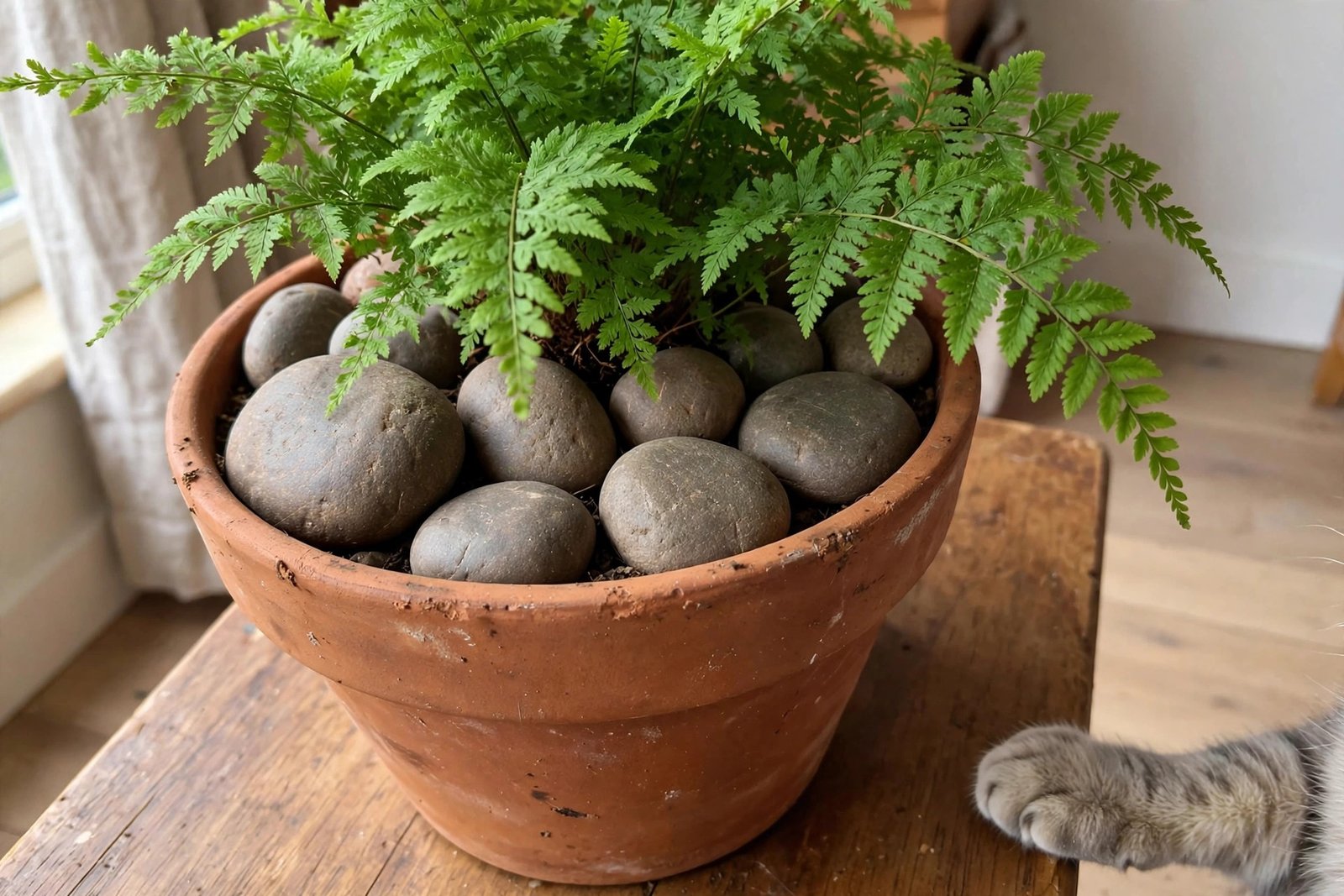
Cats dig in soil because it is loose, soft, and easy to move. Cover it with large, smooth stones too big to swallow and too heavy to push aside, and check that water can still reach the soil. Covering the soil is a simple, cheap part of how to keep cats out of houseplants.
Avoid cocoa shell mulch, which is toxic to pets. Scoop the litter box often, and keep fertilizer pellets off the soil surface.
4. Hang Plants Safely, and Choose Shelves Cats Cannot Use as Perches
Hanging planters help only if they are hung safely. Use a ceiling hook rated for more than the full weight of the pot and a sturdy hanger, not a thin string. Hang the planter high enough that leaves do not dangle within reach. Hanging a plant is one of the oldest tricks in how to keep cats out of houseplants, but only if the hook and hanger are strong.
Do not hang a heavy planter over a bed or walkway, and check the hook and hanger monthly. For shelves, stability matters more than height: use brackets rated for the weight, anchor them into a stud, and keep the shelf too narrow for a cat to sit on. See our guides on hanging planters safe for cats and cat-friendly plant shelves for setup tips.
5. Make Leaves Less Appealing — Without Harmful Sprays
Some owners try bitter or citrus sprays, essential oils, chili, or cayenne pepper to stop chewing. Be very careful: many are not safe for cats, and some can irritate skin, eyes, or airways. Do not use essential oils around cats unless a veterinarian has advised it.
A physical cover is safer than any spray. Do not use mothballs, ammonia, or strong household chemicals near plants, and ask your veterinarian first about any commercial repellent. If your cat keeps chewing leaves after you move the plant, our guide on how to stop cats chewing houseplant leaves has more gentle options. The honest answer to how to keep cats out of houseplants rarely involves a spray bottle at all.
6. Give Your Cat Its Own Plants to Chew
Cat grass is the usual choice: young oat, wheat, or barley grass grown in a small pot. Wheatgrass (Triticum aestivum) is a common type, and Cornell notes oat grass as an alternative for cats that crave vegetable matter. Put it at floor level in a heavy pot, and replace it regularly.
Do not use fertilizer or pesticide on cat grass. Even non-toxic grass can upset a cat’s stomach, so offer a small amount at a time. Giving your cat its own greens is one of the kindest parts of learning how to keep cats out of houseplants, because it meets the craving instead of fighting it.

7. Add Play, Climbing, and Enrichment
A busy cat is less likely to spend its time on your plants. Cornell notes that destructive behavior is usually part of normal investigation and play, and it can usually be managed with a plan and patience. Play for 10 to 15 minutes once or twice a day.
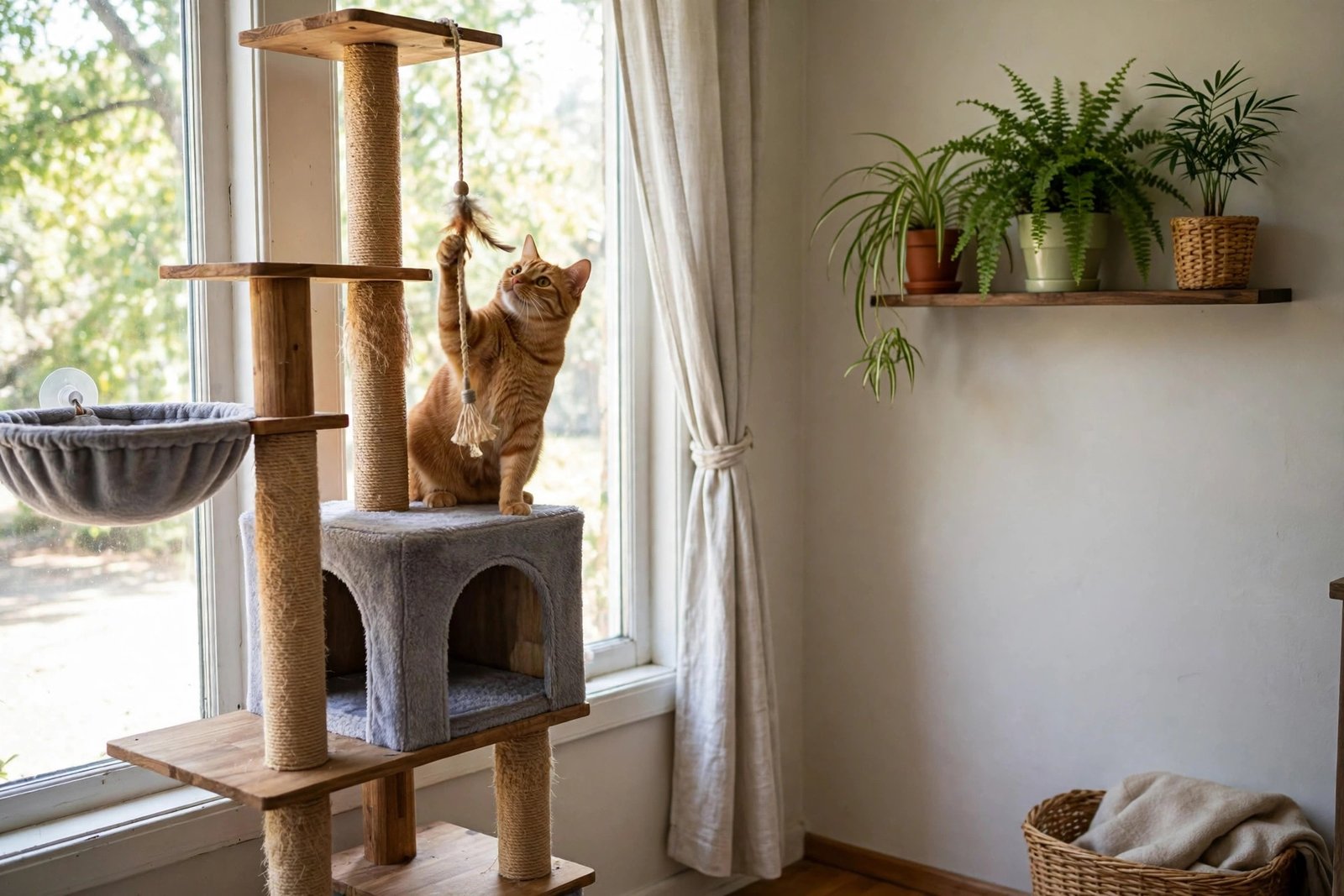
Provide a tall cat tree or window perch, rotate toys and use puzzle feeders. Enrichment does not replace barriers, but it makes them work better, because a tired, busy cat has less reason to bother your plants. This is the step many owners skip, and it often makes the biggest difference in how to keep cats out of houseplants for good.
Redirect Calmly, and Do Not Punish
When you catch your cat in a plant, do not shout, clap loudly, or spray water. Those reactions can frighten a cat and teach it to chew only when you are not watching. Instead, lure your cat away with a toy or treat and move it to its cat grass.
Be consistent, and do not punish your cat. If chewing is constant or sudden, or paired with eating less, hiding, or vomiting, talk to your veterinarian. Calm redirection is worth learning if you want to know how to keep cats out of houseplants.
What to Do If Your Cat Chews a Plant
If the plant is non-toxic and your cat only took a small bite, remove any remaining leaf if you can do so safely and watch your cat for a few hours. Call your veterinarian if you are unsure or if symptoms continue. If the plant is toxic, or you do not know what it was, contact your veterinarian or poison control promptly — do not wait for symptoms.
Save the ASPCA Animal Poison Control Center number, (888) 426-4435, and the Pet Poison Helpline number, (855) 764-7661. If it was a true lily or a daylily, treat this as an emergency and contact a veterinarian immediately, even if your cat seems fine: Cornell notes that even one bite of an Easter lily can induce kidney failure.
Do not give milk, oil, or any home remedy, and do not try to make your cat vomit unless a veterinarian or poison control operator tells you to do so. If you are unsure what your cat ate, our guide on what to do if your cat eats a toxic plant walks through the first steps. Knowing what to do after a bite is part of how to keep cats out of houseplants safely.
A Simple 7-Day Plan
You do not need to do everything at once. This plan spreads the work across one week, so each change has time to settle. It is a simple way to put how to keep cats out of houseplants into practice.
| Day | Action |
|---|---|
| Day 1 | Safety audit: check every plant by botanical name; remove lilies |
| Day 2 | Move tempting plants higher |
| Day 3 | Cover the soil and check litter boxes |
| Day 4 | Add cat grass near chewed plants |
| Day 5 | Add a barrier to the worst offender |
| Day 6 | Add play sessions and a perch |
| Day 7 | Review; call your vet if chewing continues |
Mistakes to Avoid
Never leave a toxic plant out to test your cat, and never use essential oils, chili, harsh sprays, or sticky traps that can pull fur. Do not leave fertilizer or potting mix within reach.
Do not skip the safety check when a new plant or bouquet comes home. Check every new plant by botanical name first, and keep bouquets with lilies out of the house. Avoiding these mistakes is half of how to keep cats out of houseplants without stress.
Frequently Asked Questions
How can I stop my cat from digging in my plants?
Cover the soil with large, smooth stones, a fitted cover, or mesh. Use a taller, heavier pot and keep litter boxes clean. Most cats stop once the soil is no longer loose. Covering the soil is one of the fastest answers to how to keep cats out of houseplants when digging is the problem.
What is the best way to keep cats away from houseplants?
Use placement, barriers, and redirection together: move plants to high shelves, cover the soil, and give your cat its own oat or wheat grass. Add daily play and a tall perch. That combination is the heart of how to keep cats out of houseplants.
Can I spray my plants to stop my cat chewing them?
Be cautious with sprays: many repellents, essential oils, and homemade chili or citrus sprays are unsafe for cats. A physical barrier, such as a wire cover, is safer. Check that any commercial product is made for use around cats. Most vets will tell you the same about how to keep cats out of houseplants: a cover beats a spray.
What should I give my cat to chew instead of houseplants?
Cat grass — young oat, wheat, or barley grass — is the usual choice. Put it in a heavy pot at floor level and replace it when it turns yellow. Do not use fertilizer or pesticide on it. It gives your cat something of its own to chew, a big part of how to keep cats out of houseplants.
Is it okay to let my cat chew a non-toxic plant?
A small nibble of an ASPCA-listed non-toxic plant is lower risk than a bite of a toxic plant, but it is not risk-free: eating any plant material can cause vomiting or stomach upset. If your cat chews a lot, redirect it to cat grass. Even a non-toxic plant still counts when you are learning how to keep cats out of houseplants.
How do I introduce a new houseplant to a cat?
Start with a plant you have checked by botanical name against the ASPCA database. Place it high or behind a barrier for the first week, with cat grass nearby, and watch how your cat reacts before moving it to its final spot. Our guide on introducing houseplants to cats covers this step by step. A slow introduction is a smart first step in how to keep cats out of houseplants.
Conclusion: A Calmer Home for Cats and Plants
Keeping cats out of houseplants without harming them is about making your home work for both of you: remove lilies, check every plant by its botanical name, make plants harder to reach, cover the soil, and give your cat a safe plant. Add play, a perch, and a calm routine.
Start today: do the Day 1 safety audit, remove any lilies, and put a fresh pot of cat grass where your cat can reach it. Once you know how to keep cats out of houseplants, the rest is keeping the routine going.
Disclaimer: This article is for general information only and does not replace advice from a veterinarian. If your cat has eaten a plant, seems unwell, or you are unsure whether a plant is toxic, contact your veterinarian or poison control promptly.
Sources and References
- ASPCA — Toxic and Non-Toxic Plants: https://www.aspca.org/pet-care/animal-poison-control/toxic-and-non-toxic-plants
- ASPCA — Do You Know Which Flowers and Plants Are Toxic to Pets? Our Experts Explain: https://www.aspca.org/news/do-you-know-which-flowers-and-plants-are-toxic-pets-our-experts-explain
- Cornell University College of Veterinary Medicine — Feline Behavior Problems: Destructive Behavior: https://www.vet.cornell.edu/departments-centers-and-institutes/cornell-feline-health-center/health-information/feline-health-topics/feline-behavior-problems-destructive-behavior
- Cornell University College of Veterinary Medicine — Easter Peril: Look Out for Lilies and Other Items: https://vet.cornell.edu/departments-centers-and-institutes/cornell-feline-health-center/health-information/cat-health-news/easter-peril-look-out-lilies-and-other-items
- Pet Poison Helpline — About: https://petpoisonhelpline.com/about
- PetMD — Garden Plant Toxicity in Cats: https://www.petmd.com/cat/poisoning/garden-plant-toxicity-in-cats
22 thoughts on “How to Keep Cats Out of Houseplants Without Harming Them”