
Cat-friendly plant shelves give your plants the light they need while keeping them out of your cat’s easy reach. The best cat-friendly plant shelves are fixed to the wall properly, hold heavy pots without tipping, and sit where your cat cannot use nearby furniture as a launch pad. They also hold only plants listed as non-toxic to cats, because a shelf never guarantees that a cat cannot reach a plant.
A high shelf feels like a safety plan on its own, but cats climb, leaves fall, and pollen drifts down. Good cat-friendly plant shelves come from three decisions: the right plants, the right fixings, and the right spot.
The Short Answer
Put non-toxic plants in heavy, stable pots on cat-friendly plant shelves fixed into studs or with heavy-duty anchors, on a bare wall with nothing below for your cat to stand on. Keep toxic plants out of the home entirely, or in a room your cat cannot enter — a high shelf is not enough on its own.
Give your cat its own sunny spot nearby, with something safe to chew, such as cat grass. That is the whole idea of cat-friendly plant shelves: safe plants, strong fixings, a bare wall, and a happy cat with somewhere better to sit.
Before you buy a single bracket, check every plant by its botanical name in the ASPCA Toxic and Non-Toxic Plants list. Placement cannot make a toxic plant safe, and no shelf changes that.
Safety First: Only Non-Toxic Plants on Open Shelves
Choose the plants before you choose your cat-friendly plant shelves. No shelf is perfect: a determined cat can still reach a leaf, chew a fallen stem, or knock a pot down. Check every plant by its botanical name first — common names can mislead, and two plants sold as “palm,” “fern,” or “lily” can have very different safety profiles.
Non-toxic does not mean safe to chew without limit: the ASPCA notes that eating any plant material may cause vomiting and stomach upset in cats. It does not make the leaves food, and it does not cover fertilizer, pesticides, or leaf-shine sprays.
Plants listed by the ASPCA as non-toxic to cats include spider plant (Chlorophytum comosum), Boston fern (Nephrolepis exaltata), parlor palm (Chamaedorea elegans), areca palm (Dypsis lutescens), calathea, peperomia, and African violet. For more ideas, see 15 cat-safe houseplants. If a plant’s identity is uncertain, or if two sources disagree about it, treat it as unsafe until you can confirm the botanical name.
Never Put Lilies on a Shelf
True lilies (Lilium species) and daylilies (Hemerocallis species) do not belong in a home with a cat, on a shelf or anywhere else. The ASPCA states they can be lethal to cats, and even small exposures to pollen can cause kidney failure or death.
A shelf does not stop pollen drifting down onto the floor, furniture, or your cat’s fur, where it can be licked off later. Leaves, petals, stems, and vase water are dangerous too. Keep true lilies and daylilies out of the home entirely — learn the exact types in Are Lilies Toxic to Cats?.
Shelf Types That Work With Cats
Not every shelf suits a cat home, and the best cat-friendly plant shelves depend on your wall, your light, and how athletic your cat is.
Wall-Mounted Floating Shelves
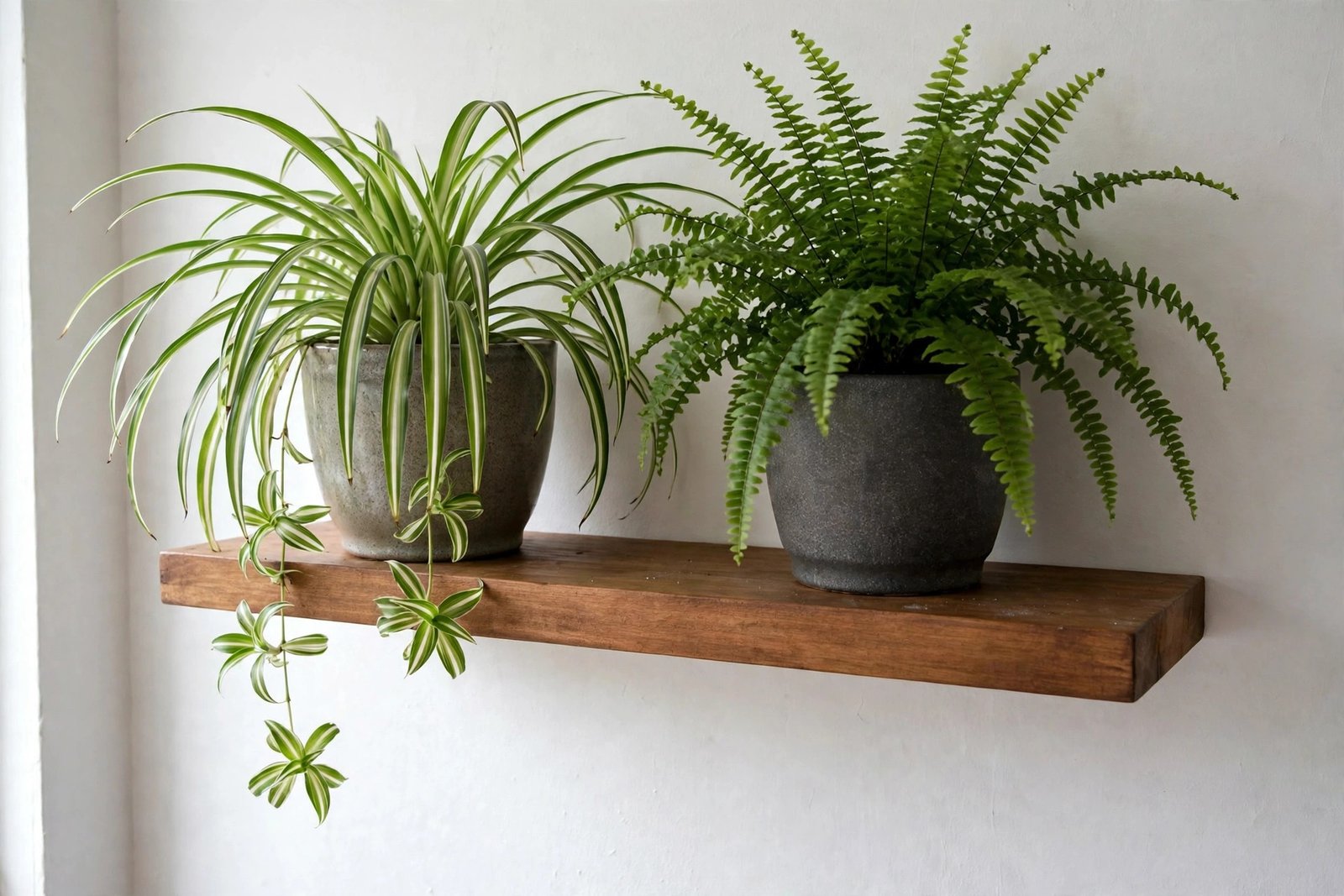
Floating shelves are the most popular choice for cat homes: no brackets underneath for a cat to grab, and a clear wall below. Cat-friendly plant shelves of this type work best on a bare wall, with nothing beneath them a cat can stand on.
Choose a shelf at least 20 cm (8 inches) deep, so a pot sits fully on it with room to spare. A shallow shelf leaves pots half-hanging over the edge, which is exactly how they get knocked off.
Corner Shelves
Corner shelves use space cats often ignore, away from the main traffic of a room, and with no furniture nearby a corner shelf is harder to reach than one in the middle of a long wall. Corners also suit plants that like steady, indirect light.
Ladder and Leaning Shelves
Ladder shelves look good, but they are the weakest choice in a cat home: a leaning shelf is not fixed to the wall unless you anchor it, and a cat climbing it can pull the whole unit forward. Cat-friendly plant shelves should never be unanchored leaning units.
If you use one, anchor it and keep heavy pots low.
Window Shelves
A shelf across or beside a window gives plants excellent light, but it also puts them exactly where a cat wants to sit. Leave a clear section of the sill for your cat, place plants at the sides of the window, and use heavy pots on your cat-friendly plant shelves.
For more on placement, see where to place houseplants with cats.
Shelves With a Lip or Rail
A raised front edge or small rail helps keep pots from sliding forward. It will not stop a cat from batting a pot, but it stops a pot from sliding off with a light touch — a lip of even a centimetre or two makes a real difference on cat-friendly plant shelves.
How to Install Plant Shelves Safely
A shelf is only as safe as its fixings, and cat-friendly plant shelves are no exception. A falling shelf can injure a cat, break a pot, and scatter soil, and most failures come from fixings never strong enough for a wet, heavy pot.
Find the studs first: the solid timber behind the plasterboard is the strongest place to fix a shelf, so use a stud finder before you drill. If you cannot hit a stud, use proper toggle bolts or heavy-duty plasterboard anchors, not light plastic plugs, which are made for picture frames, not wet soil.
Check the weight rating before you load your cat-friendly plant shelves, adding up the shelf, pots, soil, and plants when wet — a watered pot is much heavier than a dry one. As a rough guide, a small shelf with two small pots needs fixings rated for at least 10 kg (22 lb). Use at least two brackets per shelf, spaced evenly, and check the shelf is level before you tighten everything.
After installation, press down firmly on the front edge and pull gently outward. If it moves, flexes, or creaks, take it down and refix it.

Check your cat-friendly plant shelves again every few months: brackets loosen, walls settle, and pots get heavier as plants grow.
Keeping Shelves Out of Jumping Reach
Cats can jump much higher than most people realise, and they use furniture as steps: a shelf that looks out of reach from the floor may be easy to reach from the back of a sofa, a bookshelf, a bed, or a cat tree — which is why the spot matters as much as the fixings on cat-friendly plant shelves.
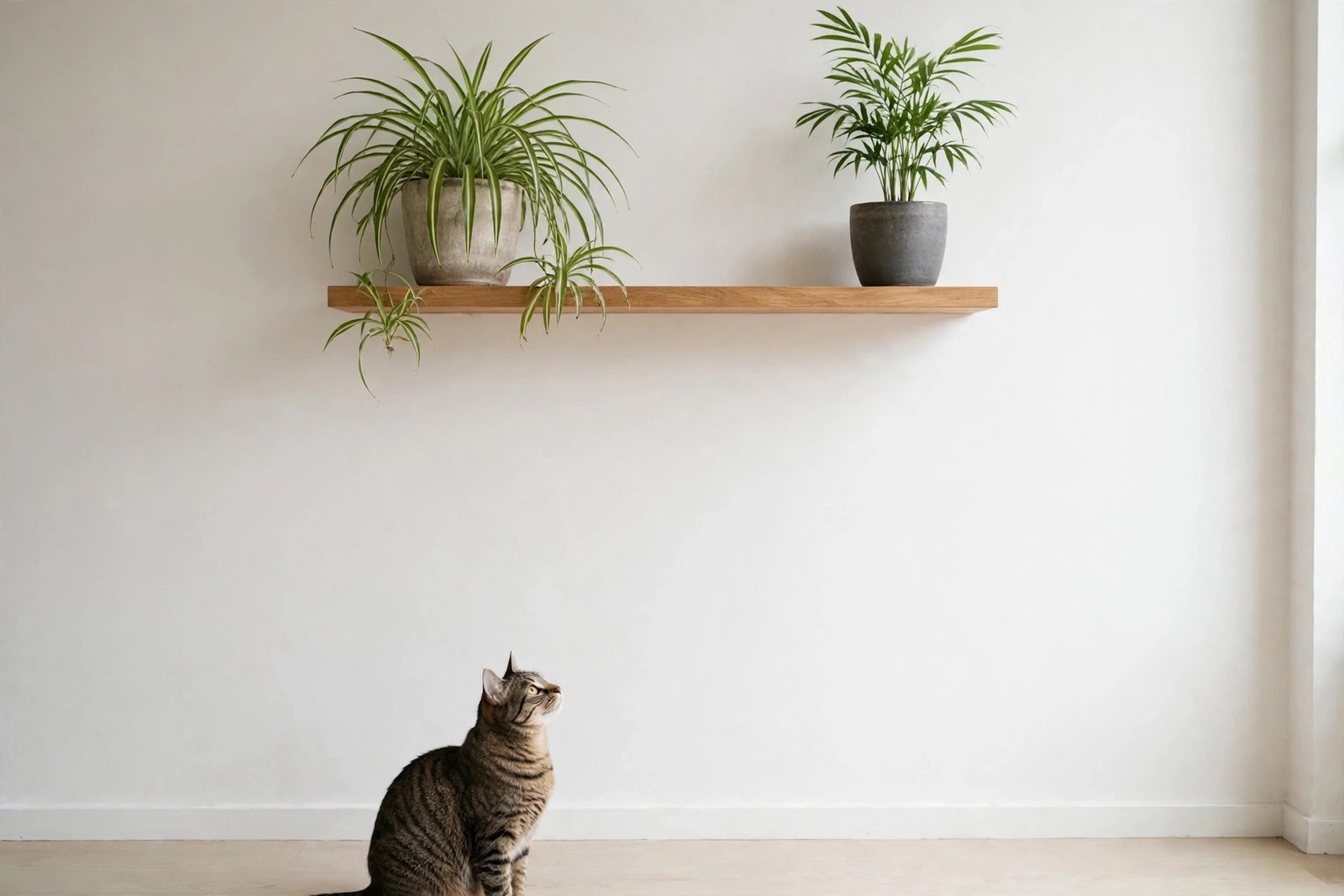
The bare-wall rule is the simplest test: a shelf on a bare wall, with no furniture, radiator, or cat tree below or beside it, is much harder to reach than a shelf above a sofa. Stand where your cat stands — if you can see a path in two easy jumps, so can your cat.
If the only good light is above a sofa, accept that the shelf is within reach: choose only non-toxic plants for it, in heavy pots, and leave space between them. If your cat jumps to a new shelf, do not punish the cat — move the plants, raise the shelf, or remove the launch pad.
Pots, Soil, and Stability on Shelves
Heavy pots are your friend on cat-friendly plant shelves. Ceramic, stone, and concrete pots are more stable than thin plastic pots, and a wide base resists tipping better than a tall, narrow one. If you like a light outer pot, put a heavier inner pot inside it.
Make sure the pot drains well, and use a saucer to catch water. Empty it after watering, because standing water is a drinking bowl for a cat and adds weight the shelf was not rated for.
Keep the soil a little below the rim, because a pot filled to the top is easier to dig in and spill. If your cat digs in shelf pots, cover the soil with large, smooth stones too big to move or swallow, or lay fine mesh over it. Leave space between pots.
See also how to protect houseplants from curious cats.
Matching Plants to Shelf Light
Light decides where cat-friendly plant shelves can go: a plant in the wrong light will weaken, drop leaves, and tempt a cat that bats at falling foliage. Match the plant to the window first, then solve the cat problem for that spot.
Low-light shelves suit parlor palms, spider plants, and peperomia: try a north-facing wall, or a spot a few feet from a window. These plants cope well with less light and still look full and healthy on cat-friendly plant shelves.
Bright, indirect light suits Boston ferns, calatheas, and African violets: try beside an east-facing window, or set back from a south- or west-facing window behind a sheer curtain. Avoid direct midday sun through glass and dark corners.
Best Plants for Cat-Friendly Shelves
Small and medium plants suit shelves best: large, heavy plants belong on the floor or a sturdy stand, not a wall shelf, so pick plants that stay compact for your cat-friendly plant shelves.
Spider plants trail gently, tolerate a range of light, and are listed as non-toxic to cats — see Are Spider Plants Safe for Cats?. Boston ferns are listed as non-toxic too, though they need humidity and regular watering — see Are Boston Ferns Safe for Cats?.
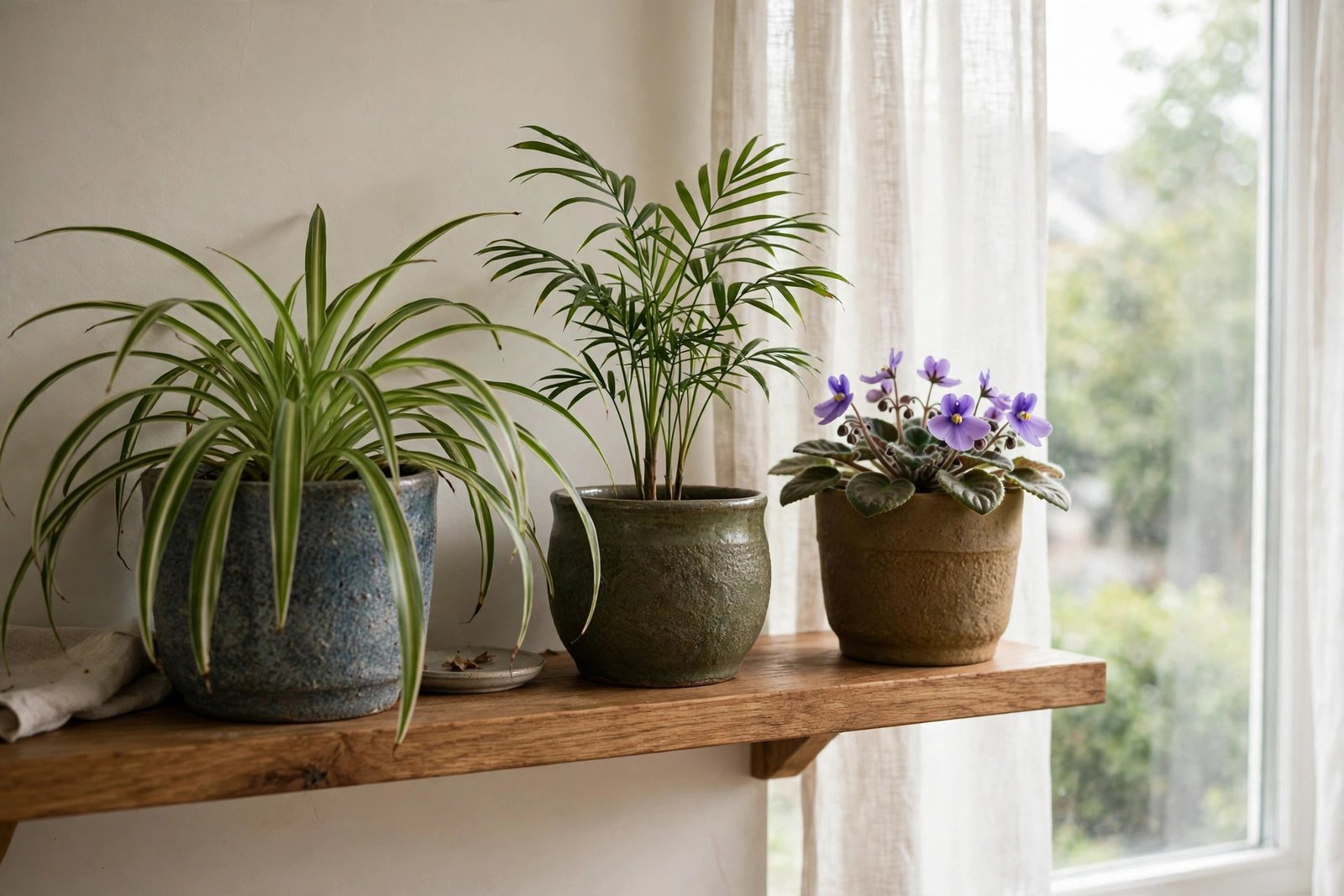
Parlor palms are compact, slow-growing, and happy in low light — see Are Parlor Palms Safe for Cats?. African violets, peperomias, and calatheas are also compact, shelf-sized, and listed as non-toxic. Check the botanical name on the label against the ASPCA list before the plant goes up on your cat-friendly plant shelves.
Give Your Cat a Perch of Its Own
This is the shelf tip most people skip: if you fill the only sunny spot with plants, your cat will push through them to reach the sun. Give your cat its own place — a window perch, a cat bed in the sun, or a clear section of windowsill.
A cat with its own sunny spot is far less interested in climbing your cat-friendly plant shelves. Add a scratching post or a cat tree near the plant area, and a pot of cat grass — usually wheatgrass, oat grass, or barley grass — where your cat can reach it.
What to Do If Your Cat Chews a Shelf Plant
Even on good cat-friendly plant shelves, a cat may still chew a leaf. Stay calm, move your cat away gently, and remove plant material from its mouth only if you can do so safely. Note the plant’s name, roughly how much was eaten, and when, and photograph the plant and its label.
Then call your veterinarian or an animal poison control service promptly: in the United States, the ASPCA Animal Poison Control Center is at (888) 426-4435, and Pet Poison Helpline is at (855) 764-7661 (a fee may apply). Do not wait for symptoms, do not try home remedies, do not try to make your cat vomit, and do not give milk, oil, or other substances unless a veterinarian tells you to.
If the plant was a true lily or daylily, treat it as an emergency and contact a veterinarian immediately, even if your cat looks well — see What to Do If Your Cat Eats a Toxic Plant for a fuller guide.
Frequently Asked Questions
Are wall-mounted plant shelves safe with cats?
Yes, when installed properly: fix it into studs or with heavy-duty anchors rated for the full wet weight, use at least two brackets, and place it on a bare wall with no furniture below it.
How high should a plant shelf be to keep it away from a cat?
No height guarantees a cat cannot reach a shelf: cats jump from nearby furniture, so what is below and beside the shelf matters more than its height.
What is the best shelf for plants in a home with cats?
A wall-mounted floating shelf on a bare wall is usually the best choice for cat-friendly plant shelves. It has no brackets underneath for a cat to grab, and it can be fixed firmly into studs.
Can I put toxic plants on a high shelf?
No. A high shelf does not make a toxic plant safe — cats climb, leaves fall, and pollen drifts down. Keep toxic plants out of a cat home, or in a room your cat cannot enter.
How do I stop my cat from knocking pots off a shelf?
Use heavy, wide-based pots, leave space between pots, and add a small front lip. Move furniture away from below your cat-friendly plant shelves, and give your cat its own perch nearby.
Which plants are best for cat-friendly shelves?
Spider plants, Boston ferns, parlor palms, peperomias, African violets, and calatheas are good choices for cat-friendly plant shelves. All are listed by the ASPCA as non-toxic to cats, but non-toxic does not mean safe to chew without limit.
Conclusion
Cat-friendly plant shelves are built, not bought: fix your shelf into studs or with heavy-duty anchors, place it on a bare wall where your cat cannot use furniture as a launch pad, and use heavy, wide-based pots. Most of all, put only plants listed as non-toxic to cats on open shelves, and keep true lilies and daylilies out of the home entirely.
Start with one wall, one shelf, and one non-toxic plant. Watch how your cat reacts for a week or two before you add a second shelf. A small setup that works is worth far more than a wall full of shelves your cat treats as a climbing frame.
Disclaimer: This article is for general information only and does not replace advice from a veterinarian. Plant safety listings can change, and individual cats can react differently. If your cat has eaten a plant and seems unwell, contact your veterinarian or an animal poison control service promptly.
Sources and References
- ASPCA Animal Poison Control Center. Toxic and Non-Toxic Plants list. https://www.aspca.org/pet-care/animal-poison-control/toxic-and-non-toxic-plants
- ASPCA Animal Poison Control Center. Toxic and Non-Toxic Plant List — Cats. https://www.aspca.org/pet-care/animal-poison-control/cats-plant-list
- ASPCA. Do You Know Which Flowers and Plants Are Toxic to Pets? Our Experts Explain! https://www.aspca.org/news/do-you-know-which-flowers-and-plants-are-toxic-pets-our-experts-explain
- ASPCA. Which Lilies Are Toxic to Pets? https://www.aspca.org/news/which-lilies-are-toxic-pets
- Cornell University College of Veterinary Medicine, Cornell Feline Health Center. Feline Behavior Problems: Destructive Behavior (houseplant chewing). https://www.vet.cornell.edu/departments-centers-and-institutes/cornell-feline-health-center/health-information/feline-health-topics/feline-behavior-problems-destructive-behavior
- Cornell University College of Veterinary Medicine, Cornell Feline Health Center. Common Cat Hazards. https://www.vet.cornell.edu/departments-centers-and-institutes/cornell-feline-health-center/health-information/feline-health-topics/common-cat-hazards