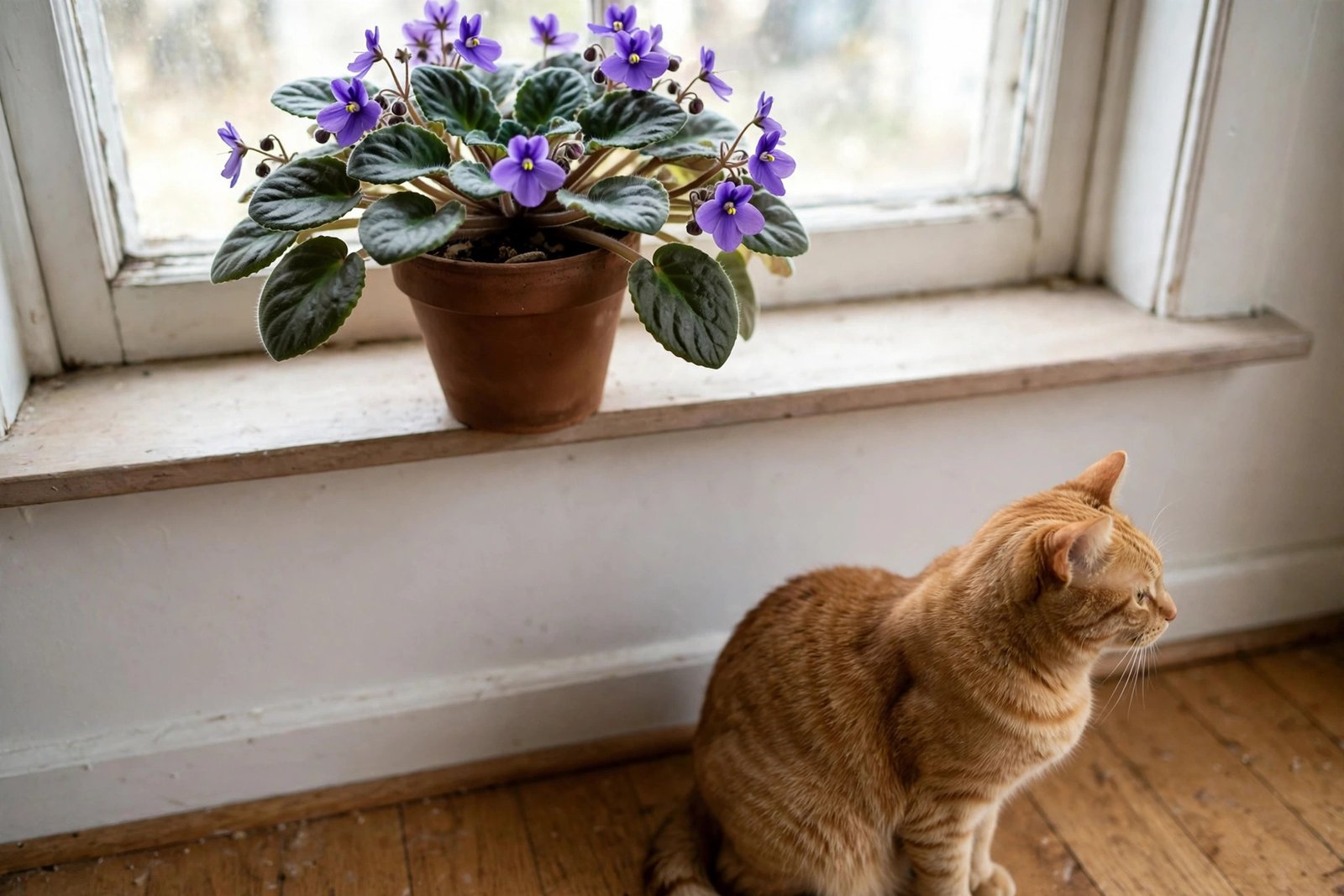
Are African violets safe for cats? Yes. The African violet, Saintpaulia spp., is listed by the ASPCA as non-toxic to cats, dogs, and horses.
But non-toxic is not the same as safe to chew or eat, so the full answer to “are African violets safe for cats” depends on the plant in the pot, what is in the soil, and how much your cat eats. A cat that eats a lot of fuzzy leaves or flowers can still get mild stomach upset.
The Short Answer
Are African violets safe for cats? For most households, yes. The ASPCA lists the African violet as Saintpaulia spp., also filed as Streptocarpus sect. Saintpaulia, in its list of plants that are non-toxic to cats.
Botanists now place African violets in the genus Streptocarpus, so a label may say Streptocarpus ionanthus instead of Saintpaulia ionantha. What matters is the botanical name on the label, not the common name on the tag.
The listing covers cats, dogs, and horses, not every animal. If your cat eats a large amount, vomits repeatedly, seems lethargic, or stops eating, contact your veterinarian or poison control promptly. That is the short version of “are African violets safe for cats”: yes, with the cautions in this guide.
For plants that are not suitable for cats, see Common Houseplants That Are Toxic to Cats: What to Avoid.
What Is an African Violet?
The African violet is a small, flowering houseplant native to the mountains of Tanzania and Kenya in eastern Africa. Indoors, it is grown for its rosette of soft, fuzzy, dark green leaves and clusters of small flowers. A mature plant is usually only 6 to 12 inches wide.
Most shop plants are hybrids of Saintpaulia ionantha. Because it stays small and grows slowly, it suits a windowsill or a desk where a cat walks past — one reason people ask “are African violets safe for cats” before buying one.
How to Identify an African Violet
Check the leaves first. An African violet grows as a low rosette of round to oval leaves with soft, velvety fuzz on top. The leaves are dark green and grow from a short central crown.
Next, check the flowers: clusters of five-petalled blooms on short stalks above the leaves. Finally, read the label for Saintpaulia spp. or Streptocarpus sect. Saintpaulia. If the label says only “violet,” ask the seller for the botanical name. If you cannot confirm it, do not assume the plant is safe — confirming the name is the first step in answering “are African violets safe for cats” for the plant you actually own.

What “Non-Toxic” Really Means
Non-toxic means the ASPCA has not identified compounds in the plant known to poison cats. A cat that nibbles a leaf or a flower is not expected to be poisoned by it. The ASPCA notes that eating any plant material may cause vomiting and stomach upset, even when the plant is listed as non-toxic.
It does not mean digestible. African violet leaves are fuzzy and fibrous, so a large amount may cause vomiting or loose stool. This is the part people miss when they ask “are African violets safe for cats”: the plant is not poisonous, but it is still not food.
It also does not cover sprays and soil additives. Many flowering plants are treated with pesticides before sale, and fertilizer in the pot can be a problem if a cat digs. Ask whether a new plant was treated, and keep the cat away from the soil until you know what is in the pot.
Kittens, older cats, and cats with health problems may react differently — ask your veterinarian first. Listings can change, so the question “are African violets safe for cats” deserves a fresh check.
Watch Out for Look-Alikes
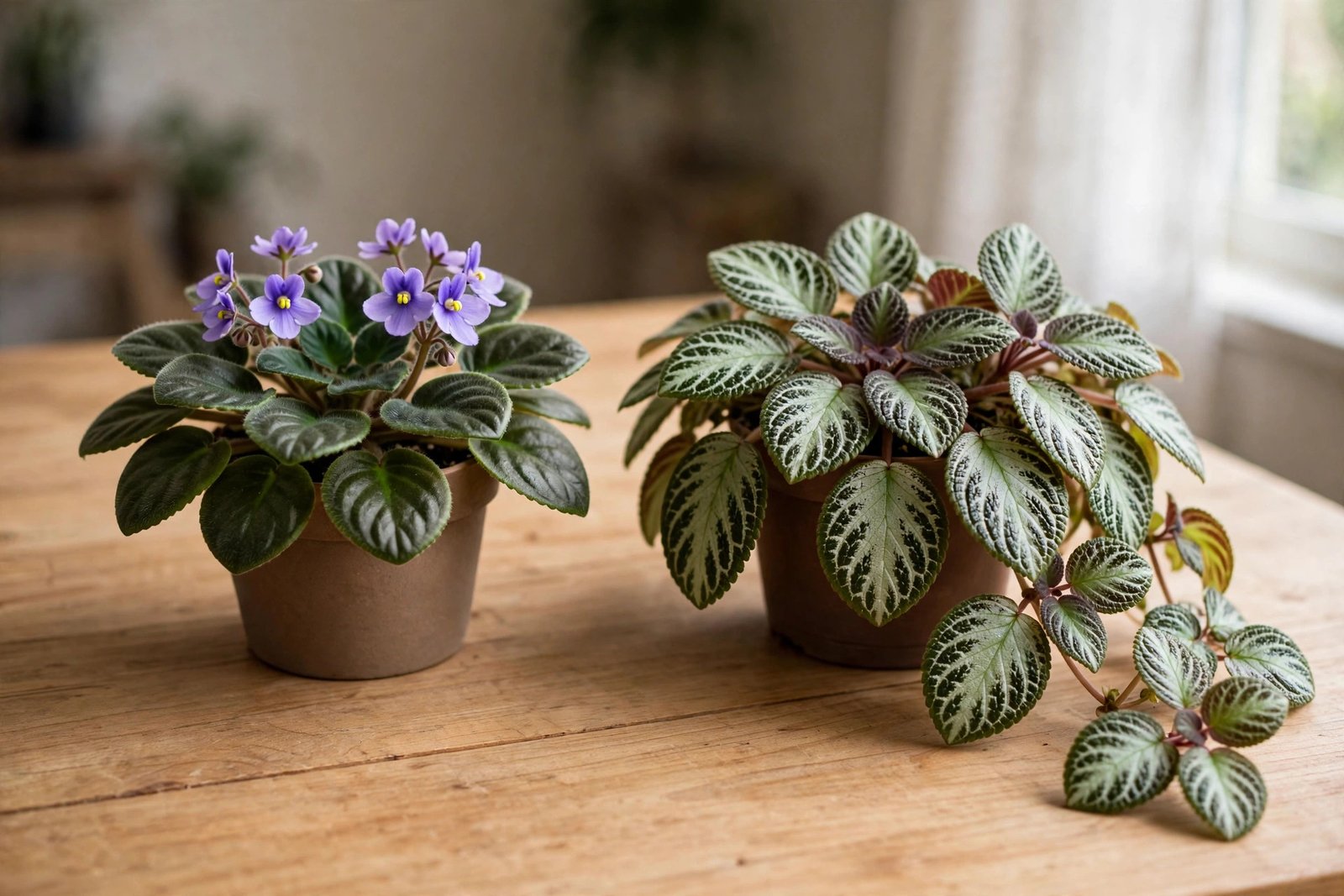
African violets are easy to confuse with other small flowering plants. The “flame African violet” is not an African violet at all. It is Episcia reptans, a different plant in the same family, sold as flame violet or frosty. It is a trailing plant with patterned leaves, not a compact rosette.
When the name on the label does not match Saintpaulia, the answer to “are African violets safe for cats” does not apply to that plant.
True violets, such as the common garden violet (Viola odorata), are a different genus, and Cape primrose (Streptocarpus spp.) is a close relative but a different plant. If two sources disagree, or you cannot confirm the identity, treat the plant as unsafe until you can — that caution is part of “are African violets safe for cats” done properly.
Benefits in a Cat Household
An African violet is one of the few flowering houseplants that is both widely available and listed as non-toxic to cats. Many flowering plants are toxic, so cat owners often give up flowers altogether. An African violet brings color to a windowsill without that concern. For more flowering options, see Cat-Safe Flowering Houseplants for a Pet-Friendly Home.
Its size is a second benefit: it fits on a desk or a narrow windowsill, and grows slowly. It also blooms for months at a time with enough light. That combination — small, colorful, and listed as non-toxic — is why the question “are African violets safe for cats” comes up so often.
African Violet Care
African violets prefer bright, indirect light, lightly moist soil, and moderate humidity. They dislike cold water on their leaves. The most common mistake is watering from above, with cold water — water the soil, not the leaves.
Good care keeps the plant healthy — another small reason care matters when you ask “are African violets safe for cats.”
Light
Give bright, indirect light, such as near an east-facing window. They need enough light to bloom, but direct sun through glass can scorch the fuzzy leaves.
If it grows lush leaves but never flowers, it needs more light — move it closer to a bright window, or add a grow light for 12 to 14 hours a day. A plant in the right light blooms longer — the reward for asking “are African violets safe for cats” before you bought it.
Water
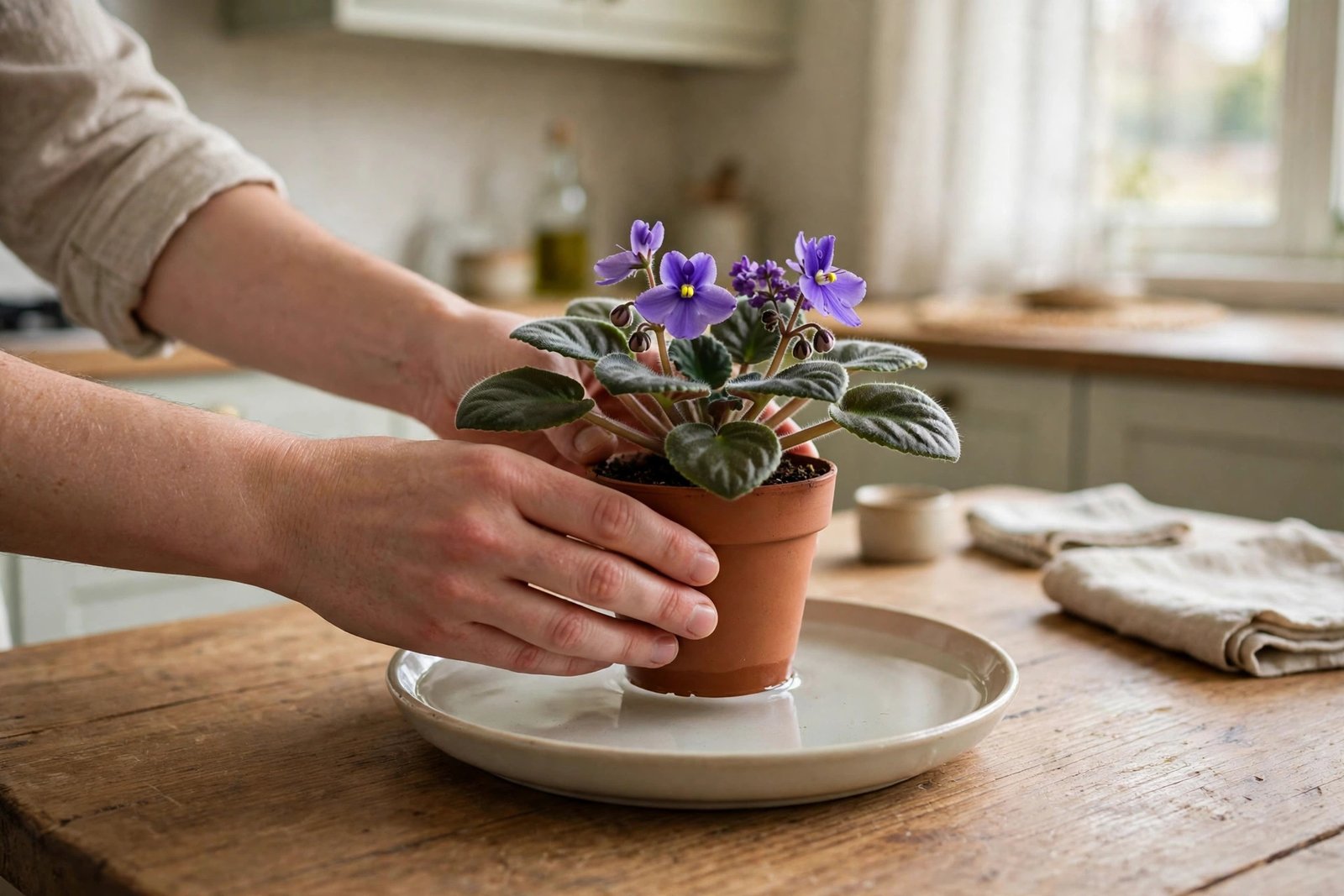
Water from the bottom. Set the pot in a shallow dish of room-temperature water for 20 to 30 minutes, then let it drain completely.
Water when the top of the soil feels dry — use the soil, not the calendar, as your guide. Once you know the answer to “are African violets safe for cats,” that routine keeps the plant blooming.
Humidity and Temperature
African violets prefer moderate humidity, around 40 to 60 percent, which suits most homes. Very dry air can crisp leaf edges, while very damp, still air encourages rot. Keep it warm, ideally 65 to 75 degrees Fahrenheit (18 to 24 degrees Celsius), and avoid cold below about 60 degrees Fahrenheit (16 degrees Celsius), drafts, and hot, dry air from vents.
Move it back from a cold windowsill at night to protect the blooms you chose it for after asking “are African violets safe for cats.”
Soil, Feeding, and Repotting
Use a loose, well-draining African violet mix, or standard mix lightened with perlite. The pot must have drainage holes, and a shallow pot suits the plant better than a deep one.
Feed lightly in spring and summer with African violet fertilizer, as the label directs. Repot once a year in spring, keeping the crown at soil level — burying it invites rot. That matters because “are African violets safe for cats” is only about the plant, not about what is in its pot.
Common Problems
Brown leaf edges are the most common complaint, caused by cold water on the leaves or overfertilizing. Check water and humidity first.
Crown rot is the most serious problem: water sitting in the center turns the crown soft, dark, and mushy, and it is hard to save a plant once it has rotted. Prevent it by watering from below and keeping the crown dry.
A plant that grows leaves but never flowers usually needs more light or feeding. Move it to a brighter spot, feed lightly, and remove spent stalks. Pests are uncommon indoors, but isolate any infested plant and keep cats away until treatment is dry. A sick plant is also a plant your cat is more likely to chew, so fixing problems early helps on both fronts — and it is worth remembering that “are African violets safe for cats” assumes a healthy, correctly identified plant.
Placement in a Home With Cats
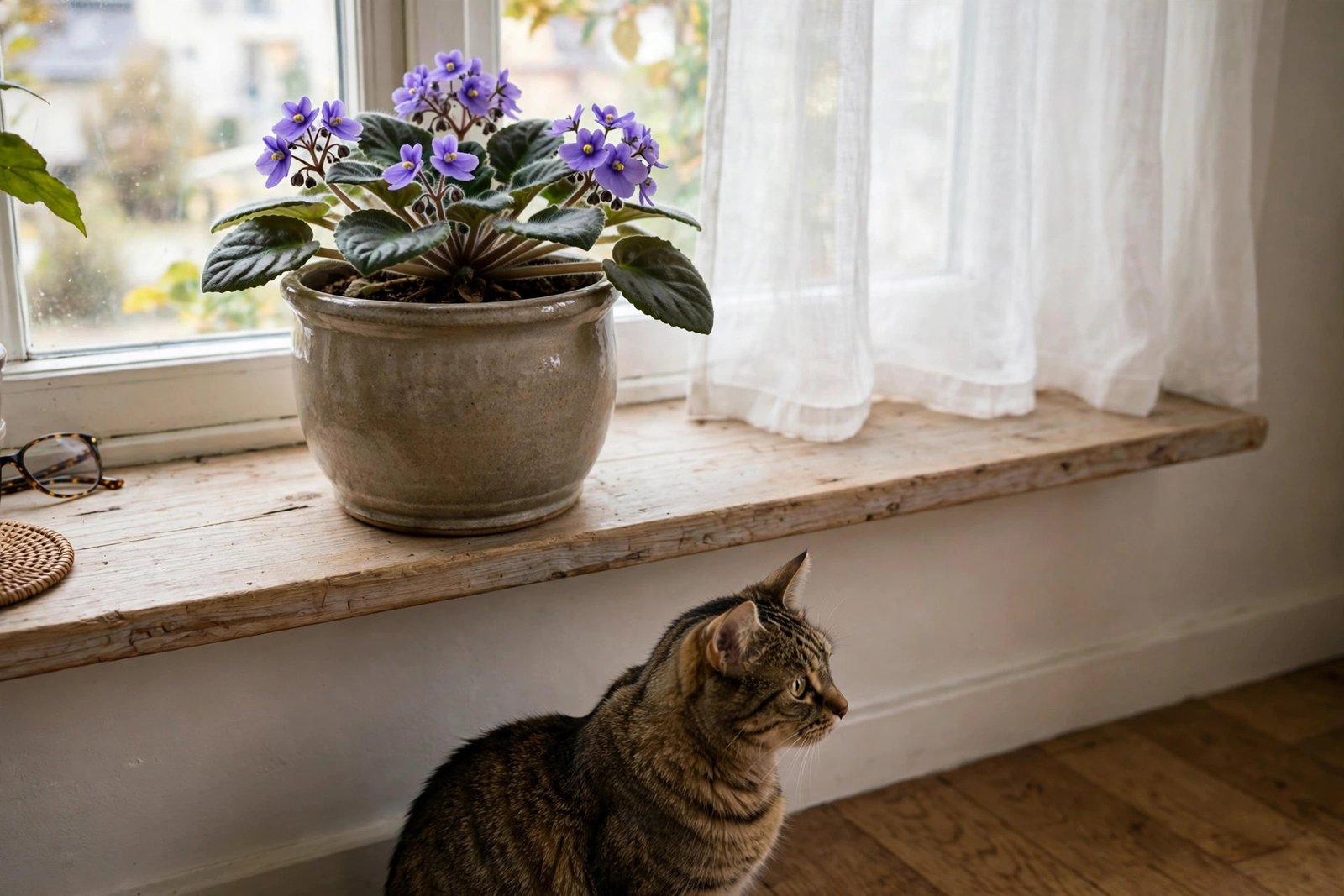
An African violet is non-toxic, so the question is not whether it will poison your cat. It is whether your cat will chew the flowers, knock the pot over, or dig in the soil. Where you put the plant is part of “are African violets safe for cats” in practice, not just on paper.
Good spots include a bright windowsill with a clear section for your cat, or a stable shelf. Use a heavier outer cache pot so a paw cannot tip it over.
Keep it away from your cat’s favorite perch. If your cat digs in the soil, cover it with large, smooth stones too big to swallow. For more ideas, see How to Keep Cats Out of Houseplants Without Harming Them and Where to Place Houseplants in a Home With Cats.
And if you are still deciding on the spot, remember that “are African violets safe for cats” is a yes that gets easier when the plant sits where your cat rarely goes.
What to Do If Your Cat Chews an African Violet
Most cases are not emergencies, because the plant is listed as non-toxic. Still, take chewing seriously: a large amount can upset a stomach, and the plant in the pot may not be the plant you think it is. Move the cat away calmly, and note what part was eaten, roughly how much, and when.
Even so, a quick call is never wrong, and it is the safest way to settle “are African violets safe for cats” for your own cat in that moment.
Contact your veterinarian or poison control promptly if your cat eats a large amount, vomits repeatedly, drools heavily, seems lethargic, refuses food or water, or has difficulty breathing. In the United States, call the ASPCA Animal Poison Control Center at (888) 426-4435, or Pet Poison Helpline at (855) 764-7661. A consultation fee may apply.
Do not try a home remedy, do not try to make your cat vomit, and do not give medication, milk, or oil unless a veterinarian tells you to. If you are unsure whether the plant was really an African violet, treat it as uncertain and call for advice. For a fuller guide, see What to Do If Your Cat Eats a Toxic Plant: A Safety Guide. The emergency advice is the same even when the answer to “are African violets safe for cats” is yes: call promptly and do not treat it at home.
Buying Checklist
Check the botanical name first: Saintpaulia spp. or Streptocarpus sect. Saintpaulia. If the label gives no botanical name, ask for it. Look for a compact rosette of firm, fuzzy leaves and fresh buds, and avoid limp leaves.
Ask whether it was treated with pesticides, and keep it out of your cat’s reach for a few days after you bring it home. Buy from a seller who can tell you the variety name — far easier to verify than a plant sold only as “violet.” A two-minute label check at the shop is the easiest way to make sure “are African violets safe for cats” applies to the plant you bring home.
Frequently Asked Questions
Are African violets safe for cats?
Yes. Saintpaulia spp. are listed as non-toxic to cats, dogs, and horses. That does not mean a cat should eat them. In short, “are African violets safe for cats” is a yes with conditions: the right plant, the right pot, and no chewing.
Can my cat chew African violet leaves?
A cat may chew a few leaves without being poisoned, but chewing should still be discouraged. It can cause mild stomach upset and damage the plant. Offer cat grass instead.
Are African violets the same as flame African violets?
No. The African violet is Saintpaulia spp., a compact rosette listed as non-toxic. The flame African violet is Episcia reptans, a trailing plant with patterned leaves — a different species in the same family. Never answer “are African violets safe for cats” for a plant you have not identified.
How often should I water an African violet?
Water from the bottom when the top of the soil feels dry, using room-temperature water. Set the pot in a shallow dish for 20 to 30 minutes, then let it drain completely. That may be about once a week in spring and summer, less often in winter.
Why won’t my African violet bloom?
It usually needs more light. Move it to a brighter spot with indirect light, such as an east-facing window, and feed lightly in spring and summer. Remove spent flower stalks.
What should I do if my cat eats a lot of African violet?
Move the cat away, note how much was eaten and when, and watch for vomiting or lethargy. Contact your veterinarian or poison control promptly if the cat eats a large amount or shows any worrying change. Do not try a home remedy, and do not make the cat vomit.
Conclusion
Saintpaulia spp. are listed by the ASPCA as non-toxic to cats, dogs, and horses, stay compact, and bloom for months on a bright windowsill. You already know the answer to “are African violets safe for cats”: yes, for a correctly identified plant, kept where your cat cannot chew it.
Treat “non-toxic” as a starting point, not a guarantee: confirm the botanical name, watch for look-alikes, and keep sprays and fertilizer out of reach. For more help building a safe indoor space, see How to Create a Cat-Friendly Indoor Plant Space.
Disclaimer: This article is for general information only and does not replace advice from a veterinarian. Plant safety listings can change, and individual cats can react differently. If your cat eats a plant and seems unwell, contact your veterinarian or an animal poison control service promptly.
Sources and References
- ASPCA Animal Poison Control Center. Toxic and Non-Toxic Plant List — Cats. Lists African Violet, Saintpaulia spp., as non-toxic to cats. https://www.aspca.org/pet-care/animal-poison-control/cats-plant-list
- ASPCA. “Do You Know Which Flowers and Plants Are Toxic to Pets? Our Experts Explain!” https://www.aspca.org/news/do-you-know-which-flowers-and-plants-are-toxic-pets-our-experts-explain
- ASPCA Animal Poison Control Center. “Toxic and Non-Toxic Plants.” https://www.aspca.org/pet-care/aspca-poison-control/toxic-and-non-toxic-plants
- North Carolina Cooperative Extension, Beaufort County Center. “Velvet Blossoms and Windowsill Charm: Growing African Violets With Confidence.” https://beaufort.ces.ncsu.edu/news/velvet-blossoms-and-windowsill-charm-growing-african-violets-with-confidence/
1 thought on “Are African Violets Safe for Cats? Benefits, Risks, and Care Tips”