
You do not have to give up flowers to keep a cat safe. These cat-safe flowering houseplants are listed by the ASPCA Animal Poison Control Center as non-toxic to cats, including African violets, moth orchids, Christmas cactus, Gerbera daisies, bromeliads, hoyas, and lipstick plants. They bring color to a windowsill or shelf without the danger that comes with lilies, tulips, or daffodils.
The seven plants in this guide are the best-known cat-safe flowering houseplants you can buy in a grocery store or garden center. Each one has been checked by its botanical name against the ASPCA list.
The trick is checking each plant by its botanical name before it comes home. Common names are unreliable: two plants sold as “lily,” “daisy,” or “cactus” can have opposite safety ratings.
What “Non-Toxic” Really Means
When the ASPCA lists one of these cat-safe flowering houseplants as non-toxic, it means the ASPCA has not identified compounds in the plant known to poison cats, so a cat that nibbles a petal is not expected to be poisoned by the plant itself. Even so, the ASPCA notes that eating any plant material may still cause vomiting and stomach upset in cats.
That is why a list of cat-safe flowering houseplants is a starting point, not a free pass to let a cat chew. Non-toxic does not mean the plant is food, and it does not mean a cat can eat as much as it likes. It also does not cover sprays, fertilizer, or potting mix.
Many flowering plants are treated with pesticides or leaf-shine products before sale, and fertilizer in the pot can be a problem if a cat digs. No plant is completely risk-free.
The 7 Plants at a Glance
Here is the short list of cat-safe flowering houseplants in this guide, with the botanical name to look for on the label: African violet (Saintpaulia spp.), moth orchid (Phalaenopsis spp.), Christmas cactus (Schlumbergera bridgesii), Gerbera daisy (Gerbera jamesonii), bromeliad (Neoregelia spp. and Guzmania lingulata), hoya (Hoya carnosa), and lipstick plant (Aeschynanthus humilis).
All seven are listed by the ASPCA as non-toxic to cats.
1. African Violet (Saintpaulia spp.)
The African violet is one of the most popular cat-safe flowering houseplants, and the easiest place to start. It is a small, compact plant with soft, fuzzy leaves and clusters of purple, pink, blue, or white flowers that can appear for much of the year.
The ASPCA lists African violet, filed under Saintpaulia spp. (now grouped under Streptocarpus sect. Saintpaulia), as non-toxic to dogs, cats, and horses.
Give these cat-safe flowering houseplants bright, indirect light, such as an east- or north-facing window, and water from the bottom: set the pot in a shallow dish of room-temperature water for 20 to 30 minutes, then let it drain. Water on the fuzzy leaves leaves pale marks. Keep the soil lightly moist, never soggy, and feed lightly in spring and summer.

2. Moth Orchid (Phalaenopsis spp.)
The moth orchid is one of the longest-blooming cat-safe flowering houseplants you can buy. The ASPCA lists the moth orchid, Phalaenopsis spp., as non-toxic to cats, dogs, and horses. Its arching stems carry large, long-lasting flowers in white, pink, purple, or yellow, and a single bloom spike can last two or three months.
Moth orchids grow in bark, not soil. Water about once a week by running room-temperature water through the bark and letting it drain completely, and never let the plant sit in standing water, because the roots rot quickly. Give bright, indirect light, and keep it away from cold drafts and heating vents.
Of all the cat-safe flowering houseplants in this guide, the orchid is the one most likely to arrive with extras a cat can chew: bark chips, moss, wire stakes, and fertilizer residue. Other common orchids, including Cymbidium, Dendrobium, and Oncidium, are also listed by the ASPCA as non-toxic, but check each genus on its own.

3. Christmas Cactus (Schlumbergera bridgesii)
Christmas cactus is the seasonal star among cat-safe flowering houseplants. The ASPCA lists it, filed as Schlumbergera bridgesii, as non-toxic to cats, dogs, and horses. It blooms in late fall and winter, with pink, red, purple, or white flowers at the ends of flat, segmented stems.
Despite the name, it is not a desert cactus: it comes from humid forests, so it wants regular watering and bright, indirect light, not dry soil and full sun. In fall it needs long, cool nights to set buds: from about October, give it 12 to 14 hours of darkness each night.
Moving the plant once buds appear can make them drop, so pick its spot early and leave it alone. Christmas cactus is one of the easiest cat-safe flowering houseplants to keep from year to year, and a good seasonal swap for the poinsettia, which is mildly toxic to cats.

4. Gerbera Daisy (Gerbera jamesonii)
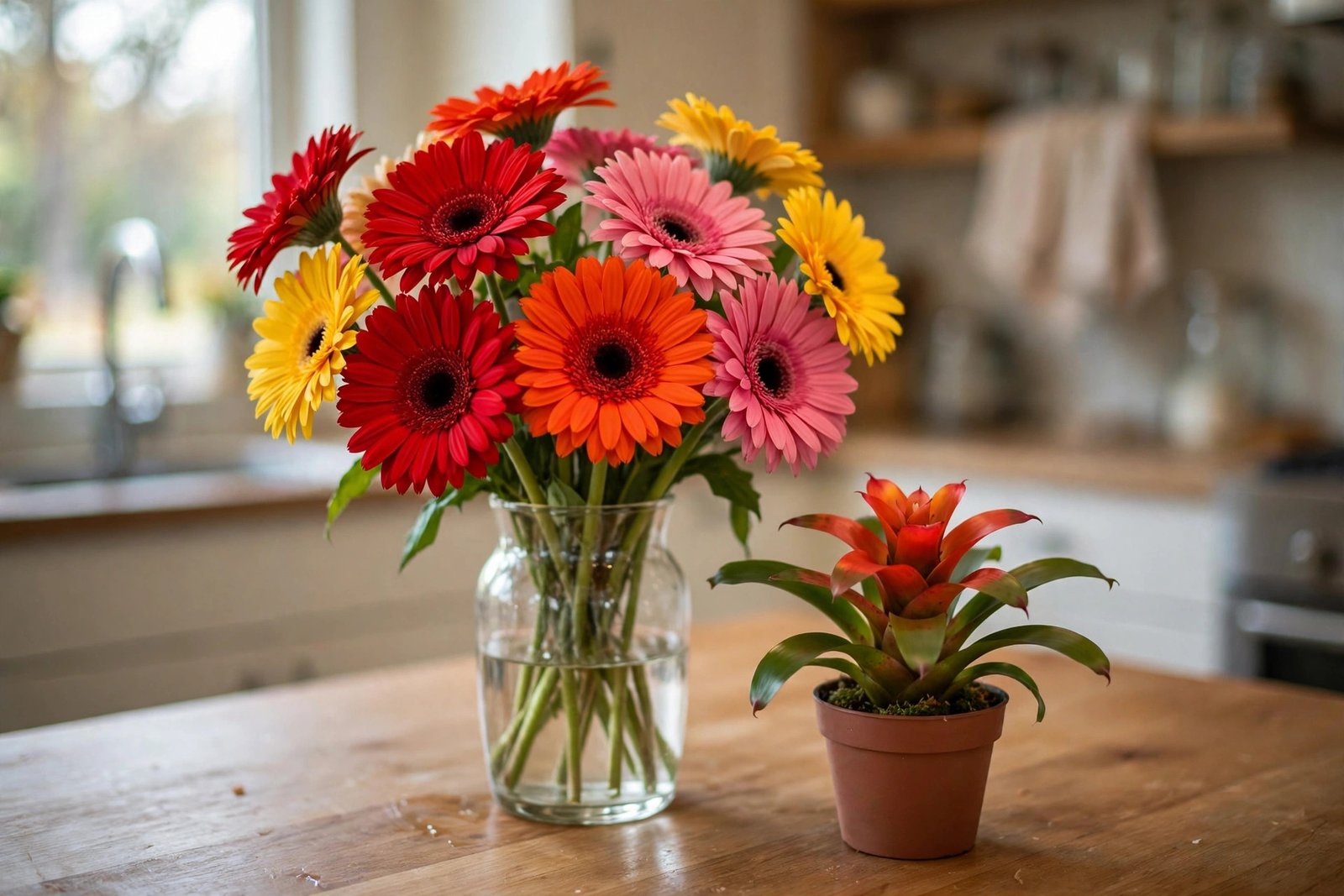
Gerbera daisies bring the brightest color of any cat-safe flowering houseplants in this guide: large, daisy-like flowers in red, orange, pink, yellow, or white on short stems above a rosette of leaves. The ASPCA lists Gerbera daisy, Gerbera jamesonii, also sold as Barberton daisy, Transvaal daisy, and Veldt daisy, as non-toxic to cats.
Gerberas want more light than most plants in this guide. Give these cat-safe flowering houseplants the brightest spot you have, such as a sunny east- or south-facing window with some protection from harsh midday sun. Water when the top inch of soil feels dry, and avoid wetting the crown, because it rots easily.
Removing spent flowers encourages new ones.
5. Bromeliad (Neoregelia spp. and Guzmania lingulata)
Bromeliads are the boldest cat-safe flowering houseplants that are still listed as non-toxic to cats. The blushing bromeliad, Neoregelia spp., is on the ASPCA cats list as non-toxic, and the scarlet star, Guzmania lingulata, is listed the same way. Their flowers are not petals in the usual sense: a central cup of leaves turns red, pink, orange, or yellow, with small flowers appearing from the center.
A bromeliad is one of the few cat-safe flowering houseplants that drinks from a central cup. Keep a little water in the cup, refreshed every week or two so it does not go stale, and keep the soil only lightly moist. Give bright, indirect light and keep the plant warm.
A bromeliad usually flowers once, then produces small offsets, or pups, at its base. Refresh the cup water often, and keep the pot in a heavy container so it cannot be tipped over.
6. Hoya, or Wax Plant (Hoya carnosa)
Hoyas are trailing cat-safe flowering houseplants with thick, waxy leaves and clusters of small, star-shaped, sweetly scented flowers that look like porcelain. The ASPCA lists the wax plant, Hoya carnosa, also sold as honey plant, as non-toxic to cats, as is the twisted Hindu rope plant, Hoya carnosa ‘Krinkle Kurl’.
Hoyas are slow-growing cat-safe flowering houseplants and easy to keep. Give bright, indirect light, let the soil dry out between waterings, and do not overwater, because the thick leaves store water. A hoya may take a year or two to flower, and it blooms best when slightly pot-bound.
Let the stems trail from a hanging basket, and trim them so they do not dangle down to a surface a cat can stand on.
7. Lipstick Plant (Aeschynanthus humilis)
The lipstick plant rounds out our list of cat-safe flowering houseplants with the most unusual flowers of the seven. It is a trailing plant with glossy green leaves and tubular red flowers that poke out of dark buds like lipstick from a tube. The ASPCA entry for the lipstick plant, Aeschynanthus humilis, lists it as non-toxic to dogs, cats, and horses.
Shops also sell the closely related Aeschynanthus radicans under the same common name, so read the label: the ASPCA entry covers A. humilis only. If the label says A. radicans instead, check that species in the ASPCA list before you buy.
These cat-safe flowering houseplants want bright, indirect light and even moisture, with good drainage. They flower best in spring and summer, kept high in a hanging basket.
Flowering Plants to Avoid: Toxic Look-Alikes
Flowering plants cause more confusion than any other group, because the dangerous ones can look like cat-safe flowering houseplants. True lilies and daylilies are the most dangerous: lilies from the Lilium genus and daylilies from the Hemerocallis genus can cause life-threatening kidney failure in cats, even in tiny amounts, including leaves, petals, pollen, and vase water.
Do not bring them into a cat home at all. Learn the exact types in Are Lilies Toxic to Cats? Types, Exposure Risks, and Urgent Steps.
Tulips and daffodils are also toxic to cats, and their bulbs are the most dangerous part. Amaryllis, often sold as a holiday bulb, is toxic too, and so is kalanchoe, a popular flowering succulent.
The peace lily, Spathiphyllum spp., is not a true lily, but it contains insoluble calcium oxalate crystals and is listed as toxic to cats. Poinsettias are mildly toxic. For the fuller list, see Common Houseplants That Are Toxic to Cats: What to Avoid.
If a flowering plant is not on the ASPCA non-toxic list by its botanical name, do not assume it belongs with cat-safe flowering houseplants. When in doubt, leave it at the shop and check the ASPCA list at home first.
How to Choose a Flowering Plant: Check the Label
Before you buy any of these cat-safe flowering houseplants, read the label for the botanical name, not just the common name. A plant sold as “daisy,” “lily,” “cactus,” or “orchid” may be one of several species with different safety ratings. If the label gives no botanical name, ask the seller, or look the plant up in the ASPCA list before you buy it.
If you are unsure about a plant you already own, keep it out of your cat’s reach until you can identify it. A plant kept in a closed room while you check is a small inconvenience; a misidentified plant in a shared room is a real risk.
Placement With Cats
Flowering plants tempt cats because the blooms move, smell, and sit at nose height on a windowsill. Place your cat-safe flowering houseplants where they get the right light, in heavy, stable pots, away from your cat’s favorite perches. A wide shelf on a bare wall is harder for a cat to reach than a shelf above a sofa.
Keep the soil covered if your cat digs, and clean up fallen petals promptly. For more ideas, see Where to Place Houseplants in a Home With Cats and How to Create a Cat-Friendly Indoor Plant Space.
What to Do If Your Cat Chews a Flowering Plant
If the plant is one of the cat-safe flowering houseplants in this guide, most cases are not emergencies, but still take chewing seriously. Move the cat away calmly, check how much was eaten and when, and watch the cat for the rest of the day.
Contact your veterinarian or an animal poison control service promptly if your cat eats a large amount, vomits repeatedly, has diarrhea that does not settle, seems lethargic, refuses food or water, or has difficulty breathing. In the United States, the ASPCA Animal Poison Control Center is available at (888) 426-4435, and Pet Poison Helpline is available at (855) 764-7661; a consultation fee may apply. Do not try a home remedy, do not try to make your cat vomit, and do not give medication, milk, or oil unless a veterinarian tells you to.
If the plant could be a true lily or daylily, treat it as an emergency and contact a veterinarian immediately. Do not wait for symptoms to appear, because kidney damage from lilies can progress before a cat looks sick. For a fuller guide, see What to Do If Your Cat Eats a Toxic Plant: A Safety Guide.
Frequently Asked Questions
What flowering houseplants are safe for cats?
African violets, moth orchids, Christmas cactus, Gerbera daisies, bromeliads, hoyas, and lipstick plants are the cat-safe flowering houseplants the ASPCA lists as non-toxic to cats. Check each plant by its botanical name, because common names can cover several species with different safety ratings.
Are orchids safe for cats?
Moth orchids, Phalaenopsis spp., are listed by the ASPCA as non-toxic to cats, dogs, and horses. Other common orchids, including Cymbidium, Dendrobium, and Oncidium, are also listed as non-toxic, but check each genus on its own.
Are African violets safe for cats?
Yes. African violets, Saintpaulia spp., are cat-safe flowering houseplants listed by the ASPCA as non-toxic to dogs, cats, and horses. A cat that nibbles a leaf or flower is not expected to be poisoned, though eating a large amount can still cause mild stomach upset.
Can cats be around roses?
Roses, Rosa spp., are listed as non-toxic to cats. The thorns are the main hazard, so strip thorns from stems within a cat’s reach and use a heavy vase that cannot be tipped over.
What flowers are toxic to cats?
True lilies (Lilium spp.) and daylilies (Hemerocallis spp.) are the most dangerous and can cause kidney failure. Tulips, daffodils, amaryllis, kalanchoe, and peace lilies are also listed as toxic to cats. Poinsettias are mildly toxic.
My cat chewed a flower. What should I do first?
Move the cat away calmly, note the plant’s name and how much was eaten, and watch for vomiting, diarrhea, or lethargy. If your cat eats a large amount, seems unwell, or the plant could be a lily, contact your veterinarian or poison control promptly.
Conclusion
These seven blooms let you add color without adding danger. Start with one or two: an African violet, a moth orchid, or a Christmas cactus. Check the botanical name on the label, confirm it in the ASPCA list, and place the plant where it gets the right light. Keep true lilies and daylilies out of the home entirely, and remember that non-toxic does not mean edible.
Disclaimer: This article is for general information only and does not replace advice from a veterinarian. Plant safety listings can change, and individual cats can react differently. If your cat eats a plant and seems unwell, contact your veterinarian or an animal poison control service promptly.
Sources and References
- ASPCA Animal Poison Control Center. Toxic and Non-Toxic Plant List — Cats. https://www.aspca.org/pet-care/animal-poison-control/cats-plant-list
- ASPCA. Do You Know Which Flowers and Plants Are Toxic to Pets? Our Experts Explain! https://www.aspca.org/news/do-you-know-which-flowers-and-plants-are-toxic-pets-our-experts-explain
- ASPCA Animal Poison Control Center. Toxic and Non-Toxic Plants: Lipstick Plant (Aeschynanthus humilis). Lists the plant as non-toxic to dogs, cats, and horses. https://www.aspca.org/pet-care/aspca-poison-control/toxic-and-non-toxic-plants/lipstick-plant
- ASPCA Animal Poison Control Center. Toxic and Non-Toxic Plants. https://www.aspca.org/pet-care/animal-poison-control/toxic-and-non-toxic-plants — The ASPCA database used to check plant toxicity listings for cats.
- Cornell University College of Veterinary Medicine, Cornell Feline Health Center. Common Cat Hazards. https://www.vet.cornell.edu/departments-centers-and-institutes/cornell-feline-health-center/health-information/feline-health-topics/common-cat-hazards
- Cornell University College of Veterinary Medicine, Cornell Feline Health Center. Poisons. https://www.vet.cornell.edu/departments-centers-and-institutes/cornell-feline-health-center/health-information/feline-health-topics/poisons
1 thought on “Cat-Safe Flowering Houseplants for a Pet-Friendly Home”