
A cat-friendly indoor plant space works with how cats actually live: they climb, bat at dangling leaves, chew green things, dig in loose soil, and claim every sunny windowsill. Plan for that from the start: choose plants listed as non-toxic to cats, place them where your cat and the plant can both do well, make the setup stable, and give your cat something safe to chew instead.
Many cat owners give up on houseplants after one bad week: a pot knocked off a shelf, a fern chewed to stubs, soil all over the floor. Usually the problem is not the cat, but a setup designed for the plant alone. A few deliberate choices at the start of a cat-friendly indoor plant space prevent most of these headaches, and they cost very little.
What a Cat-Friendly Indoor Plant Space Really Means
A cat-friendly indoor plant space puts safety before style, but it does not have to look plain. The plants within reach of your cat have been checked by botanical name, the pots are heavy or secured, and anything dangerous has been left out of the home.
“Non-toxic” does not mean “safe to chew or eat.” The ASPCA notes that eating any plant material may cause vomiting and stomach upset for cats, even when the plant is listed as non-toxic. So a good plan reduces chewing as well as choosing safer plants, and that is what makes a cat-friendly indoor plant space different from an ordinary plant collection.
This guide walks through seven steps for building a cat-friendly indoor plant space, from watching your cat to adding cat grass and enrichment. Start small, with three or four plants.
Step 1: Watch Your Cat and Your Home First
Before you build a cat-friendly indoor plant space, spend a few days noticing how your cat uses the room. Does your cat jump onto every shelf, chew leaves, dig in pots, or knock things off tables? Does it prefer a sunny windowsill, a high perch, or a quiet hiding spot? Your cat-friendly indoor plant space should fit the cat you actually have.
Also look at the light: which windows get direct sun, and which corners stay dim all day? Match the plant to the spot. If you have more than one cat, plan for the most curious one.
Step 2: Choose One Zone for Plants and Cats at Home
A cat-friendly indoor plant space works best when it has a clear home, not plants scattered on every surface. Pick one zone to start: a corner by a bright window, a wall with a sturdy shelf, or a plant stand in the living room. One defined zone is easier to care for and to keep safe.
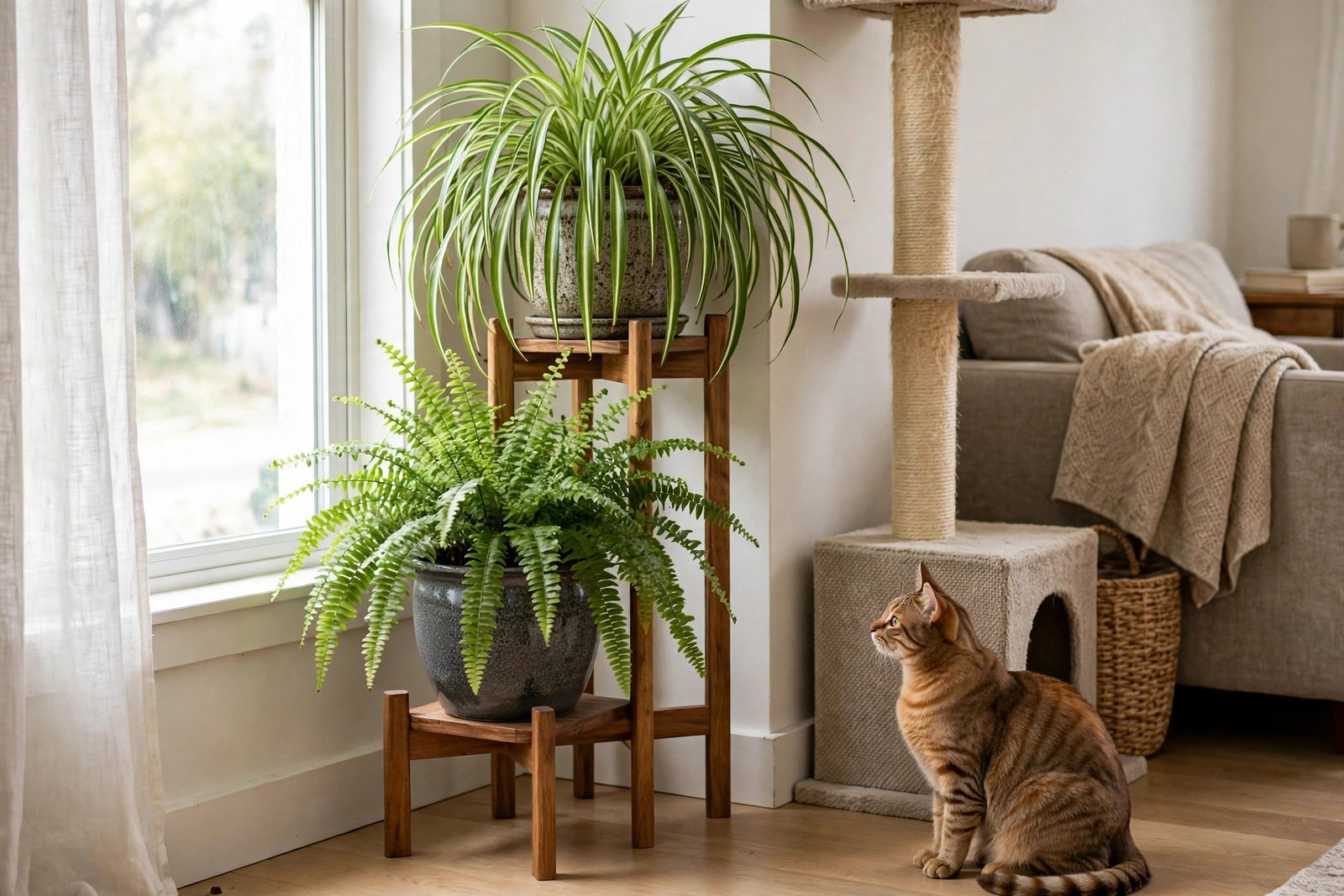
Good zones have enough light, sit away from the cat’s food, water, and litter area, and give your cat a place of its own nearby, such as a perch or a scratching post. In a small home, a tall plant stand, a wall shelf, and one or two floor plants can make a green corner. Live with one zone for a few weeks, watch your cat, and adjust before you expand.
Step 3: Choose Cat-Safe Plants for Your Indoor Plant Space
Check every plant by its botanical name in the ASPCA Toxic and Non-Toxic Plants list before it comes home. Common names can be misleading: two plants sold as “palm,” “fern,” or “lily” can have very different safety profiles, and a common name alone is never a safety check.
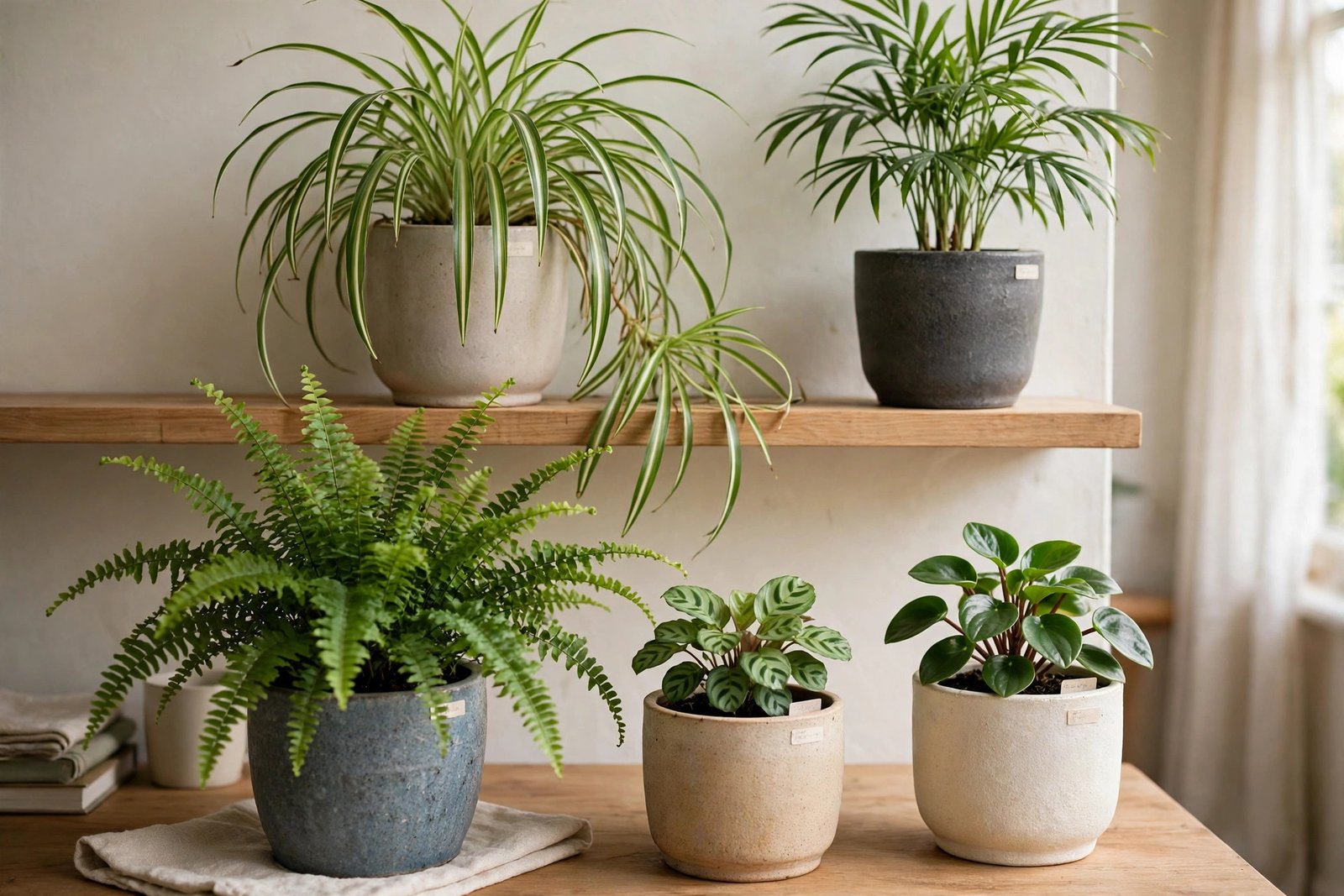
These plants are listed by the ASPCA as non-toxic to cats: spider plant (Chlorophytum comosum), Boston fern (Nephrolepis exaltata), parlor palm (Chamaedorea elegans), areca palm (Dypsis lutescens), calathea (Calathea spp.), peperomia (Peperomia spp.), and African violet (Saintpaulia spp.). For more detail, see Are Spider Plants Safe for Cats? and 15 Cat-Safe Houseplants for a Greener, Pet-Friendly Home.
Do not describe any plant as completely risk-free: even a non-toxic plant can cause stomach upset if a cat eats a lot of it. If you are unsure, leave it at the shop and check the ASPCA list at home first. Choosing carefully is the heart of a cat-friendly indoor plant space.
Plants That Do Not Belong in a Cat-Friendly Indoor Plant Space
Some plants should not be in a cat home at all, even on a high shelf, because cats climb, jump, and knock things down.
True lilies and daylilies are the clearest example. Lilies from the Lilium genus and daylilies from the Hemerocallis genus can cause life-threatening kidney failure in cats, even in tiny amounts. The ASPCA states that if a cat ingests any part of a lily, or even grooms lily pollen from its fur, it could cause serious kidney damage and potentially death, and Cornell University’s Feline Health Center gives the same warning. That includes leaves, stems, petals, pollen, and vase water.
Do not bring true lilies or daylilies into a home with a cat, not even as a gift bouquet. For the full distinction, see Are Lilies Toxic to Cats?
Other common houseplants to keep out include pothos, monstera, snake plants, ZZ plants, philodendrons, peace lilies, aloe vera, jade plants, sago palms, tulips, and daffodils. For a fuller list, see Common Houseplants That Are Toxic to Cats: What to Avoid. If you already own a toxic plant and a cat, move the plant out of the home or to a room your cat cannot enter. A closed door is more reliable than a high shelf.
Step 4: Place Plants With Cats in Mind
Give cats their own sunny spot: if you fill the only sunny windowsill with plants, your cat will likely push through them to reach the sun, so keep a window bed or a clear section of sill free for your cat.
Place trailing plants where the stems do not dangle at cat-eye level, and trim the longest trails. Use wide, stable shelves fixed to the wall, with brackets rated for the weight of the pot, soil, and plant when wet. Keep heavier pots low, leave space between pots, and hang planters only on hooks rated for the full wet weight, out of jumping reach. When you arrange your cat-friendly indoor plant space, think like a cat: look for the jumping route, the dangling stem, and the wobbly shelf.
Step 5: Pots, Soil, and Water — The Details Cats Notice
Cats notice pots and soil more than most owners expect. Loose, dry soil looks like a litter box to some cats, a light plastic pot feels like a toy, and a saucer full of standing water is a drinking bowl.
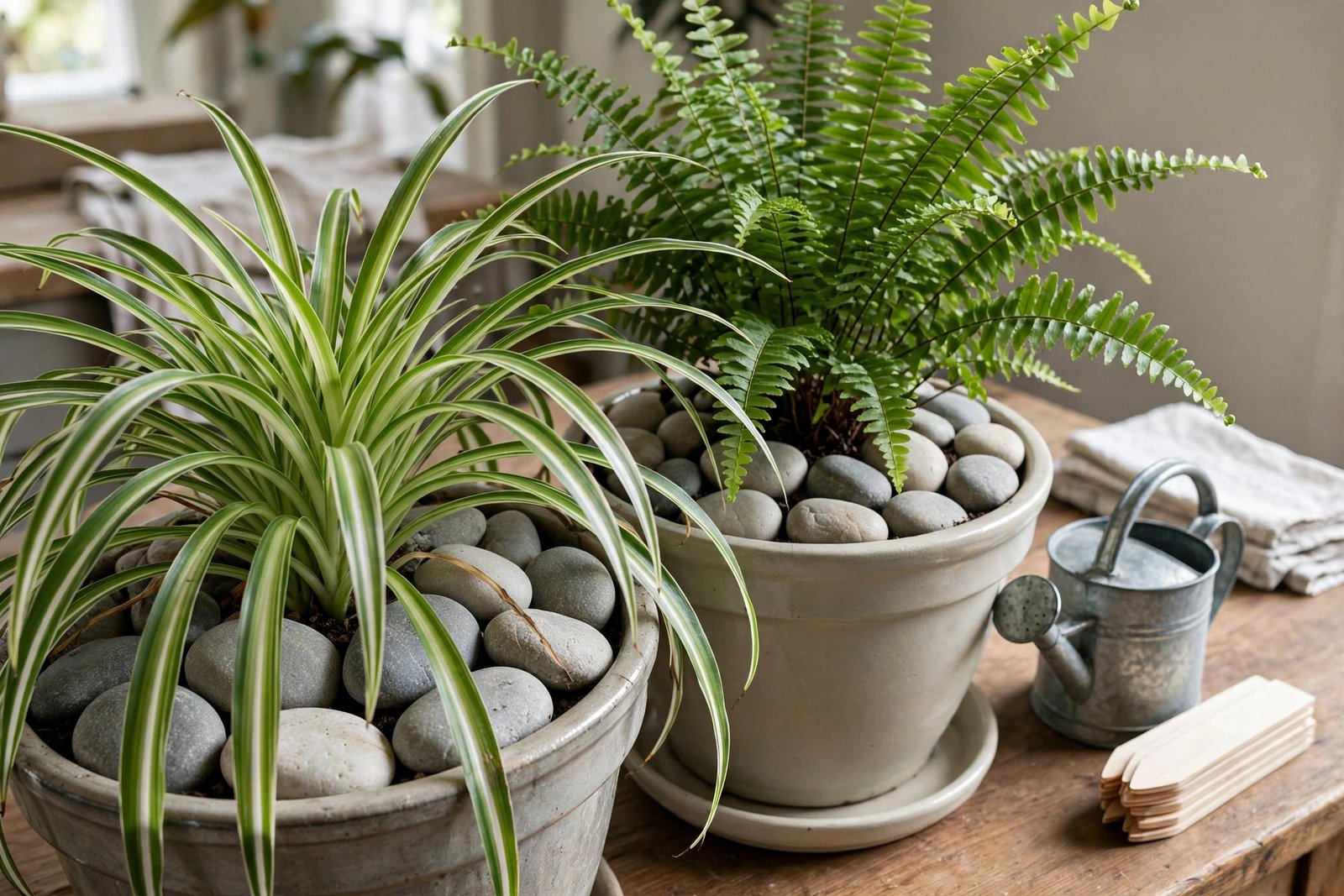
Use heavy pots where you can: ceramic, stone, or a heavy outer cache pot. In a cat-friendly indoor plant space, weight is your best friend, because a pot that is hard to move stays on the shelf. Cover the soil if your cat digs, with large, smooth stones or a fitted cover. Avoid small pebbles a cat could swallow, and avoid cocoa shell mulch, which is not safe around pets.
Water carefully, empty saucers after watering, and keep fertilizer, pesticides, and plant food in a closed cabinet. Do not use chemical, essential-oil, or homemade deterrent sprays on plants your cat may chew. For humane ideas, see How to Keep Cats Out of Houseplants Without Harming Them. Label each pot with its common and botanical names.
Step 6: Add Cat Grass and Enrichment, Not Just Plants
Many cats chew plants because they want green matter, because they are bored, or because they are exploring. Cat grass is the simplest safe outlet: grow wheatgrass, oat grass, or barley grass in a low, heavy pot where your cat can reach it easily. Keep it fresh, and grow a second pot so one is always ready. Place it near the houseplants, not far away.
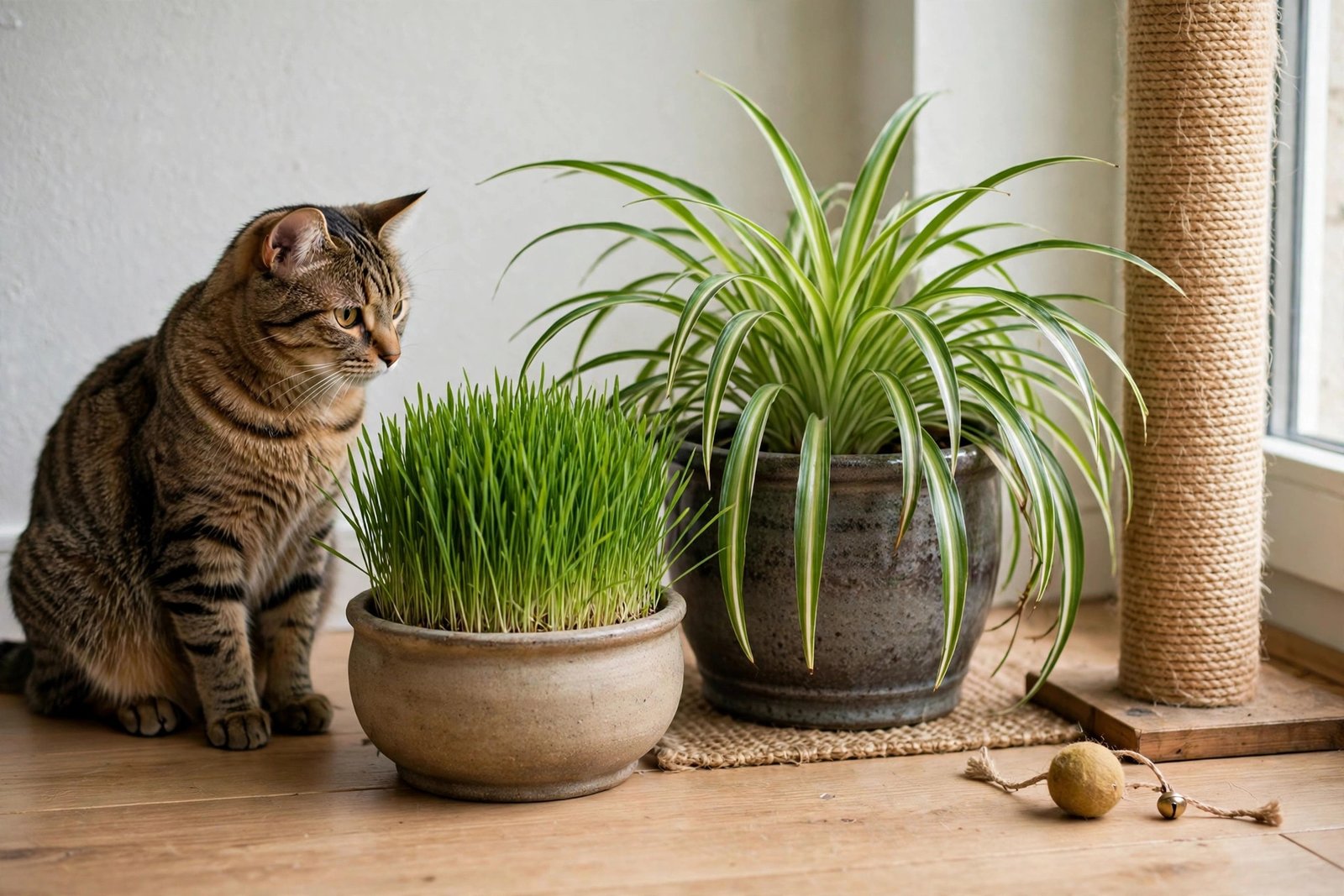
Add enrichment around the plant area, too: a scratching post, a cat tree, a window perch, and a few toys, rotated so they stay interesting. A cat-friendly indoor plant space is not just about the plants; it is about the whole room working for the cat that lives in it. When the cat has grass to nibble, a post to scratch, and a perch to watch from, your houseplants become background decoration. If your cat vomits repeatedly, seems lethargic, or refuses to eat, call your veterinarian promptly.
Step 7: Build a Simple Care Routine You Can Keep
Once a week, check each plant in your cat-friendly indoor plant space for chewed leaves, dry soil, yellowing leaves, pests, and pots that have shifted. Wipe dusty leaves with a damp cloth, and remove dead leaves promptly, because a fallen leaf is easy for a cat to eat.
Water only when the plant needs it: check the soil with your finger first. Keep a plant list with each plant’s botanical name, its place, and when you last watered it — useful in an emergency, when you need to tell a veterinarian what your cat ate. A simple routine keeps a cat-friendly indoor plant space healthy with only a few minutes of care each week.
What to Do If Your Cat Chews a Plant
Even in a well-planned space, a cat may chew a leaf. Quick, calm action is the safety net under any cat-friendly indoor plant space, so act promptly: move your cat away from the plant, and remove any plant material from its mouth only if you can do so safely.
Note the plant’s name, photograph the plant and its label, and note roughly how much was eaten and when, then call your veterinarian or an animal poison control service. In the United States, the ASPCA Animal Poison Control Center is available at (888) 426-4435, and Pet Poison Helpline is available at (855) 764-7661. A consultation fee may apply.
Do not wait for symptoms, do not try home remedies, do not try to make your cat vomit, and do not give milk, oil, or other substances unless a veterinarian tells you to. For a guide, see What to Do If Your Cat Eats a Toxic Plant: A Safety Guide. If it was a true lily or daylily, treat it as an emergency and contact a veterinarian immediately, even if your cat looks well.
Common Mistakes to Avoid
The most common mistake is trusting a common name: a plant sold as a “palm,” “fern,” or “lily” may not be the species you think it is, so always check the botanical name. The second is trusting height alone, because cats climb and jump. The third is using sprays, oils, or chemicals to keep a cat away; many deterrents are not safe for cats, and barriers and enrichment work better.
The fourth is starting too big: begin with three or four non-toxic plants, and add more only when the first ones are doing well. The fifth is forgetting the cat’s own space: give your cat a perch and a scratching post nearby. Avoid these five mistakes, and your cat-friendly indoor plant space will be far easier to live with.
Frequently Asked Questions
Can cats and houseplants live in the same room?
Yes, in many homes they can, if the plants are checked by botanical name and listed as non-toxic to cats, the setup is stable, and toxic plants are kept out of the home. A cat-friendly indoor plant space also gives the cat its own perch and some cat grass.
How many plants should I start with?
Start with three or four: enough for a green corner without overwhelming your care routine or your cat. Choose plants that suit the light you have, and add cat grass.
Where is the best place for a cat-friendly plant space?
The best place is a bright spot your cat does not already claim, away from food, water, and litter areas. A corner by a window, a wall with a sturdy shelf, or a stable plant stand can all work. Keep a sunny perch for your cat nearby: a cat-friendly indoor plant space works best as one defined zone rather than plants scattered everywhere.
Are hanging plants safe with cats?
Hanging plants can be safe if the hook and planter are rated for the full wet weight, the planter is out of jumping reach, and the plant itself is non-toxic to cats. Hanging does not make a toxic plant safe.
What should I do if my cat keeps digging in the soil?
Cover the soil with large, smooth stones or a fitted cover, use a heavier pot, and give your cat a digging alternative, such as a scratching post. Do not use chemical deterrents or punish your cat. If digging continues, move the plant somewhere your cat cannot easily reach.
Is cat grass necessary in a cat-friendly plant space?
Cat grass is not required, but it is helpful: it gives many cats a safe green thing to nibble, which can reduce chewing on houseplants. Grow it in a low, heavy pot, keep it fresh, and place it where your cat can reach it easily. For many owners, it is the simplest addition to a cat-friendly indoor plant space.
Conclusion: Start Small With Your Cat-Friendly Indoor Plant Space
A cat-friendly indoor plant space does not need to be large or expensive. It needs to be planned: choose one zone, check every plant by its botanical name in the ASPCA list, place plants in stable pots where they get the right light, give your cat a sunny spot and some cat grass, and keep toxic plants — especially true lilies and daylilies — out of the home entirely.
Your next step is simple: pick your zone, note the light it gets, and choose three non-toxic plants that suit that light. Check each one in the ASPCA list, label the pots, and add a pot of cat grass nearby. Live with that setup for a few weeks, watch your cat, and adjust before you add more. A small, well-planned cat-friendly indoor plant space will grow into a green corner you and your cat enjoy for years.
Disclaimer: This article is for general information only and does not replace advice from a veterinarian. Plant toxicity can depend on the exact species, the amount eaten, and the individual cat. If you think your cat has eaten a toxic plant, contact your veterinarian or an animal poison control service promptly.
Sources and References
- ASPCA Animal Poison Control Center. Toxic and Non-Toxic Plants list. https://www.aspca.org/pet-care/animal-poison-control/toxic-and-non-toxic-plants
- ASPCA. Which Lilies Are Toxic to Pets? https://www.aspca.org/news/which-lilies-are-toxic-pets
- ASPCA. Gardening Safety 101: Your Guide to Keeping Your Pet Safe. https://www.aspca.org/news/gardening-safety-101-your-guide-keeping-your-pet-safe
- Cornell University College of Veterinary Medicine, Cornell Feline Health Center. Common Cat Hazards. https://www.vet.cornell.edu/departments-centers-and-institutes/cornell-feline-health-center/health-information/feline-health-topics/common-cat-hazards
- Cornell University College of Veterinary Medicine, Cornell Feline Health Center. Feline Behavior Problems: Destructive Behavior (houseplant chewing). https://www.vet.cornell.edu/departments-centers-and-institutes/cornell-feline-health-center/health-information/feline-health-topics/feline-behavior-problems-destructive-behavior
- Cornell University College of Veterinary Medicine, Cornell Feline Health Center. Poisons. https://www.vet.cornell.edu/departments-centers-and-institutes/cornell-feline-health-center/health-information/feline-health-topics/poisons
7 thoughts on “How to Create a Cat-Friendly Indoor Plant Space”