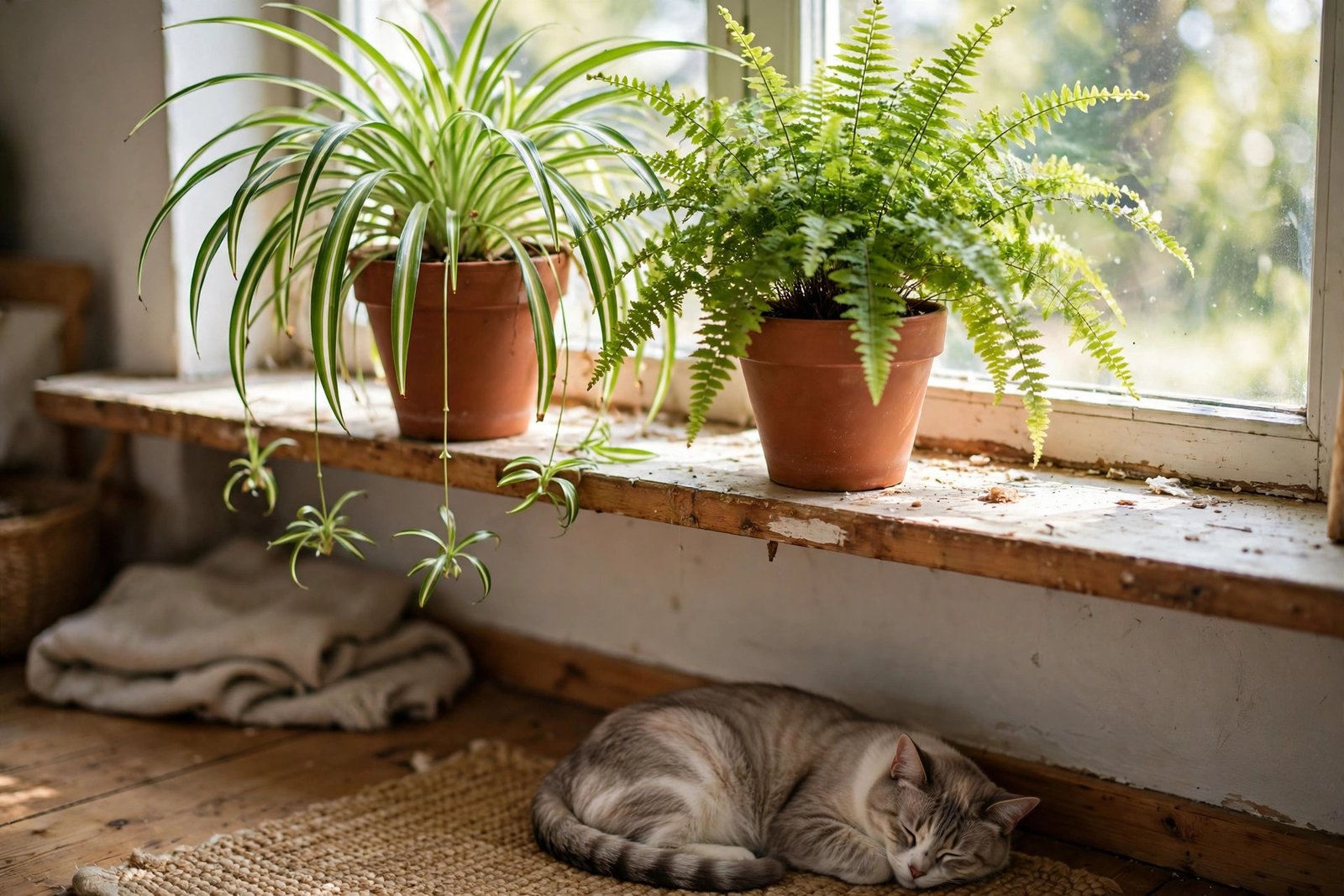
Cat friendly plant care for beginners means looking after two living things at once: your plants and your cat. You do not need to be an expert gardener — just a short list of forgiving plants, a simple watering routine, and a few habits that keep a curious cat from turning your windowsill into a salad bar.
This guide covers choosing safe plants, watering and lighting them, placing them out of reach, and knowing what to do if your cat chews one. Cat friendly plant care for beginners starts with the plant you choose.
The Short Answer
Start with one or two plants the ASPCA lists as non-toxic — a spider plant or a Boston fern is a good first choice. Check the botanical name on the label against the ASPCA plant list before you buy. Water only when the top inch of soil feels dry, give bright indirect light, and put the plant where your cat cannot easily reach it. Offer a pot of cat grass.
If your cat eats a plant and you are not sure it is safe, call your veterinarian or poison control promptly — do not wait for symptoms. That is the heart of cat friendly plant care for beginners: check first, then enjoy the plant.
Step 1: Check the Plant Before You Buy It
The most important beginner habit is checking a plant’s safety before it comes home. Cat friendly plant care for beginners begins in the shop, not on the windowsill.
Get the Botanical Name
Every plant has a common name, such as “palm,” and a botanical name, such as Chamaedorea elegans for the parlor palm. Safety listings follow the botanical name; common names are unreliable. A “palm” could be a non-toxic parlor palm or a highly toxic sago palm; a “lily” could be a peace lily, which irritates the mouth, or a true lily (Lilium species), which can cause life-threatening kidney failure from even a tiny nibble. That is why cat friendly plant care for beginners always starts with the Latin name on the label.
Read the label for the Latin name in italics. If the label gives only a common name, ask the seller. If nobody can tell you, do not buy the plant. For the full lily guide, see Are Lilies Toxic to Cats? Types, Exposure Risks, and Urgent Steps.
Check the ASPCA List
Search the botanical name on the ASPCA plant list for cats. Do not rely on the shop tag or a gardening site; check the name yourself before the plant comes home.
Cat friendly plant care for beginners gets much easier once this check becomes a habit — it takes about a minute. For the plants most often involved in cat poisonings, see Common Houseplants That Are Toxic to Cats: What to Avoid.
Remember What “Non-Toxic” Means
Non-toxic does not mean safe to chew. It means the ASPCA has found no compounds in the plant known to poison cats — but a cat that eats a lot of any plant material can still get stomach upset. Cat friendly plant care for beginners means protecting both sides: the cat from the plant, and the plant from the cat.
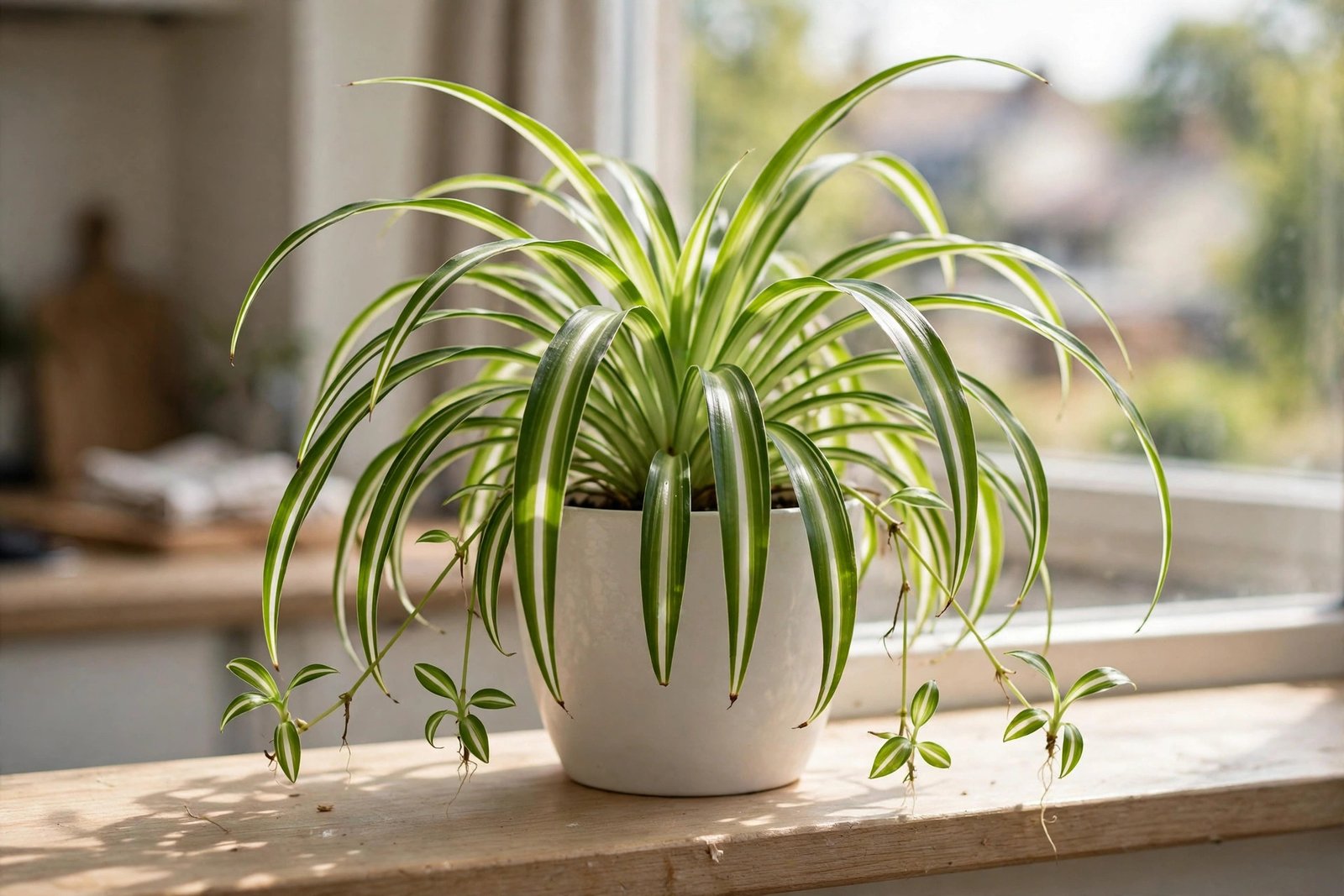
Five Easy First Plants for Cat Owners
Each is listed by the ASPCA as non-toxic to cats. Buy one or two to start, not five at once. Cat friendly plant care for beginners works best when you learn one plant at a time.
Spider plant (Chlorophytum comosum). The classic beginner plant. It tolerates missed waterings, grows fast, and produces small plantlets on arching stems. It likes bright indirect light. Cat friendly plant care for beginners often starts here, because the spider plant forgives almost everything except constant soggy soil. See Are Spider Plants Safe for Cats? Benefits, Risks, and Care Tips.
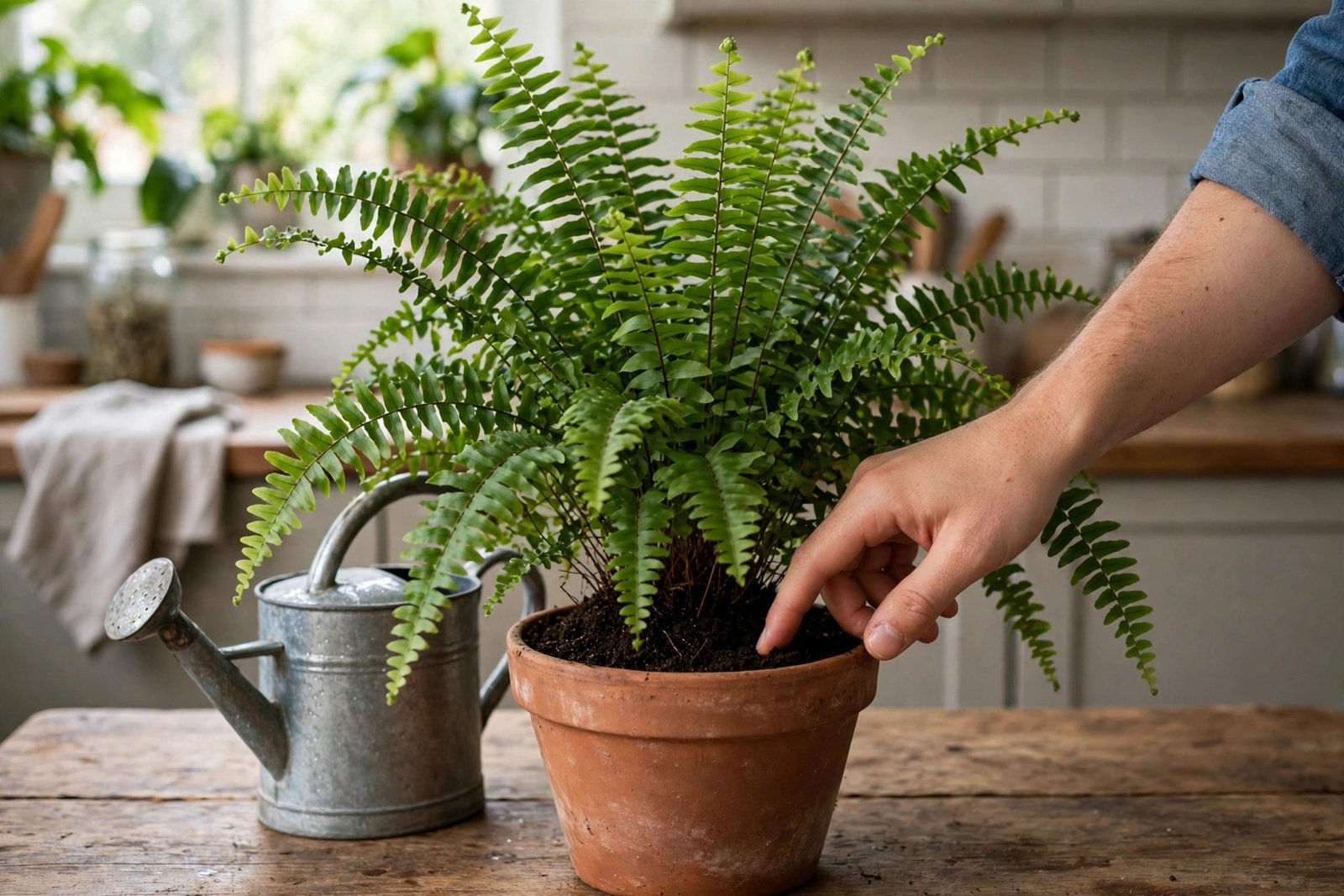
Boston fern (Nephrolepis exaltata ‘Bostoniensis’). A full, feathery fern that likes humidity and evenly moist soil. Keep it away from dry, hot air, which turns the fronds brown. Cat friendly plant care for beginners suits the Boston fern well: brown frond tips mean the air is too dry.
Parlor palm (Chamaedorea elegans). A slow-growing palm that tolerates low light better than most houseplants. Water when the top inch of soil is dry.
African violet (Saintpaulia spp.). The best flowering option for a beginner. It blooms for months on a bright windowsill and needs only light watering at the soil edge.
Haworthia (Haworthia spp.). A small, tough succulent for a bright windowsill. Let the soil dry out fully between waterings. Do not confuse it with aloe vera, which is toxic to cats.
The Basics: Light, Water, Soil, and Feeding
Most beginner plant deaths come from the same two mistakes: too much water and too little light. Cat friendly plant care for beginners is mostly about these two basics.
Light
Most houseplants want bright, indirect light — near a window, but out of harsh direct sun. An east-facing window is a good default. Cat friendly plant care for beginners means matching each plant to its light needs first, and only then choosing the spot your cat cannot reach.
Water
Water less than you think — the most common beginner mistake is watering on a fixed schedule. Push a finger an inch into the soil: if it feels dry, water until it runs from the drainage holes; if it still feels damp, wait.
Never let a pot sit in standing water — roots rot in soggy soil, and root rot is hard to reverse. Cat friendly plant care for beginners improves fast once you trust your finger more than the calendar.
Soil, Pots, and Feeding
Use ordinary houseplant potting mix and a pot with drainage holes — a pot without holes traps water and kills the plant.
Feed lightly only in spring and summer: a balanced liquid fertilizer diluted to half strength, about once a month, is enough. Do not feed in winter, or a sick or newly repotted plant. Cat friendly plant care for beginners keeps feeding simple: a little, in the growing season, never as a fix for a struggling plant.
Quarantine New Plants
Many new plants are treated with pesticides before sale. Quarantine the plant in a room your cat cannot enter for one to two weeks. Check the leaf undersides for insects or webbing. Cat friendly plant care for beginners includes this quiet waiting period, because a new plant should prove itself safe before it joins the living room. For the full introduction routine, see Introducing Houseplants to Cats: How to Do It Safely at Home.
Keeping Your Cat and Your Plants Safe Together
Cats chew houseplants as part of normal investigation and play, or because they crave vegetable matter, according to Cornell’s Feline Health Center. Cat friendly plant care for beginners is not about stopping the curiosity — it is about giving it a safe outlet.
Place Plants Where Cats Cannot Easily Reach Them
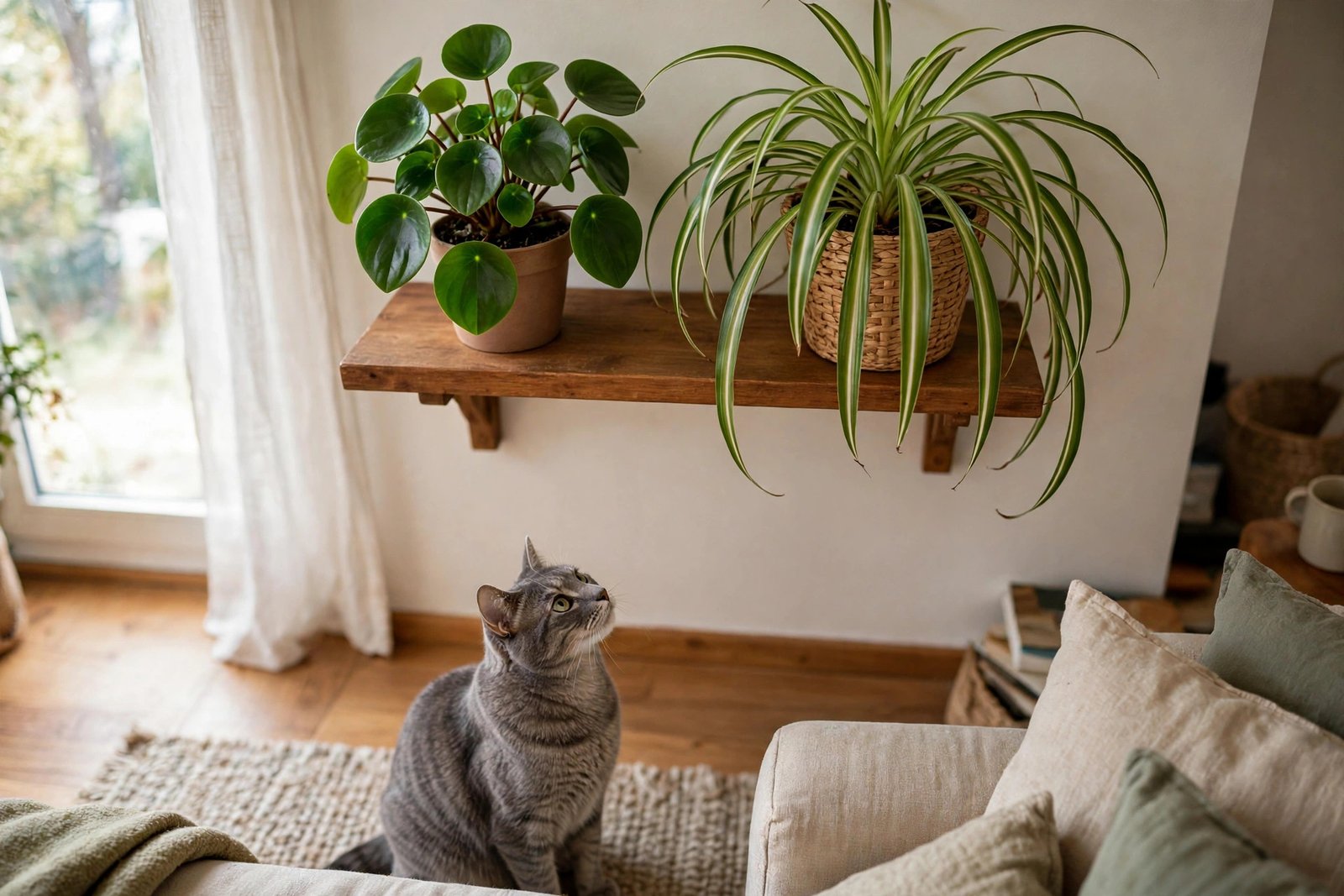
Placement is the simplest protection. Once you know the light a plant needs, look for the hardest spot for your cat to reach in that light zone — a high shelf, a hanging planter, or a room the cat rarely enters. For more ideas, see Where to Place Houseplants in a Home With Cats.
Use a heavy outer pot or a wide tray so a curious paw cannot tip a small pot over. Cat friendly plant care for beginners means checking the spot from the cat’s point of view: if a chair or bookcase is nearby, your cat can probably reach it. Cover the soil with large stones too big to swallow — never small pebbles or cocoa shell mulch, which is toxic to pets. Cat friendly plant care for beginners often comes down to small fixes like this.
Offer Cat Grass
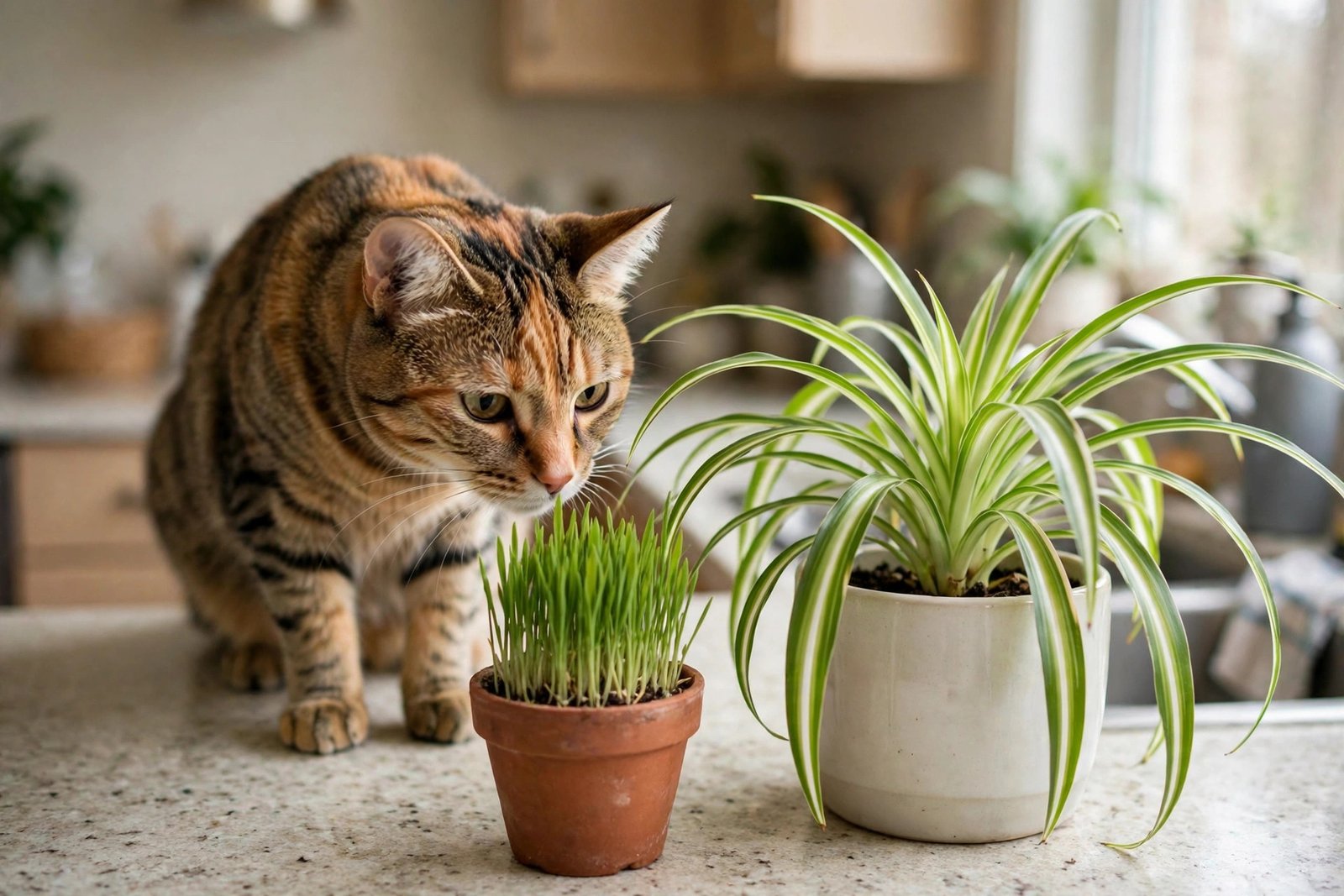
A pot of cat grass — young wheat, oat, barley, or rye grass grown from untreated seed — gives your cat a plant it is allowed to chew. Place it next to the houseplant your cat targets most, and when you catch the cat chewing the houseplant, move it calmly to the grass. For the full guide, see Cat Grass vs. Houseplants: What Cat Owners Should Know.
Cat friendly plant care for beginners works better with a decoy plant than with a scolding — a cat with its own grass is far less interested in your spider plant.
Redirect, Do Not Punish
Cornell is clear that cats do not respond well to punishment: they see no link between the punishment and the behavior, so it only teaches fear — and the cat chews when you are not watching. Redirect calmly to a scratching post or the cat grass.
Add a daily ten-minute play session — cat friendly plant care for beginners includes playtime, because a tired cat leaves your plants alone.
Cornell notes that even with cat grass offered, a cat may still snack on houseplants. The only guaranteed protection is blocking access — a closed door or a room the cat cannot enter.
Common Beginner Mistakes
Most new plant owners make the same few mistakes — cat friendly plant care for beginners is mostly a matter of unlearning a few habits that feel helpful but are not.
| Mistake | Why it causes trouble | What to do instead |
|---|---|---|
| Buying on looks alone | The plant may be toxic and you will not know it | Check the botanical name on the ASPCA list first |
| Punishing the cat for chewing | The cat learns fear, not avoidance, and chews when you are away | Redirect calmly to cat grass or a toy, and reward the right choice |
What to Do If Your Cat Chews a Plant
If your cat chews a plant and you are not sure the plant is safe, treat it as an exposure and act promptly — cat friendly plant care for beginners includes knowing these steps before you need them.
First, move the plant out of reach and pick up any fallen leaves. If there is plant material in your cat’s mouth, remove it only if you can do so safely.
Second, call your veterinarian or poison control promptly. In the United States, the ASPCA Animal Poison Control Center is available at (888) 426-4435, and Pet Poison Helpline is available at (855) 764-7661. Be ready to share the plant’s name or a photo, which part your cat ate, and how much and when. Do not wait for symptoms before calling, and do not induce vomiting unless a veterinarian directs you to.
Third, watch your cat closely for the next few hours, indoors in a quiet room with fresh water available. If the cat vomits repeatedly, drools heavily, seems lethargic, or has difficulty breathing, contact a veterinarian again immediately. Do not try a home remedy, do not give milk, oil, or activated charcoal, and do not try to make your cat vomit.
Frequently Asked Questions
What is the easiest cat-safe plant for a complete beginner?
A spider plant (Chlorophytum comosum). It is listed by the ASPCA as non-toxic to cats, tolerates missed waterings, grows fast in bright indirect light, and tells you when it needs water — the leaves go pale and limp. Cat friendly plant care for beginners often starts with this one plant, because it forgives almost every beginner mistake. A Boston fern is a good second choice for a bright, humid bathroom window.
How often should I water my houseplants?
There is no single schedule. Check the soil with your finger about an inch deep: if it feels dry, water thoroughly and let the excess drain away; if it still feels damp, wait. Cat friendly plant care for beginners means watering by feel, not by the calendar.
Why does my cat chew my houseplants?
Chewing is usually normal investigation and play, or a sign the cat is craving vegetable matter, according to Cornell. Offer cat grass, add a daily play session, and move targeted plants out of easy reach.
Can I keep a toxic plant if my cat never chews plants?
It is still a risk. Cats change: a cat that ignores plants for years may start chewing after a move or a new routine. Toxic plants — especially true lilies and daylilies — should not be in a home with a cat at all.
What should I do first if my cat eats a plant I have not identified?
Treat it as an exposure. Move the plant out of reach, keep the label or take a photo, and call your veterinarian or poison control promptly — the ASPCA Animal Poison Control Center at (888) 426-4435, or Pet Poison Helpline at (855) 764-7661. Do not wait for symptoms, do not try a home remedy, and do not try to make your cat vomit.
Conclusion
Cat friendly plant care for beginners is simpler than it looks: start with one or two plants the ASPCA lists as non-toxic, check the botanical name before you buy, water only when the soil is dry, give bright indirect light, and place plants out of easy reach. Add a pot of cat grass your cat is allowed to chew, and redirect calmly when the cat targets the wrong one.
Start today with one plant — a spider plant on a bright windowsill is the easiest first step. Check its label, look it up on the ASPCA list, and put a pot of cat grass beside it. Cat friendly plant care for beginners is a habit that gets easier every time you repeat it.
Disclaimer: This article is for general information only and does not replace advice from a veterinarian. If your cat eats a plant and seems unwell, contact your veterinarian or an animal poison control service promptly.
Sources and References
- ASPCA Animal Poison Control Center. “Toxic and Non-Toxic Plant List — Cats.” The searchable database used to check plant toxicity listings for cats by botanical name, including Spider Plant (Chlorophytum comosum), Boston Fern (Nephrolepis exaltata ‘Bostoniensis’), Parlor Palm (Chamaedorea elegans), African Violet (Saintpaulia spp.), and Haworthia (Haworthia spp.). https://www.aspca.org/pet-care/animal-poison-control/cats-plant-list
- ASPCA Animal Poison Control Center. “Toxic and Non-Toxic Plants.” The ASPCA database used to check plant toxicity listings, including the note that eating any plant material may cause vomiting and stomach upset. https://www.aspca.org/pet-care/animal-poison-control/toxic-and-non-toxic-plants
- Cornell University College of Veterinary Medicine, Cornell Feline Health Center. “Feline Behavior Problems: Destructive Behavior.” Cats that chew houseplants are usually indoor cats with little access to grass; chewing is usually normal investigation and play, or a sign the cat is craving vegetable matter; the only guaranteed protection is blocking access; cats do not respond well to punishment. https://www.vet.cornell.edu/departments-centers-and-institutes/cornell-feline-health-center/health-information/feline-health-topics/feline-behavior-problems-destructive-behavior
- Cornell University College of Veterinary Medicine, Cornell Feline Health Center. “Common Cat Hazards.” Advises calling a veterinarian immediately after a suspected toxic ingestion and warns not to induce vomiting unless specifically directed to do so; notes lilies are especially toxic to cats and can cause life-threatening kidney failure even in tiny amounts. https://www.vet.cornell.edu/departments-centers-and-institutes/cornell-feline-health-center/health-information/feline-health-topics/common-cat-hazards
- Pet Poison Helpline. “Cat Poisoning: What to Do.” Guidance on gathering the plant name, the part eaten, the amount, and the time of exposure before calling, and on not inducing vomiting without veterinary direction. https://www.petpoisonhelpline.com/poison/cat-poisoning/
1 thought on “Cat Friendly Plant Care for Beginners: A Practical Guide”