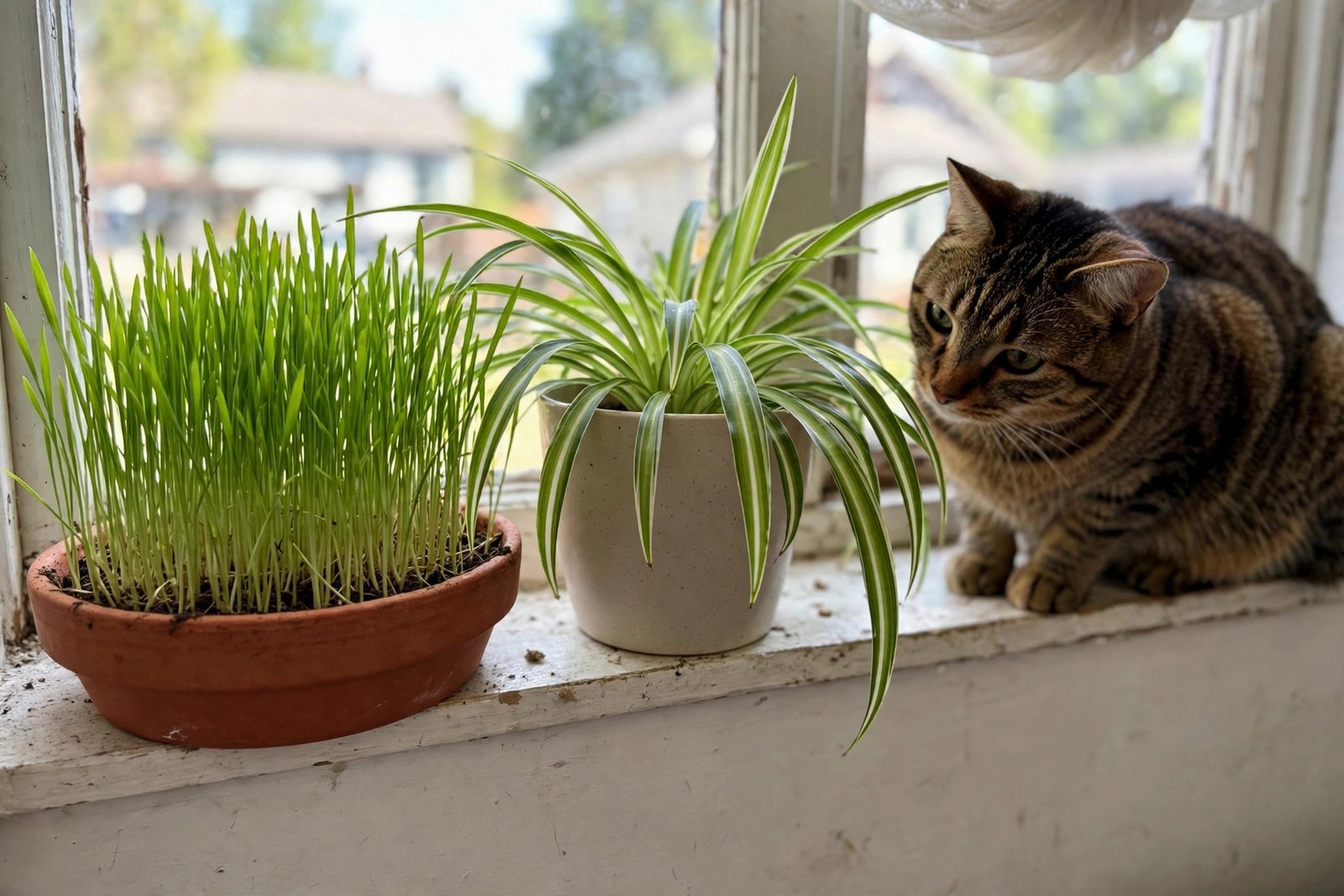
Cat grass is young cereal grass grown for your cat to nibble. Houseplants are grown for you to look at. That is the whole difference: an indoor cat that wants greens will chew whatever is green and within reach. Give it a pot it is allowed to eat, and your other plants stand a much better chance.
That simple swap is the heart of cat grass vs houseplants. A cat with its own grass is less likely to strip your spider plant. It costs a few dollars of seed and takes about a week to grow. It will not fix every chewing problem or make a toxic plant safe — but for many cats it is the simplest change that helps.
The Short Answer
Cat grass is young wheat, oat, barley, or rye grass, grown indoors from untreated seed. Offer it next to the plant your cat chews most, and replace it every few weeks.
Houseplants are not a substitute: a lot of any plant material can upset a cat’s stomach. In the cat grass vs houseplants comparison, the grass is the plant your cat may eat. Not sure a plant is safe? Check the ASPCA plant list first — see Common Houseplants That Are Toxic to Cats: What to Avoid.
What Cat Grass Actually Is
Cat grass means young cereal grass seedlings: usually wheat (Triticum aestivum), oat (Avena sativa), barley (Hordeum vulgare), or rye (Secale cereale). Seed packets sold as “cat grass” usually contain one of these, or a mix.
First, there is no single ASPCA entry for “cat grass” — it is a group of cereal grasses, not one plant. The grasses are widely regarded as non-toxic — but still buy untreated seed. Second, cat grass is not catnip: catnip (Nepeta cataria) affects behavior through nepetalactone, while cat grass is eaten for texture and fiber.
How Cat Grass Differs From a Houseplant
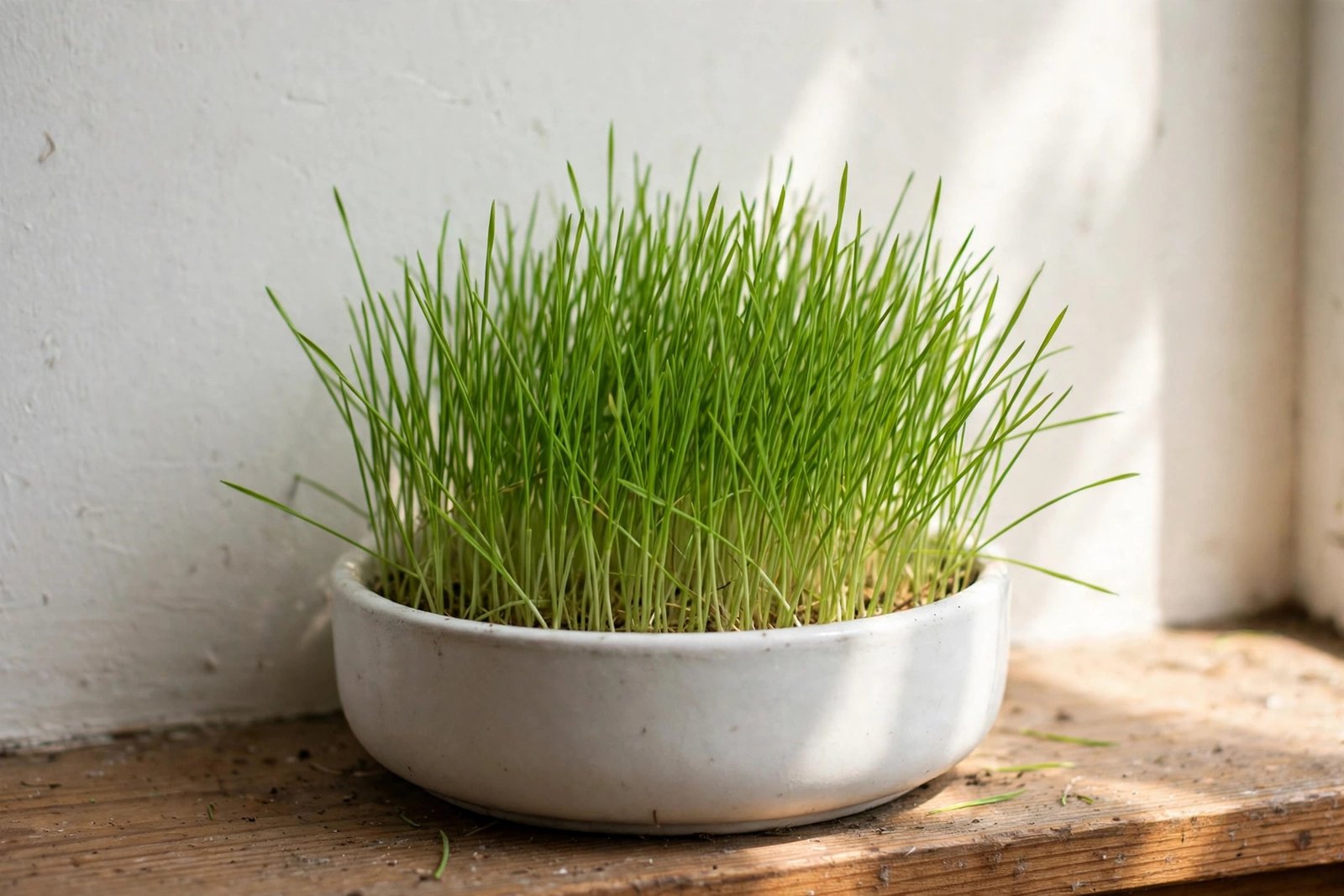
A houseplant is chosen for looks, bought once, and lives for months or years. Cat grass is chosen to be eaten, bought as seed, and lasts two to four weeks.
Cat grass grows differently: shallow, wide container, plain potting soil with no fertilizer, bright light, watered lightly. The cat eats it, so nothing goes on it that the cat should not swallow. That rule is the clearest line in cat grass vs houseplants: one plant is food, the other is decoration.
Why Cats Want Greens
Cats that chew houseplants are usually indoor cats with little access to grass. Cornell’s Feline Health Center notes chewing is usually normal investigation and play, or a craving for vegetable matter.
Owners often assume a cat eats grass because it is sick. The reasons are not fully understood, and eating grass alone does not prove illness or a hairball problem.
Boredom is a real driver: a cat left alone will find its own entertainment, and a plant is an excellent toy — it rustles, it moves when batted, and chewing it gets a reaction. Stress plays a part, too: a new pet, a move, or a change in routine can make an anxious cat return to chewing. Understanding that motive is the first step in cat grass vs houseplants. A calm cat with something safe to chew is the goal of cat grass vs houseplants.
Cat Grass vs. Houseplants
| Cat grass | Houseplant | |
|---|---|---|
| Grown for | Your cat to chew and nibble | You to look at |
| What it is | Young wheat, oat, barley, or rye | A decorative plant |
| Lifespan in the pot | 2 to 4 weeks | Months to years |
| If a cat eats a lot | Mild stomach upset possible | Upset if non-toxic; poisoning if toxic |
| Cost to replace | A few dollars of seed | The plant, the pot, and the mess |
| Care | Bright light, light watering | Varies by species |
| Role in the home | The plant your cat may eat | The plant you want to protect |
A spider plant (Chlorophytum comosum) is a houseplant a cat can nibble without being poisoned — see Are Spider Plants Safe for Cats? Benefits, Risks, and Care Tips — but it is not a chewing target. Read the table as a plan, and cat grass vs houseplants becomes simple: one pot of grass for the cat. Neither side replaces the other — that balance is what cat grass vs houseplants is really about.
How to Grow Cat Grass Indoors
Growing cat grass is easy: seed to nibbling takes about 7 to 10 days.
What You Need
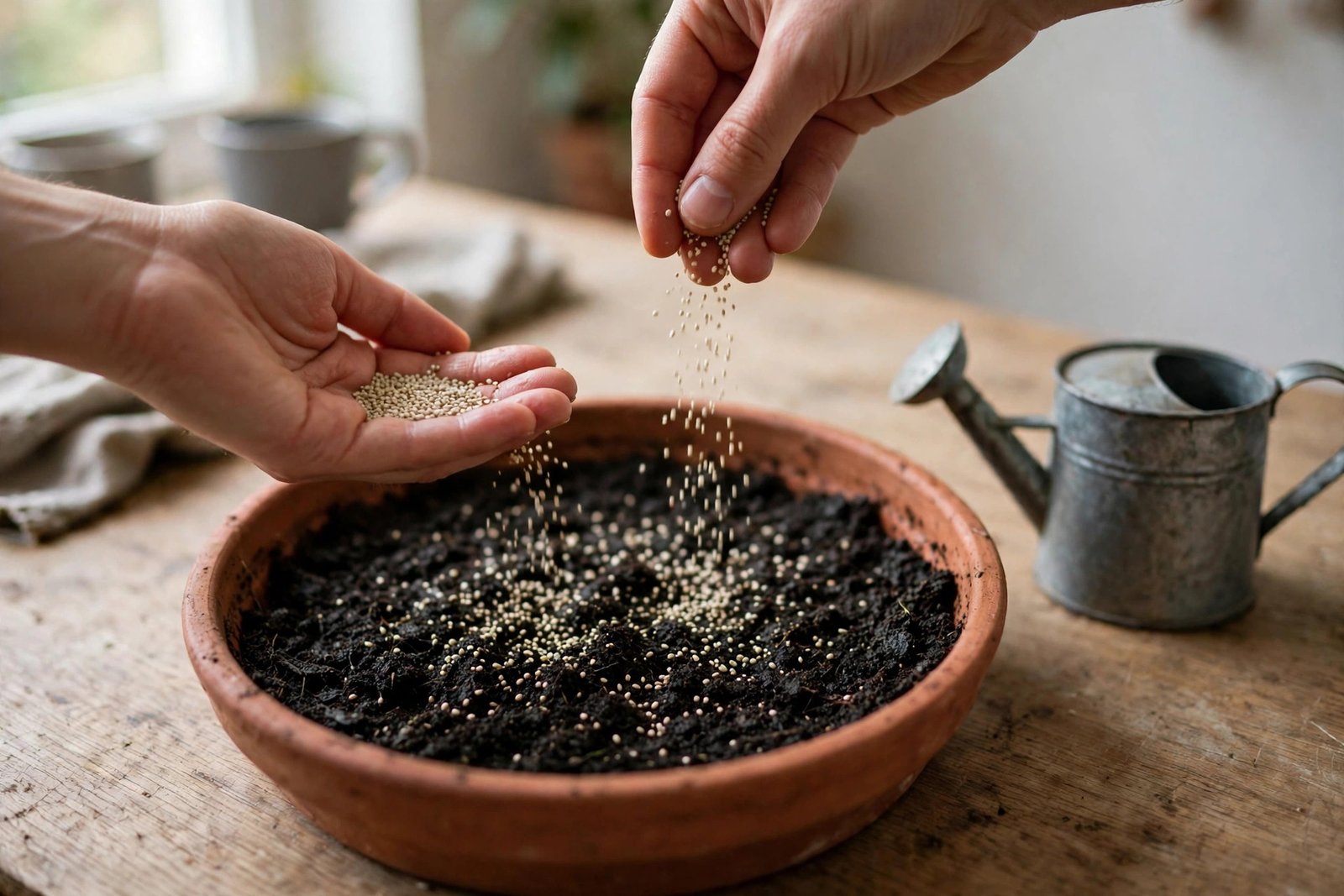
A shallow, wide container with drainage holes, plain potting soil with no fertilizer, untreated cat grass seed (wheat, oat, barley, or rye), and a bright windowsill. Buy seed sold for cats or sprouting, and check the packet says untreated. The seed is the safety story in cat grass vs houseplants.
Step by Step
First, fill the container with damp soil. Scatter the seed thickly, press it in, and cover lightly.
Second, water gently until the soil is damp through. Cover loosely with plastic wrap for two or three days, lifting it daily.
Third, move the container to bright, indirect light. Within a week, your cat has something safe to chew — the best part of cat grass vs houseplants.
Keeping It Going
Offer the grass young and tender. Grow two pots in rotation, so one is always fresh.
In cat grass vs houseplants, placement is half the job: a sunny, visible spot makes the grass the obvious choice. Fresh seed, fresh soil, and a clean pot keep cat grass vs houseplants safe week after week.
Using Cat Grass to Redirect Chewing and Digging
Cat grass works best as a redirect in cat grass vs houseplants, not a cure.
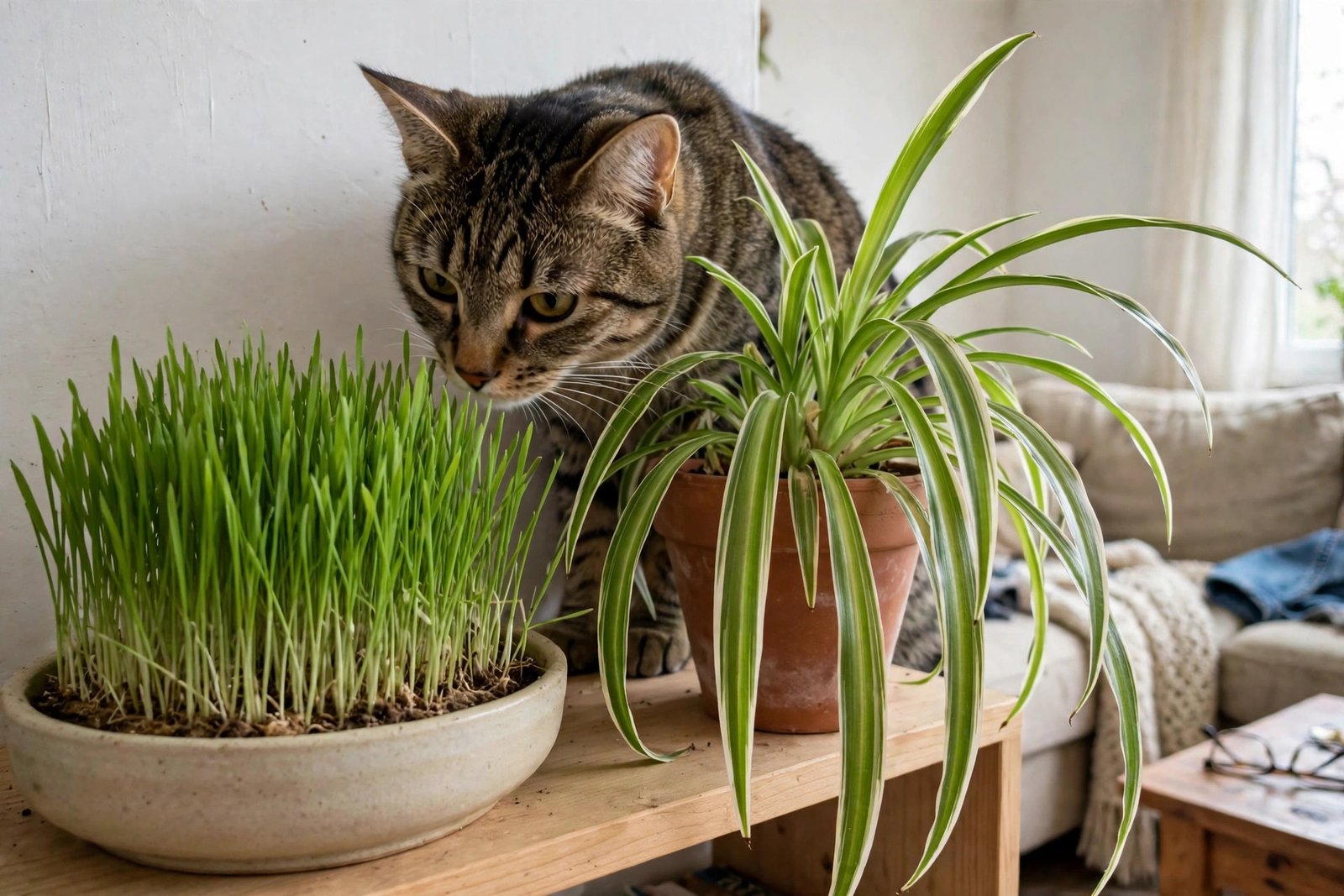
Place the pot of cat grass next to the houseplant your cat chews most. When you catch the cat chewing the houseplant, move it calmly to the cat grass. Reward the right choice — a treat, a stroke, or play. Cornell is clear that cats do not respond well to punishment.
Cat grass also helps with digging: a cat that digs in pots often chews leaves too. For the full digging guide, see How to Stop Cats From Digging in Houseplant Soil.
Cornell notes that even with oat grass, catnip, and catmint offered, a cat may still snack on houseplants. Cat grass reduces chewing; it does not guarantee it stops. The only guaranteed protection is blocking access. For the full chewing guide, see How to Discourage Cats From Chewing Houseplant Leaves. Add a short play session each day. That is the part of cat grass vs houseplants that has nothing to do with plants. If one cat monopolizes the grass, grow a second pot in another room — that is how cat grass vs houseplants turns from a tip into a routine.
Other Safe Greens
Cat grass is the main option, but it is not the only green a cat can have.
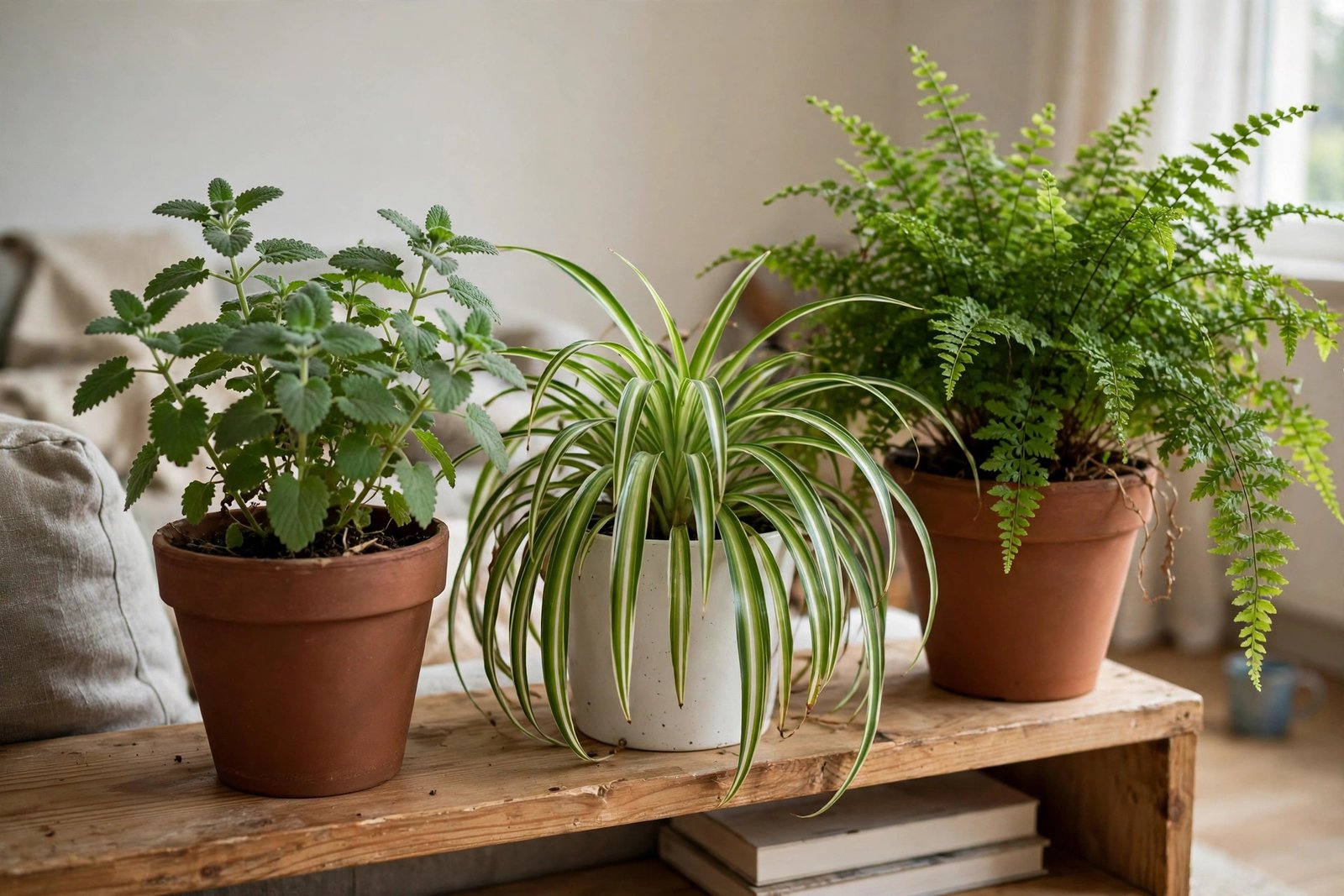
Catnip and catmint are the other two plants Cornell names. Here the sources do not fully agree — worth stating plainly. Cornell recommends catnip and catmint. The ASPCA database, however, files catnip (Nepeta cataria) as toxic to cats: nepetalactone can cause vomiting and diarrhea, and makes some cats sedated and others stimulated. That is a mild, dose-related effect, not a poisoning emergency. Offer catnip in small amounts, as a treat or toy, not as a plant to graze on freely. If your cat vomits after catnip, stop offering it and ask your veterinarian.
This split is the one honest complication in cat grass vs houseplants: Cornell points owners toward catnip, and the ASPCA files it as toxic. Neither source is wrong — they describe different amounts and reactions. The safe way through is small amounts and close watching.
Lettuce or parsley in the food bowl is another option — ask your veterinarian first. A spider plant or a Boston fern (Nephrolepis exaltata) also works as a second target. See Are Boston Ferns Safe for Cats? A Complete Plant Guide. Keep the fern as decoration and the grass as food, and cat grass vs houseplants stays simple. Given a fair choice, cats pick the plant grown for them — the quiet proof behind cat grass vs houseplants.
What NOT to Do
Do not bring in grass from the lawn: it may carry pesticides, fertilizer, parasites, or bacteria from other animals. Only offer grass you grew indoors from untreated seed.
Do not fertilize cat grass: it is eaten within weeks, and fertilizer can upset a cat’s stomach. Pet Poison Helpline warns essential oils can pose a toxic risk to cats, which lack a liver enzyme to clear them.
Do not use cat grass as a reason to keep a toxic plant. A pot of cat grass next to a pothos, a monstera, or a peace lily does not make those plants safe. Toxic plants must be removed or kept in a room the cat cannot enter. True lilies (Lilium species) and daylilies (Hemerocallis species) are especially dangerous — even pollen or vase water can cause kidney failure.
Learn the exact types in Are Lilies Toxic to Cats? Types, Exposure Risks, and Urgent Steps. The safety line in cat grass vs houseplants: one pot of clean grass does not cancel out a toxic plant on the next shelf. For a fuller emergency guide, see What to Do If Your Cat Eats a Toxic Plant: A Safety Guide.
When Greens-Eating Signals a Bigger Problem
Most grass-eating is normal, but a sudden change deserves attention. Call your veterinarian if the chewing starts abruptly, especially with other changes: eating non-food items; repeated vomiting; eating less or drinking much more; hiding; or avoiding the litter box.
Eating soil, litter, or non-food items may signal pica — do not diagnose this yourself. Your veterinarian can check for underlying problems. When the pattern of cat grass vs houseplants shifts suddenly, treat the change, not the plant, as the signal. If your cat has chewed a toxic plant, or you are unsure what the plant was, contact your veterinarian or animal poison control promptly: the ASPCA Animal Poison Control Center at (888) 426-4435, or Pet Poison Helpline at (855) 764-7661. Do not wait for symptoms, try a home remedy, or make your cat vomit.
Frequently Asked Questions
Is cat grass safe for cats?
Yes, in the usual sense. Cat grass is young wheat, oat, barley, or rye grass grown indoors from untreated seed for cats to nibble. There is no single ASPCA entry for it, because it is not one species — but the grasses are widely regarded as non-toxic. The safety case in cat grass vs houseplants is straightforward.
What is the difference between cat grass and catnip?
Cat grass is a cereal grass (wheat, oat, barley, or rye) that a cat eats. Catnip (Nepeta cataria) is a mint-family herb that affects behavior through nepetalactone. They are not interchangeable. Offer catnip in small amounts — the ASPCA notes it can cause vomiting and diarrhea in some cats.
How long does cat grass last?
Usually two to four weeks. The grass is ready at 3 to 4 inches tall, about 7 to 10 days after sowing, and is chewed down or yellowing within a few weeks. That rotation is the practical answer to cat grass vs houseplants.
Will cat grass stop my cat from chewing my houseplants?
It helps many cats, but it does not guarantee it. Cornell notes a cat may still snack on houseplants. Cat grass works best with better placement and play: put the grass where the habit is, and move vulnerable plants out of reach. That honest limit is part of cat grass vs houseplants.
Why does my cat vomit after eating grass?
A small amount of vomiting after eating grass is common and usually not alarming — grass can irritate the stomach. Repeated vomiting, or vomiting with appetite loss, hiding, lethargy, or eating non-food items, is different: contact your veterinarian. Do not try a home remedy, and do not make your cat vomit. Frequent vomiting after grass is worth a vet visit — the one sign in cat grass vs houseplants that should never be ignored.
Conclusion
Cat grass and houseplants have different jobs. Cat grass is young cereal grass grown to be eaten, replaced every few weeks, and placed where your cat already chews. Houseplants are grown to be looked at, and even non-toxic ones are not a substitute for cat grass. What works: fresh cat grass next to the plant your cat targets, vulnerable plants out of reach, and a short play session each day. That three-part routine is the whole of cat grass vs houseplants in practice.
Start today: sow oat or wheat grass seed in plain, untreated soil, put it in bright light, and offer it at 3 to 4 inches. A week from now, your cat will have something safe to chew. That is the payoff of cat grass vs houseplants. Keep the grass fresh and toxic plants out of reach — that steady routine is what makes cat grass vs houseplants work month after month.
Disclaimer: This article is for general information only and does not replace advice from a veterinarian. If your cat eats a plant and seems unwell, vomits repeatedly, or starts eating non-food items, contact your veterinarian or an animal poison control service promptly.
Sources
- Cornell University College of Veterinary Medicine, Cornell Feline Health Center. “Feline Behavior Problems: Destructive Behavior.” Cats that chew houseplants are usually indoor cats with little access to grass; recommends oat grass, catnip, and catmint as alternatives; blocking access is the only guaranteed protection; warns that cats do not respond well to punishment. https://www.vet.cornell.edu/departments-centers-and-institutes/cornell-feline-health-center/health-information/feline-health-topics/feline-behavior-problems-destructive-behavior
- ASPCA Animal Poison Control Center. “Toxic and Non-Toxic Plants: Catnip.” Scientific name Nepeta cataria, additional common name Catmint; listed as toxic to cats, toxic principle nepetalactone; clinical signs vomiting and diarrhea, sedation or stimulation in some cats. https://www.aspca.org/pet-care/animal-poison-control/toxic-and-non-toxic-plants/catnip
- ASPCA Animal Poison Control Center. “Toxic and Non-Toxic Plants.” The ASPCA database used to check plant toxicity listings for cats; “cat grass” has no single entry because it is a group of cereal grasses rather than one species. https://www.aspca.org/pet-care/animal-poison-control/toxic-and-non-toxic-plants
- Cornell University College of Veterinary Medicine, Cornell Feline Health Center. “Common Cat Hazards.” Advises calling a veterinarian immediately after a suspected toxic ingestion and warns not to induce vomiting unless specifically directed to do so. https://www.vet.cornell.edu/departments-centers-and-institutes/cornell-feline-health-center/health-information/feline-health-topics/common-cat-hazards
- Pet Poison Helpline. “Essential Oils and Cats.” Essential oils can pose a toxic risk to cats, which lack a liver enzyme needed to clear them. https://www.petpoisonhelpline.com/uncategorized/essential-oils-cats/
4 thoughts on “Cat Grass vs Houseplants: What Cat Owners Should Know”