
A chewed spider plant, a pothos with ragged edges, a fern stripped to the stems — if you live with a cat and houseplants, you have probably seen the damage. If you want to stop cats chewing houseplant leaves, start with the safety question first, then give your cat something better to chew.
Most cats chew far less once they have something better to chew and the plants they should not touch are out of reach. The goal, when you stop cats chewing houseplant leaves, is not to punish the chewing out of your cat. It is to redirect it.
The Short Answer
First, check whether the plant is toxic. Then give your cat something safe to chew, such as cat grass, move vulnerable plants out of reach, and add play.
First, Check Whether the Plant Is Toxic
A cat that chews leaves will swallow some of what it chews, and if the plant is toxic, even a few bites can matter.
True lilies (Lilium species) and daylilies (Hemerocallis species) are especially dangerous — even pollen or vase water can cause kidney failure — and they should not be in a home with a cat at all. Learn the exact types in Are Lilies Toxic to Cats? Types, Exposure Risks, and Urgent Steps.
Pothos, monstera, philodendron, snake plants, and aloe vera are also listed as toxic, and hanging them does not make them safe. See Are Pothos Plants Toxic to Cats? Symptoms and Safer Alternatives.
If a plant is toxic, the safest answer is to rehome it or move it to a room your cat cannot enter. No spray or barrier makes a toxic plant safe to chew, and that is the first rule to remember when you stop cats chewing houseplant leaves in your home. For a fuller emergency guide, see What to Do If Your Cat Eats a Toxic Plant: A Safety Guide.
Also check the plant itself, not just the species: pesticide or leaf-shine spray on the leaves is a separate risk, and fertilizer in the pot can upset a cat’s stomach. That check is part of how you stop cats chewing houseplant leaves safely.
Why Cats Chew Houseplant Leaves
Chewing is not spite. Cornell University’s Feline Health Center notes that cats that chew houseplants are usually indoor cats with little access to grass, and that chewing is usually normal investigation and play — or a sign the cat is craving vegetable matter.
Instinct and Investigation
Cats explore the world with their mouths. A new leaf moves, smells green, and feels different from everything else in the room, so a cat may chew it once or twice just to find out what it is. Kittens chew the most, and teething can make chewing soothing. Most kittens outgrow the worst of it, so early steps to stop cats chewing houseplant leaves usually work best with kittens.
Craving Greens
Many cats actively want greens, and that craving is the starting point when you stop cats chewing houseplant leaves. Wild cats eat grass, and indoor cats often seek out the nearest green thing when they have no grass of their own. Cornell’s behavior guidance says that if your cat craves vegetable matter, you can provide alternatives such as oat grass, catnip, and catmint.
A cat that chews leaves every day is often telling you it wants something green to nibble. When you stop cats chewing houseplant leaves by offering cat grass first, you are answering that craving instead of fighting it.
Boredom, Attention, and Stress
A bored cat left alone for long hours will find its own entertainment, and a plant is an excellent toy. A new pet, a move, or a change in routine can also make a cat anxious, and anxious cats often return to repetitive behaviors such as chewing.
Chewing that starts suddenly, especially with other behavior changes, is worth taking seriously — see the section on when to call your veterinarian below.
Give Your Cat Something Better to Chew
Cornell is clear on the principle: the answer to destructive chewing is to redirect the behavior to something acceptable, not to punish it.
Grow Cat Grass
Cat grass is the single most effective fix when you stop cats chewing houseplant leaves. It is not a special species — it is young wheat, oat, barley, or rye grass grown in a pot for cats to nibble. Cornell specifically recommends oat grass, and cat grass kits are sold in pet stores and garden centers for a few dollars.
Grow it in a heavy, wide pot, keep the soil damp, and offer it when the blades are 3 to 4 inches tall, usually in 7 to 10 days. Place it near the plant your cat was chewing, and keep a fresh pot going — cat grass is usually eaten down within a week or two. Grow it without pesticides or fertilizer, using plain potting soil, so the grass you offer to stop cats chewing houseplant leaves is safe to nibble.

Offer Other Safe Greens
Catnip (Nepeta cataria) and catmint are also listed by Cornell as alternatives for cats that crave greens, and both are listed as non-toxic to cats, which makes them useful when you stop cats chewing houseplant leaves. Lettuce or parsley added to the food bowl is another option Cornell mentions — ask your veterinarian before changing your cat’s diet.
You can also keep a few non-toxic plants that cats enjoy nibbling. A spider plant (Chlorophytum comosum) is a classic: it is listed as non-toxic to cats, and many cats love its dangling leaves. A spider plant gives the cat a leaf it can nibble, which helps you stop cats chewing houseplant leaves on plants you want to protect.
See Are Spider Plants Safe for Cats? Benefits, Risks, and Care Tips. A Boston fern (Nephrolepis exaltata) is another forgiving, non-toxic option — see Are Boston Ferns Safe for Cats? A Complete Plant Guide.
Remember that “non-toxic” does not mean “safe to eat without limit”: eating a lot of any plant material can cause stomach upset.
Move the Plant Out of Reach
Cornell states it plainly: the only way to guarantee protection for both your houseplants and your cat is to block access to the plants. Blocking access is the simplest step to stop cats chewing houseplant leaves.
A plant on a high shelf, in a hanging planter, or in a room the cat cannot enter is a plant the cat cannot chew.
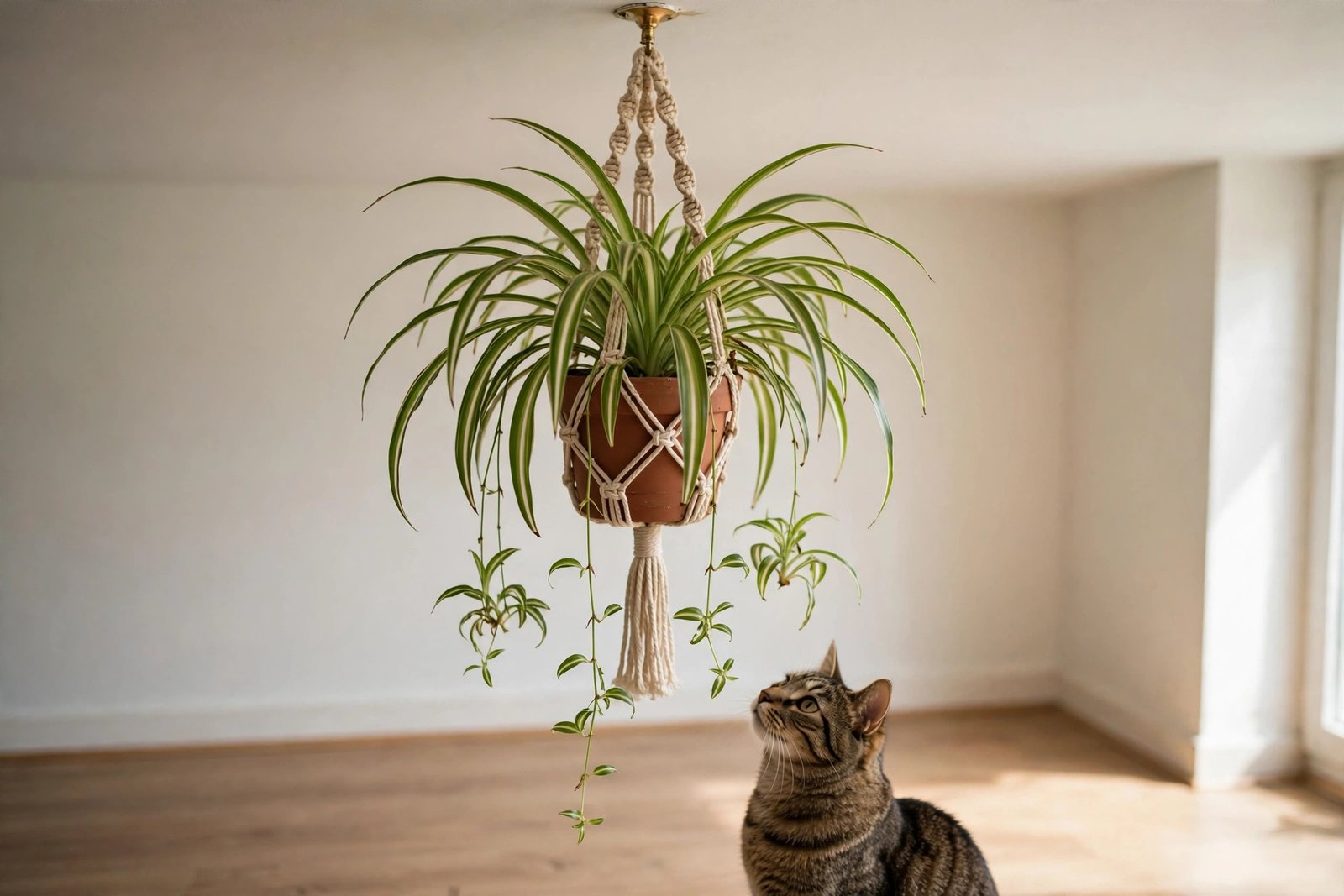
Hanging planters work well for trailing plants such as spider plants and Boston ferns. Wall-mounted shelves help too, but cats climb, so a shelf is only out of reach with no nearby launch pad.
The only fully reliable barrier is a closed door, and it is the surest way to stop cats chewing houseplant leaves on a toxic plant. If a cat is determined and the plant is toxic, a closed room is the answer — not a taller shelf. See Are Hanging Planters Safe in Homes With Cats? for setup details.
If moving the plant is not possible, a cloche, wire dome, or double-sided tape on the pot rim can keep paws off the leaves, and stones or mesh over the soil stop digging — see How to Stop Cats From Digging in Houseplant Soil.
Taste Deterrents: Use With Care
Bitter Apple Spray
The best-known option is bitter apple spray, whose active ingredient is usually denatonium benzoate — an intensely bitter compound considered safe for cats at labeled doses and widely recommended by veterinarians. That is why bitter apple spray is a backup, not the main way to stop cats chewing houseplant leaves. Spray it lightly on a non-toxic plant’s leaves, following the label exactly, and test one leaf first.
Reapply after watering. It does not work for every cat, and it does nothing about the reason your cat is chewing.
Never spray it on your cat or near its food and water, and do not use it on a toxic plant as a substitute for removing the plant.

What Counts as Cat-Safe
Use only products labeled for use as a pet deterrent when you stop cats chewing houseplant leaves, and read the label before you buy. A product labeled “pet-safe” should list its active ingredients and carry directions for use around cats specifically.
What NOT to Do
Do Not Punish the Cat
Cornell University’s Feline Health Center is clear: cats do not respond well to punishment, because they see no link between the punishment and the behavior. Yelling, squirting water, or startling your cat teaches it to fear you — and to chew when you are not watching. It can also lead to aggression. Redirect instead: move the cat calmly to the cat grass, and reward it for chewing the right thing — that redirection is how you stop cats chewing houseplant leaves without fear.
Do Not Use Essential Oils
Do not spray essential oils on leaves, put them in the soil, or use them in a diffuser near plants. Pet Poison Helpline warns that essential oils can pose a toxic risk to cats, because cats lack a liver enzyme needed to clear them. Oils known to cause poisoning in cats include wintergreen, sweet birch, citrus, pine, ylang ylang, peppermint, cinnamon, pennyroyal, clove, eucalyptus, and tea tree. Concentrated oils should never be applied to a cat, and “natural” does not mean safe for cats — a warning that matters when you stop cats chewing houseplant leaves.
Do Not Use Chili, Cayenne, or Mothballs
Chili powder, cayenne pepper, and hot sauce irritate a cat’s nose, eyes, and mouth, and a cat that grooms the powder off its paws will swallow it. Mothballs in the soil contain chemicals toxic to cats if chewed or inhaled. Skip chemical pest sprays as deterrents, too, and do not assume a commercial “pet repellent” spray is safe just because it is sold for pets — read the label first when you stop cats chewing houseplant leaves.
If you want to stop cats chewing houseplant leaves, a physical barrier and a safe alternative will always beat a painful or toxic deterrent.
Play and Enrichment
A cat that chews out of boredom needs more to do, not more barriers, and play is a key part of how you stop cats chewing houseplant leaves. Cornell recommends more play time — dangling ribbons, tossing ping-pong balls — and a “kitty condo” with crawl spaces, perches, or hanging catnip toys. A daily wand-toy session of ten to fifteen minutes can cut chewing noticeably within a week.

Rotate toys so they stay interesting, add a scratching post near the plants your cat targets, and keep a window perch available. A tired, busy cat chews less, which is why play helps you stop cats chewing houseplant leaves. This is also the fix for attention-seeking chewing: respond calmly, redirect to the cat grass, and reward chewing the right thing.
When Chewing Signals a Bigger Problem
But a sudden change deserves attention, and a plan to stop cats chewing houseplant leaves should include knowing when to call for help. Call your veterinarian if the chewing starts abruptly, especially with other changes: the cat eats non-food items such as fabric, plastic, or litter; vomits repeatedly; eats less or drinks much more than usual; hides; or stops using the litter box.
A cat that eats soil, litter, or other non-food items may be showing pica, which can have medical causes — including anemia, nutritional deficiencies, or gastrointestinal problems. Do not diagnose or treat this yourself, and do not delay a vet visit while you try to stop cats chewing houseplant leaves on your own. Your veterinarian can check for underlying problems and, if needed, refer you to a veterinary behaviorist.
If your cat has chewed a toxic plant, or you are unsure what the plant was, contact your veterinarian or animal poison control promptly: the ASPCA Animal Poison Control Center at (888) 426-4435, or Pet Poison Helpline at (855) 764-7661. A consultation fee may apply. Do not wait for symptoms, try a home remedy, or try to make your cat vomit. For a fuller guide, see What to Do If Your Cat Eats a Toxic Plant: A Safety Guide.
Frequently Asked Questions
Why does my cat chew my houseplants?
Most cats chew leaves because they are indoor cats with little access to grass, and chewing is normal investigation and play — or a sign the cat craves vegetable matter. Give the cat cat grass, move vulnerable plants out of reach, and add play time.
Is it okay to let my cat chew a spider plant?
A spider plant is listed as non-toxic to cats, so a few nibbles are not expected to poison your cat. Redirecting those nibbles to cat grass is a simple way to stop cats chewing houseplant leaves on that plant. Eating a lot of any plant material can cause stomach upset, so redirect chewing to cat grass.
Does bitter apple spray work on cats?
It works for many cats and not at all for others, so it is only one tool to stop cats chewing houseplant leaves. Bitter apple spray (denatonium benzoate) is considered safe for cats at labeled doses. Use it with cat grass and better placement — not as the only fix.
Can I use citrus peels or essential oils to keep my cat away from plants?
It is better not to, and avoiding oils is part of how you stop cats chewing houseplant leaves safely. Citrus oils are among the essential oils Pet Poison Helpline lists as known to cause poisoning in cats, and cats lack a liver enzyme needed to clear them. Concentrated oils should never be applied to a cat or its plants.
Why is my cat suddenly chewing plants when it never did before?
A sudden change often points to a cause outside the plant: a new pet or person, a change in routine, boredom, or stress. If it comes with vomiting, appetite changes, or hiding, contact your veterinarian.
Conclusion
It comes down to three steps: check that the plant is not toxic, give your cat something safe to chew, and make the plants it should not touch harder to reach. Start today with one pot of cat grass, one plant moved higher, and one short play session.
Never use a deterrent that could harm your cat: no essential oils, no chili powder, no mothballs, and no punishment. If the chewing starts suddenly or comes with other behavior changes, call your veterinarian.
Disclaimer: This article is for general information only and does not replace advice from a veterinarian. If your cat has chewed or eaten a plant and seems unwell, or starts eating non-food items, contact your veterinarian or an animal poison control service promptly.
Sources and References
- Cornell University College of Veterinary Medicine, Cornell Feline Health Center. “Feline Behavior Problems: Destructive Behavior.” Cats that chew houseplants are usually indoor cats with little access to grass; recommends oat grass, catnip, and catmint as alternatives, blocking access as the only guaranteed protection, and commercial pet repellents; warns that cats do not respond well to punishment. https://www.vet.cornell.edu/departments-centers-and-institutes/cornell-feline-health-center/health-information/feline-health-topics/feline-behavior-problems-destructive-behavior
- Pet Poison Helpline. “Updates on Essential Oils.” Cats lack a liver enzyme needed to metabolize and eliminate essential oils; lists wintergreen, sweet birch, citrus, pine, ylang ylang, peppermint, cinnamon, pennyroyal, clove, eucalyptus, and tea tree oils as known to cause poisoning in cats; concentrated oils should never be applied to cats. https://www.petpoisonhelpline.com/blog/updates-on-essential-oils/
- ASPCA Animal Poison Control Center. “Toxic and Non-Toxic Plants.” The ASPCA database used to check plant toxicity listings for cats. https://www.aspca.org/pet-care/animal-poison-control/toxic-and-non-toxic-plants
- ASPCA. “Which Lilies Are Toxic to Pets?” True lilies and daylilies can be lethal to cats, including through pollen and vase water exposure. https://www.aspca.org/news/which-lilies-are-toxic-pets
- Cornell University College of Veterinary Medicine, Cornell Feline Health Center. “Common Cat Hazards.” Advises calling a veterinarian immediately after a suspected toxic ingestion and warns not to induce vomiting unless specifically directed to do so. https://www.vet.cornell.edu/departments-centers-and-institutes/cornell-feline-health-center/health-information/feline-health-topics/common-cat-hazards
3 thoughts on “How to Discourage Cats From Chewing Houseplant Leaves”