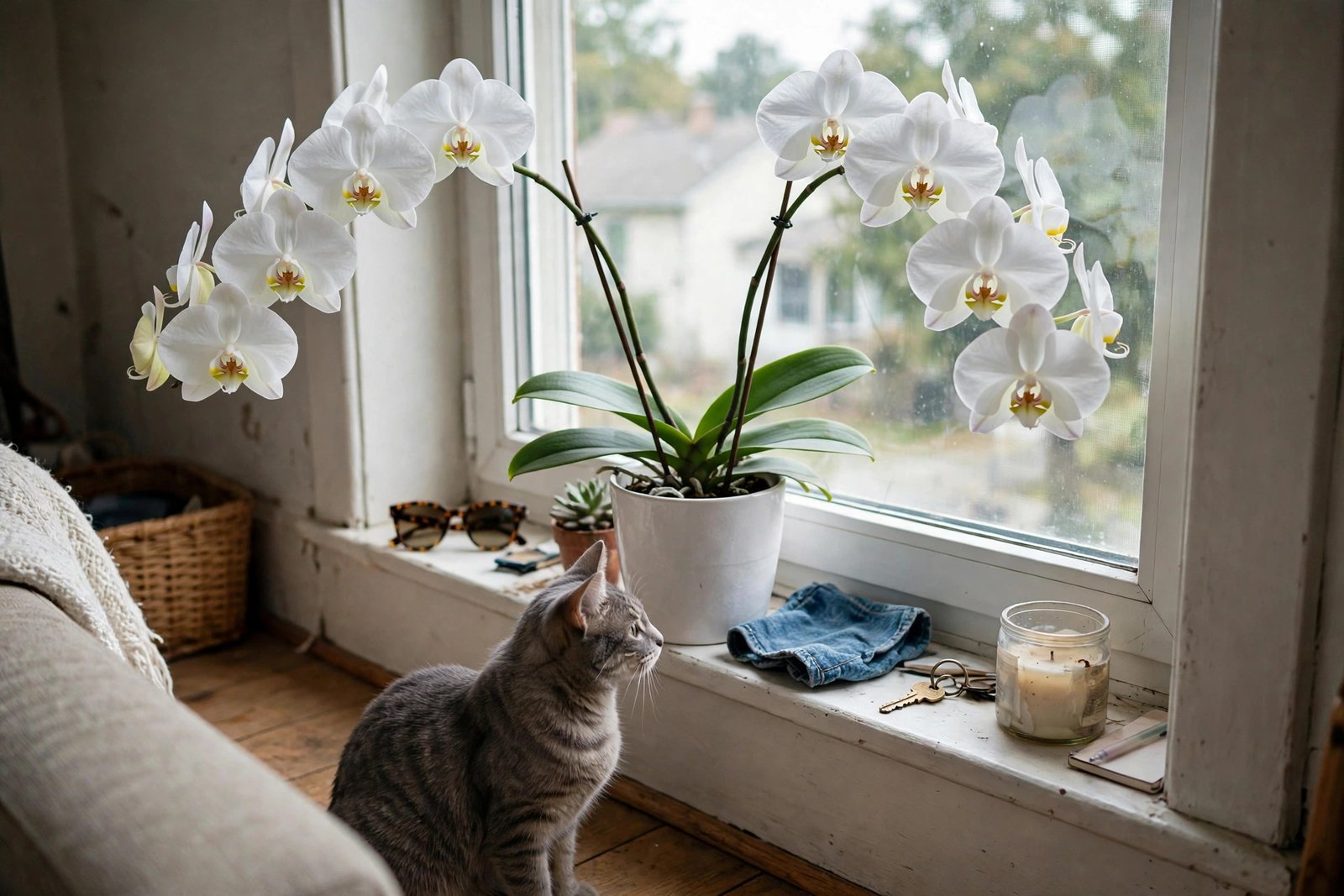
If you are asking are orchids safe for cats, the short answer is yes — with one honest caveat. The ASPCA Animal Poison Control Center lists the Phalaenopsis orchid, also called the moth orchid, as non-toxic to cats, dogs, and horses. That makes it one of the safest flowering houseplants for a home with cats.
Still, “non-toxic” and “safe to eat” are not the same thing. A cat that chews a lot of orchid leaves or petals can end up with mild stomach upset, even though no poison is involved. So are orchids safe for cats in every situation? Mostly yes — but the details matter if your cat is a determined chewer, or if the plant was recently sprayed or fertilized.
Are Orchids Safe for Cats?
When people ask are orchids safe for cats, the ASPCA entry is the first place to check. It lists the Phalaenopsis orchid under its scientific name, Phalaenopsis sp., in the family Orchidaceae, with the other common names moth orchid and moon orchid — and it lists no toxic principle, so no poison has been identified in the plant.
That is why the answer to are orchids safe for cats is yes in the toxicology sense. No part of a Phalaenopsis orchid — leaves, stems, flowers, or roots — is known to poison a cat. The ASPCA also notes that eating any plant material may cause vomiting and stomach upset, so a cat that eats a large amount can still vomit or have loose stools. That is a stomach reaction to fiber, not poisoning.
True lilies, by contrast, can cause kidney failure in cats from even a small exposure. For a direct comparison, read our guide to common houseplants that are toxic to cats and our guide to whether lilies are toxic to cats. The short version is simple: are orchids safe for cats has a reassuring answer, while the same question about lilies has a frightening one.
How to Identify a Moth Orchid
A moth orchid is an epiphyte, which means it grows on trees in nature rather than in soil. In a shop it is usually sold in a clear plastic pot filled with bark chips or sphagnum moss, with thick, fleshy green leaves in a flat rosette and one or two tall, arching flower spikes. The flowers look like moths at rest, which is where the common name comes from. Knowing what you are looking at is the first step, because are orchids safe for cats only applies when the plant really is an orchid.
Look for broad, smooth, dark green leaves, silvery-green aerial roots, and large, flat flowers with five petals and a small, brightly colored lip in the center. Common colors are white, pink, purple, and yellow. Once you can spot those features, are orchids safe for cats is a question you can answer about the right plant.
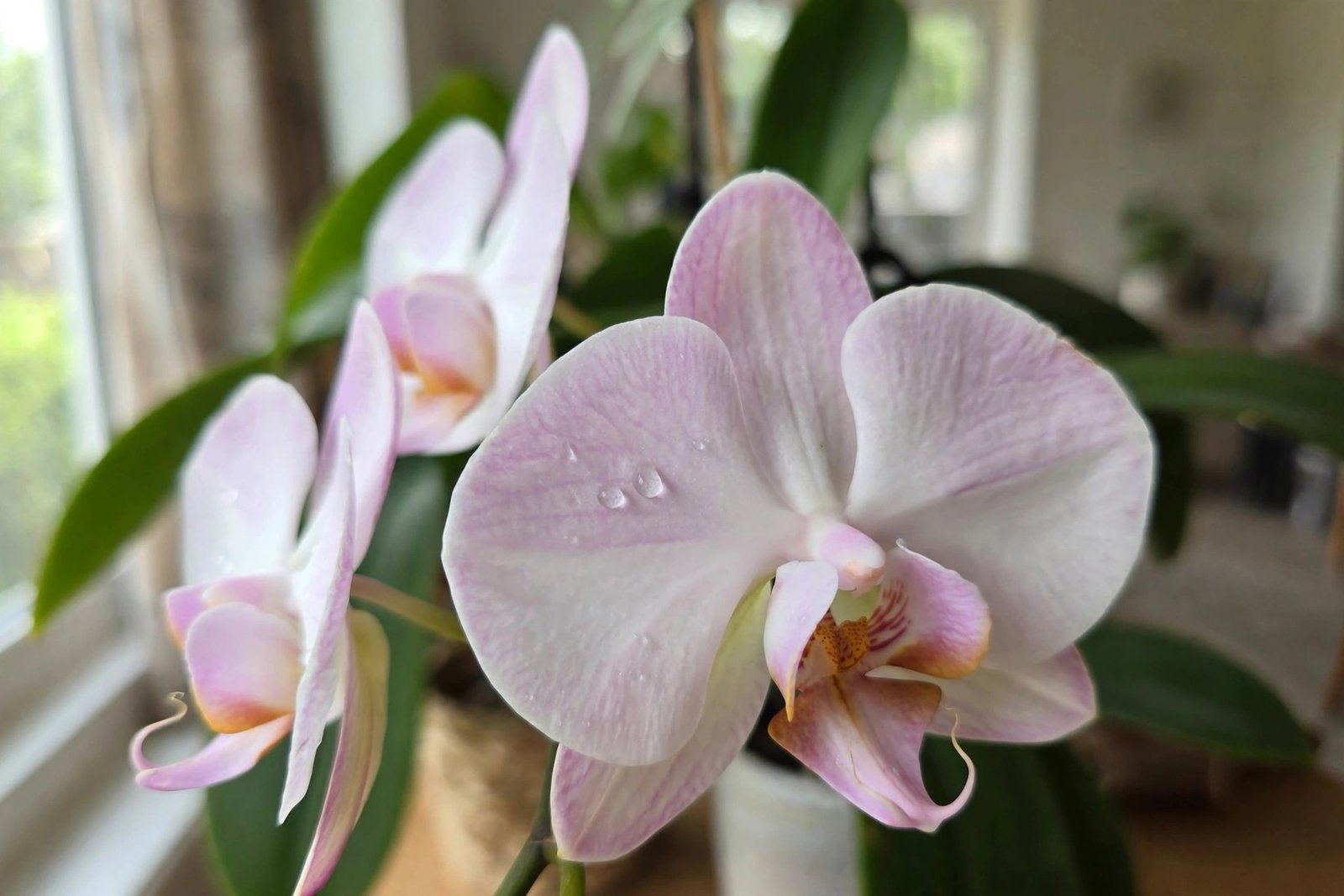
Check the botanical name before you buy: the label should say Phalaenopsis, the name the ASPCA listing covers. A nickname alone is not a safety check. Once the label matches, are orchids safe for cats is a question you can stop worrying about — and the botanical name is the first thing a veterinarian will ask for if your cat ever chews the plant.
Which Orchids Are Safe for Cats?
The orchid family, Orchidaceae, is one of the largest plant families in the world, with more than 25,000 species. Not every one has been individually tested, but the common houseplant orchids are widely listed as non-toxic by veterinary sources, which is why are orchids safe for cats is a question with a reassuring answer for the common types. The ASPCA database has a dedicated entry for the Phalaenopsis orchid.
| Orchid type | Common name | Safety for cats | Notes |
|---|---|---|---|
| Phalaenopsis sp. | Moth orchid | Non-toxic (ASPCA) | Most common; safest choice |
| Cymbidium sp. | Boat orchid | Widely listed as non-toxic | Common in bouquets |
| Dendrobium sp. | Dendrobium orchid | Widely listed as non-toxic | Check the exact species |
| Oncidium sp. | Dancing lady orchid | Small yellow flowers | |
| Cattleya sp. | Corsage orchid | Large fragrant flowers | |
| Cypripedium sp. | Lady slipper orchid | Caution advised | May upset stomachs |
If you want a guaranteed-safe orchid, ask for a Phalaenopsis by name. For the other genera, confirm the exact species with the seller and check it against the ASPCA list before you bring it home. That simple habit is what makes are orchids safe for cats a question with a reliable answer rather than a guess.
What Non-Toxic Does Not Mean
The most likely effect of eating orchid leaves or petals is mild digestive upset: drooling, vomiting, loose stools, or a short loss of appetite, most likely after a cat eats a large amount at once. In most cases the upset passes on its own. None of this changes the answer to are orchids safe for cats, which stays yes — but it is a yes with a chewing limit.
The pot is often a bigger risk than the plant. Bark chips, sphagnum moss, and perlite can block a cat’s digestive tract if swallowed in quantity, and the wire stake and clips that hold a flower spike upright can injure a mouth or throat. Keep the pot stable and heavy, and pick up loose bark from the floor.
The ASPCA listing covers the plant itself, not sprays or fertilizer. A treated plant can expose a cat to chemicals that are not part of the plant, so ask whether a new orchid has been treated and rinse the leaves with plain water before bringing it inside. Fertilizer residue on bark or leaves is a common hidden risk.
Symptoms to Watch For
If your cat chews on an orchid, watch for mild drooling, a single episode of vomiting, soft stools, or a temporary loss of appetite. These signs usually appear within a few hours and settle within a day, because the cause is fiber irritation rather than poisoning — which is why are orchids safe for cats is a yes even when a cat takes a bite. A cat that nibbles one petal and walks away will usually show no symptoms at all.
Watch for repeated vomiting, ongoing diarrhea, lethargy, hiding, or refusal to eat or drink. These are the signs that mean the question is no longer are orchids safe for cats, but whether your cat needs a vet. If you see them, or your cat has eaten a very large amount, contact your veterinarian or an animal poison control service promptly — do not wait, and do not try a home remedy. Never try to make a cat vomit unless a veterinarian tells you to. Kittens, elderly cats, and cats with a digestive condition need extra caution.
What to Do If Your Cat Chews an Orchid
Stay calm and check what your cat actually ate. If it was a leaf or a petal from a Phalaenopsis orchid, the answer to are orchids safe for cats is still yes: the plant itself is not poisonous, and most cats need nothing more than watching. Gently remove any plant material from your cat’s mouth if you can do so safely, and check whether the plant was recently sprayed or fertilized.
Watch your cat closely for the next 12 to 24 hours, keep fresh water available, and keep the orchid out of reach. If your cat vomits repeatedly, has ongoing diarrhea, becomes lethargic, or seems in pain, contact your veterinarian or the ASPCA Animal Poison Control Center at (888) 426-4435 right away. Have the plant’s botanical name ready when you call.
How to Display Orchids So Cats Leave Them Alone
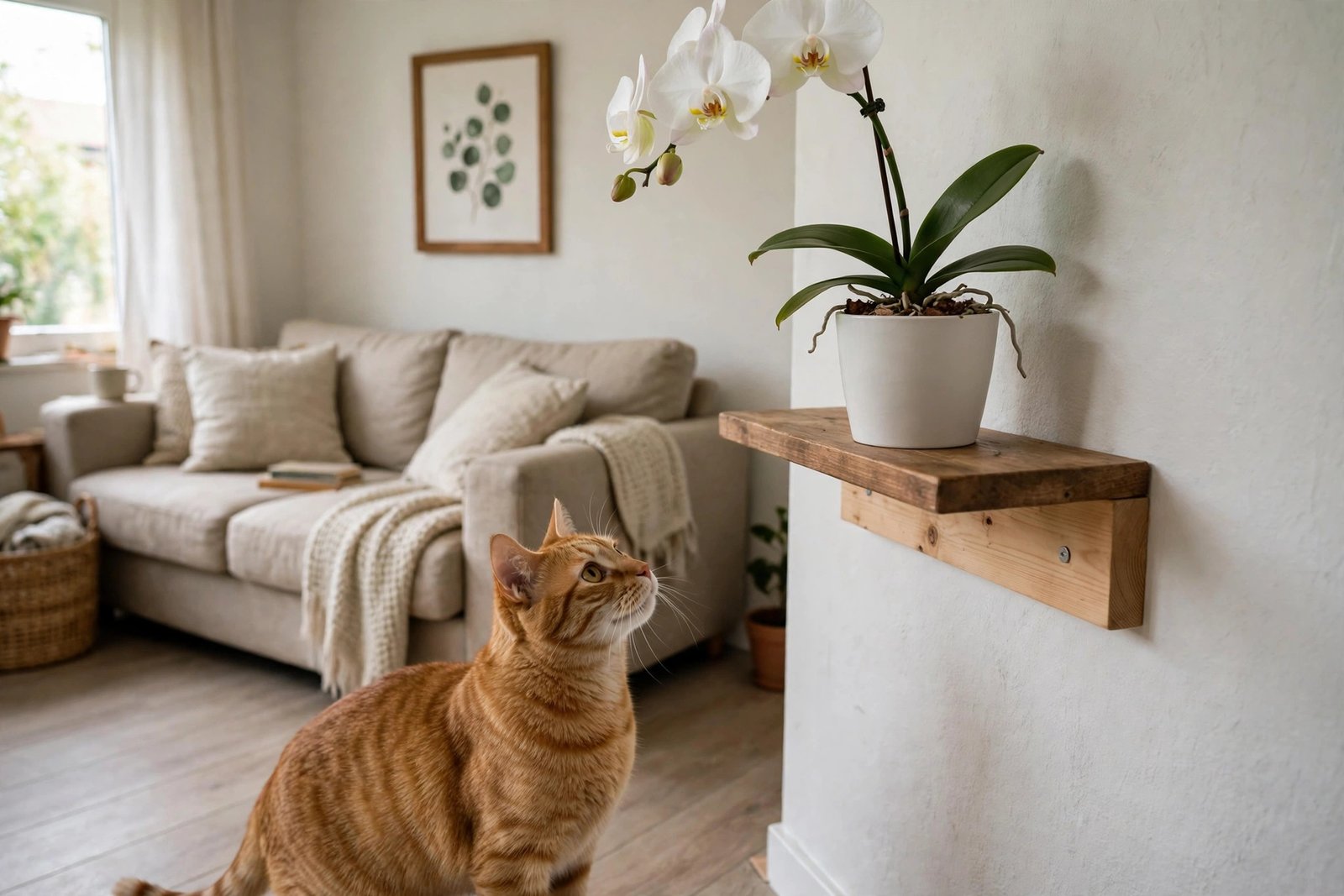
The simplest protection is height. Place orchids on a high shelf, a tall plant stand, or a wall-mounted display where your cat cannot reach them from furniture, and make sure the shelf itself is secure — a cat that can jump onto the shelf can still reach the plant. Our guide to where to place houseplants in a home with cats covers the same idea in more detail.
A hanging planter is another good option, as long as it hangs high enough and the hook and cord are strong. Check the hanger regularly for wear, because a falling pot is a bigger hazard than a chewed leaf. For more ideas, see our guides to hanging planters in homes with cats and cat-friendly plant shelves.
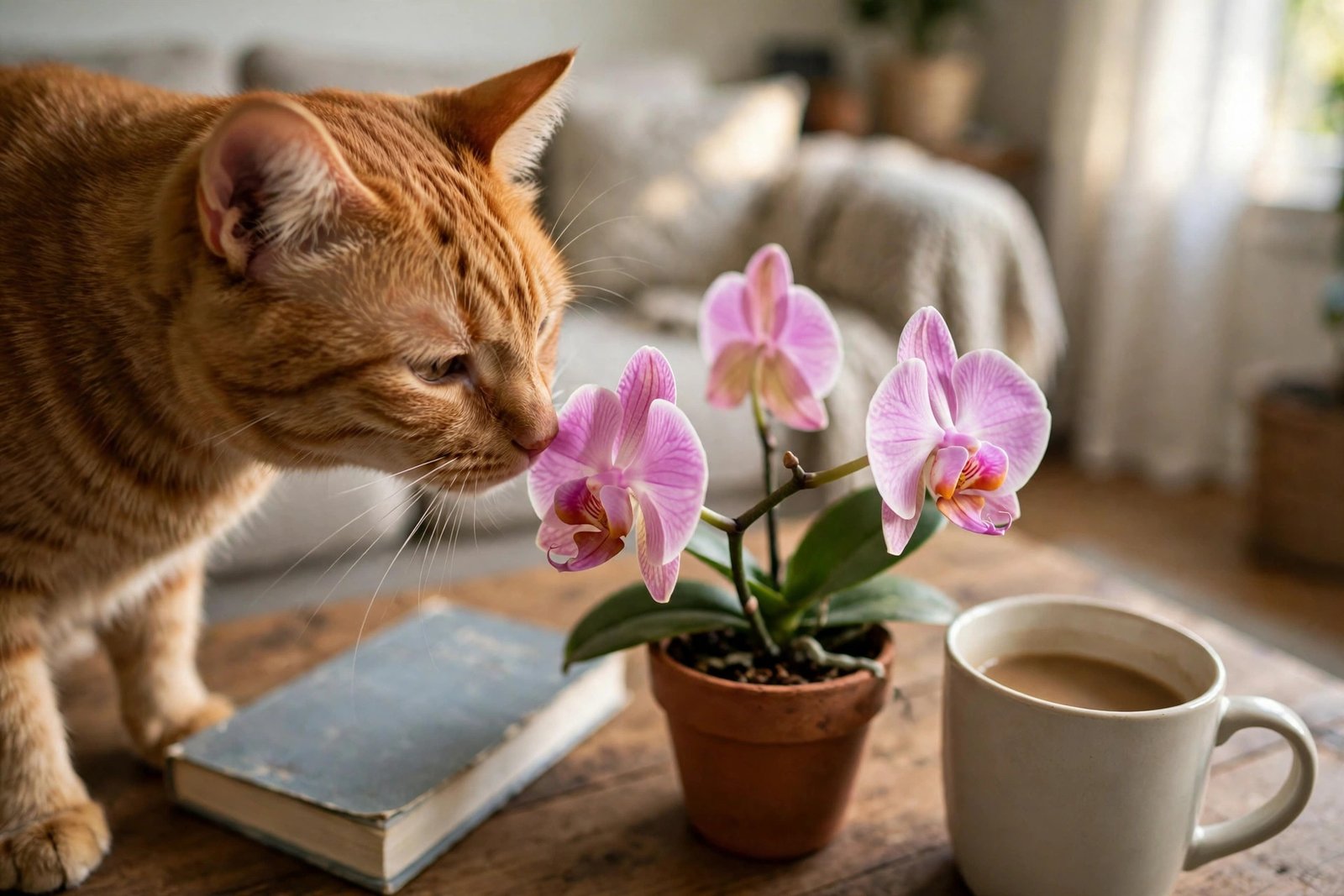
Give your cat something better to chew. A pot of cat grass on the floor gives a curious cat a safe outlet, and many cats stop bothering other plants once they have their own. Cats are drawn to the tall spikes, which sway and sit at nose height, so a reachable orchid rarely stays untouched. See our comparison of cat grass versus houseplants and our guide on how to stop cats chewing houseplant leaves. Are orchids safe for cats matters most when a cat keeps returning to the same plant, and a good display spot plus a better alternative usually solves it.
Orchid Care Basics for Beginners
Give a moth orchid bright indirect light. An east-facing window is ideal, and a south- or west-facing window works with a sheer curtain to soften the afternoon sun. Dark green leaves can mean too little light, while yellowing leaves can mean too much. The American Orchid Society notes that Phalaenopsis orchids are among the easiest orchids to grow at home, doing best above 60°F at night and between 75°F and 85°F during the day.
Water thoroughly, then wait until the bark is nearly dry before watering again — in most homes that means about once a week. Let excess water drain away completely, and never let the plant sit in water. Water in the morning so the leaves dry, and do not let water collect in the crown. Humidity of 50 to 80 percent suits them.
A single Phalaenopsis bloom spike can last two to three months, which is one reason are orchids safe for cats is such a popular question — the plant is beautiful, and the answer is reassuring. After the flowers fall, keep watering and feeding lightly. Feed with a balanced orchid fertilizer at half strength every two weeks during active growth, and flush the bark with plain water once a month to clear fertilizer salts.
Safer Alternatives If Your Cat Will Not Stop Chewing
If your cat chews the same orchid every day, replace it with a plant your cat can chew without worry. Cat grass is the obvious first choice, since it is grown to be eaten, and a pot of it costs very little. Spider plants are another good option: non-toxic, forgiving, and their arching leaves satisfy the same chewing urge. See our guides to spider plants and Boston ferns.
A wider collection also spreads the risk: when a home has several safe plants, no single plant takes all of the attention. Start with our list of 15 cat-safe houseplants and our cat-safe flowering houseplants. And since are orchids safe for cats is a yes, the orchid can stay in the mix if your cat leaves it alone.
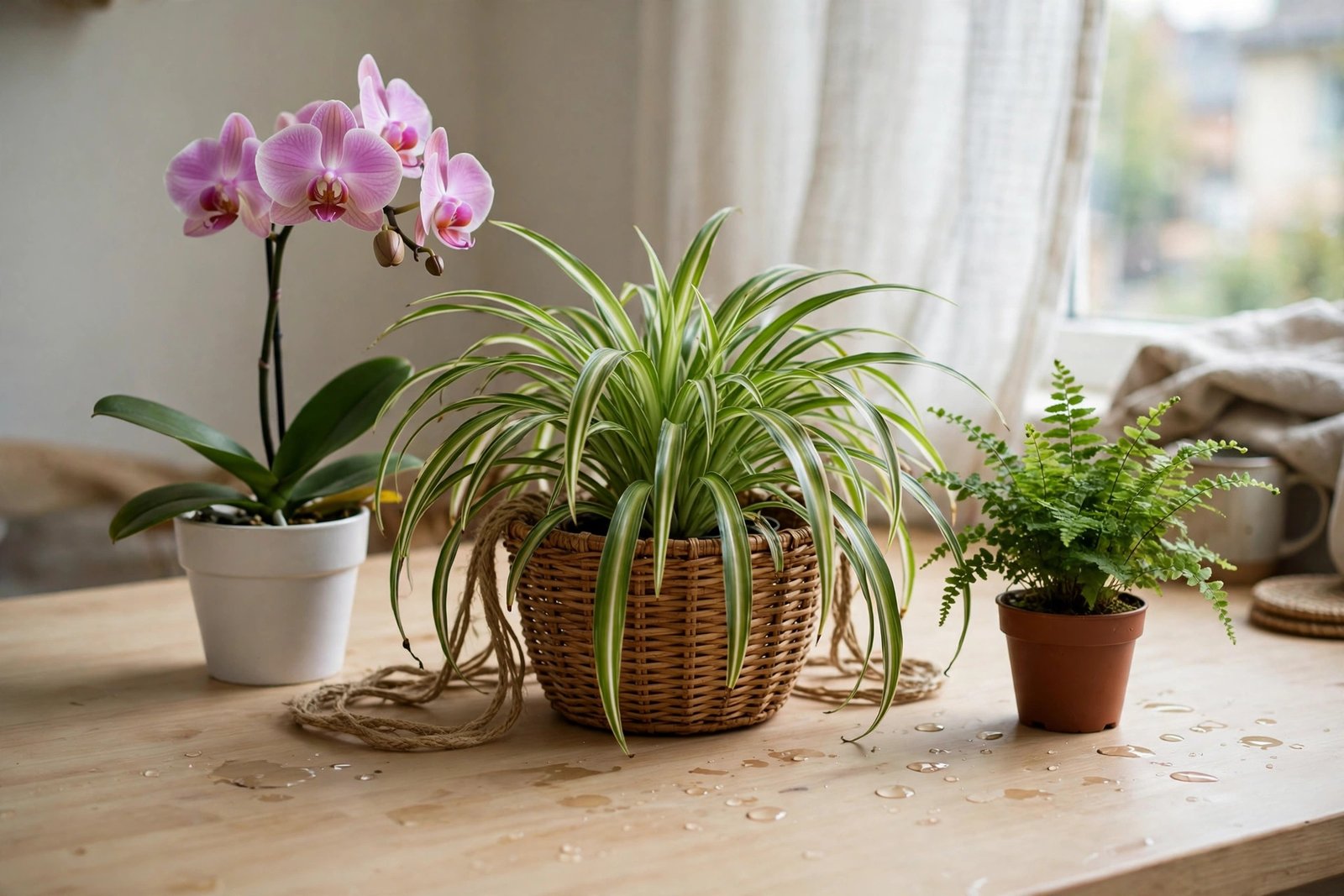
Orchids vs. Lookalikes: Plants People Confuse With Orchids
The most dangerous confusion is with lilies. True lilies, in the genera Lilium and Hemerocallis, are not orchids at all, and even a small exposure — a nibbled leaf, pollen on the fur, or a drink from a vase — can cause kidney failure in cats. Check the botanical name of any flower called an “orchid lily” or “daylily” — lilies must never enter a house with cats.
The peace lily is another lookalike that is not an orchid and not safe. Spathiphyllum is a common houseplant with white flowers, and it is toxic to cats because it contains insoluble calcium oxalate crystals that irritate the mouth and throat. Read our guide to whether peace lilies are toxic to cats before you buy any white-flowered plant on looks alone. The rule is simple: check the botanical name, not the common name — the habit that makes are orchids safe for cats a question you can answer with confidence.
Frequently Asked Questions
Are orchids safe for cats if my cat eats the flowers?
Yes, in the toxicology sense. Eating Phalaenopsis flowers can still cause vomiting or loose stools if a cat eats a lot, because any plant material can upset a cat’s stomach. That is why are orchids safe for cats is a yes even when a cat eats a few petals.
Are all orchid types safe for cats?
The common houseplant orchids — Phalaenopsis, Cymbidium, Dendrobium, Oncidium, and Cattleya — are widely listed as non-toxic, so are orchids safe for cats is a yes for the types you will actually find in shops. The ASPCA has a dedicated entry for Phalaenopsis, so that is the safest choice. A few wild types, such as some lady slipper orchids, may cause mild stomach upset.
Can I keep an orchid in my bedroom if my cat sleeps there?
Yes — are orchids safe for cats in a bedroom comes down to placement: keep the orchid out of your cat’s reach and the pot stable. A high shelf or a hanging planter works well. Keep the plant away from the bed itself, since a cat that sleeps on the bed can reach anything on a nightstand.
What should I do if my cat eats a lot of orchid?
Remove the plant and watch your cat. Contact your veterinarian or an animal poison control service promptly if your cat vomits repeatedly, has ongoing diarrhea, refuses food or water, becomes lethargic, or seems in pain. Do not try a home remedy.
Conclusion
So, are orchids safe for cats? Yes — the ASPCA lists the Phalaenopsis orchid as non-toxic to cats and dogs, and no poison has been identified in any part of the plant. That makes the moth orchid one of the lowest-risk flowering houseplants for a home with cats.
Before you buy, confirm the botanical name, Phalaenopsis, and place the plant where your cat cannot easily reach it but where it still gets bright indirect light. Water when the bark is nearly dry, feed sparingly, and rinse the leaves if the plant was treated. If a friend asks are orchids safe for cats, you can now answer yes — and explain the chewing caveat. To build a wider collection, continue with our list of 15 cat-safe houseplants.
Disclaimer: This article is for general information only and does not replace advice from a veterinarian. Plant safety can depend on the exact species, the amount eaten, and the individual cat. If your cat is unwell after chewing or eating any plant, contact your veterinarian or an animal poison control service promptly.