
So, are peace lilies toxic to cats? Yes — peace lilies are toxic to cats. The peace lily, Spathiphyllum spp., is listed by the ASPCA Animal Poison Control Center as toxic to cats and dogs. A cat that chews a leaf usually develops a painful mouth, drooling, and vomiting.
People usually ask are peace lilies toxic to cats after a cat has taken a bite, or after a peace lily arrives as a gift. A peace lily is not a true lily: it does not cause the kidney failure that makes true lilies so dangerous. It causes a different problem: mouth irritation from tiny crystals.
The Short Answer
The short answer to are peace lilies toxic to cats is yes. If your cat has just chewed a peace lily, do not wait for symptoms. Move the plant out of reach, keep your cat calm, and contact your veterinarian or poison control promptly: the ASPCA Animal Poison Control Center at (888) 426-4435 or Pet Poison Helpline at (855) 764-7661. A consultation fee may apply.
That is the core of are peace lilies toxic to cats: a painful mouth, not kidney failure. The ASPCA lists the toxic principle as insoluble calcium oxalates, and its signs as oral irritation, intense burning of the mouth, tongue and lips, drooling, vomiting, and difficulty swallowing. Pet Poison Helpline adds gagging and states plainly that a peace lily “does not result in kidney damage in cats.” For a fuller guide, see What to Do If Your Cat Eats a Toxic Plant: A Safety Guide.
What Is a Peace Lily?
A peace lily is one of the most common flowering houseplants sold today, and one of the easiest to recognize. It has large, glossy, dark green leaves and a very distinct flower: a single white, leaf-like hood, called a spathe, wrapped around a cream-colored central spike, called a spadix. The flower has no petals and no loose pollen the way a true lily does. It usually grows 1 to 3 feet tall indoors and blooms for weeks.
Understanding the plant helps explain are peace lilies toxic to cats in the right way. The botanical name is Spathiphyllum, and the ASPCA lists the plant under that genus name, with the additional common name Mauna Loa Peace Lily. It belongs to the aroid family — the same family as pothos, monstera, philodendrons, and ZZ plants. That family connection explains its toxicity, because these plants share the same defense.
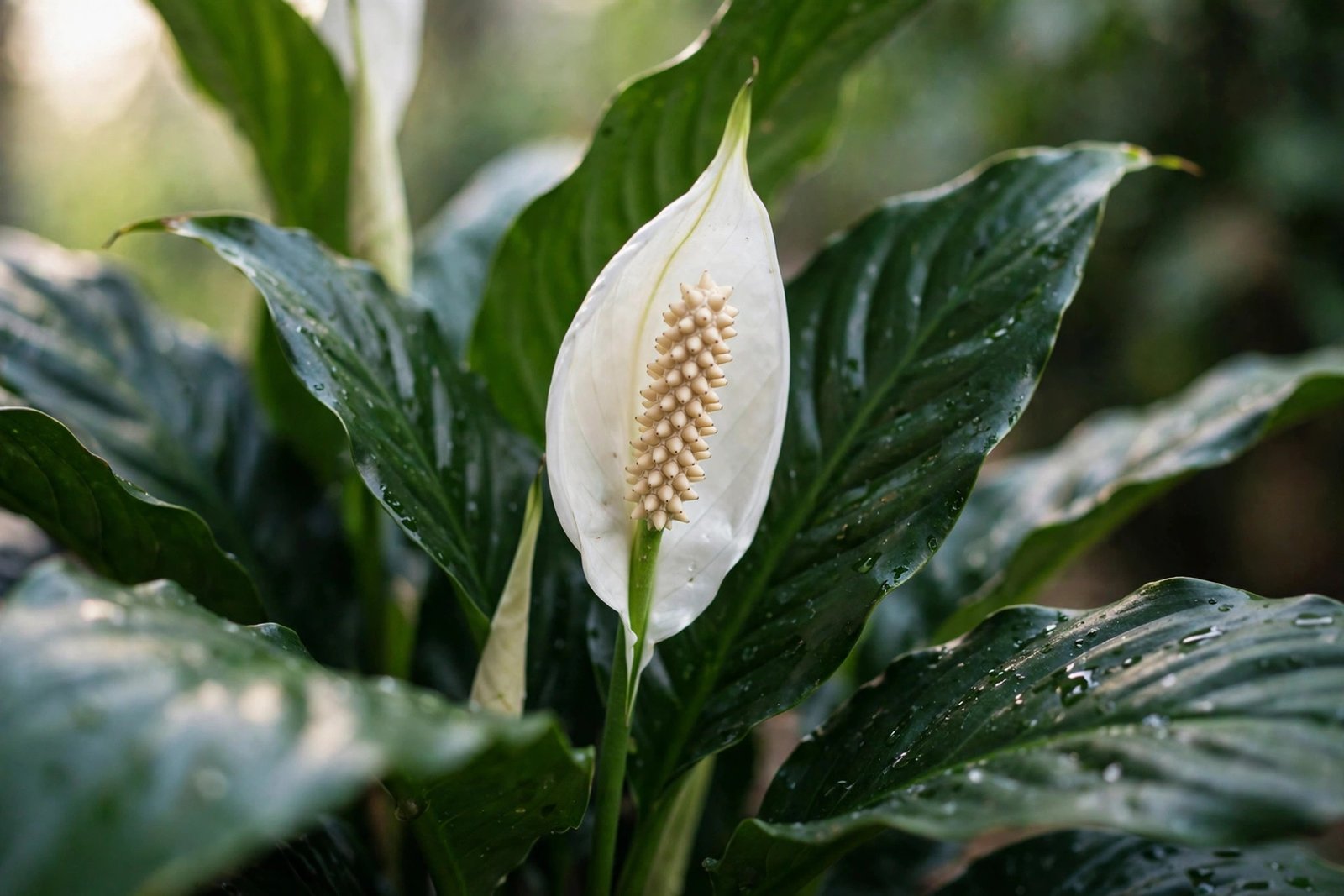
Most sold peace lilies are Spathiphyllum wallisii or hybrids. Whatever the variety, are peace lilies toxic to cats has the same answer: yes. If the label says Spathiphyllum, treat the plant as toxic to cats.
Why Peace Lilies Are Toxic
Peace lilies contain microscopic, needle-shaped crystals of insoluble calcium oxalate, called raphides, packed into the leaves, stems, and sap. Every part of the plant carries them. There is no nibble-safe part.
The reason are peace lilies toxic to cats gets a yes is mechanical, not chemical. When a cat bites into a leaf, the plant cells break open and the crystals stab into the mouth, tongue, and throat. The crystals do not dissolve, and they are not absorbed into the bloodstream. They injure exactly where they land, which is why the first signs are in the mouth.
Most cats stop chewing after the first bite. The pain is immediate, so the cat spits the plant out — and that is why are peace lilies toxic to cats usually ends in a sore mouth rather than a hospital stay.
Peace Lily vs True Lily: The Difference That Matters
The confusion behind are peace lilies toxic to cats starts with the name. Confusing the two kinds of “lily” causes the most fear — and, in the other direction, the most dangerous under-reaction.
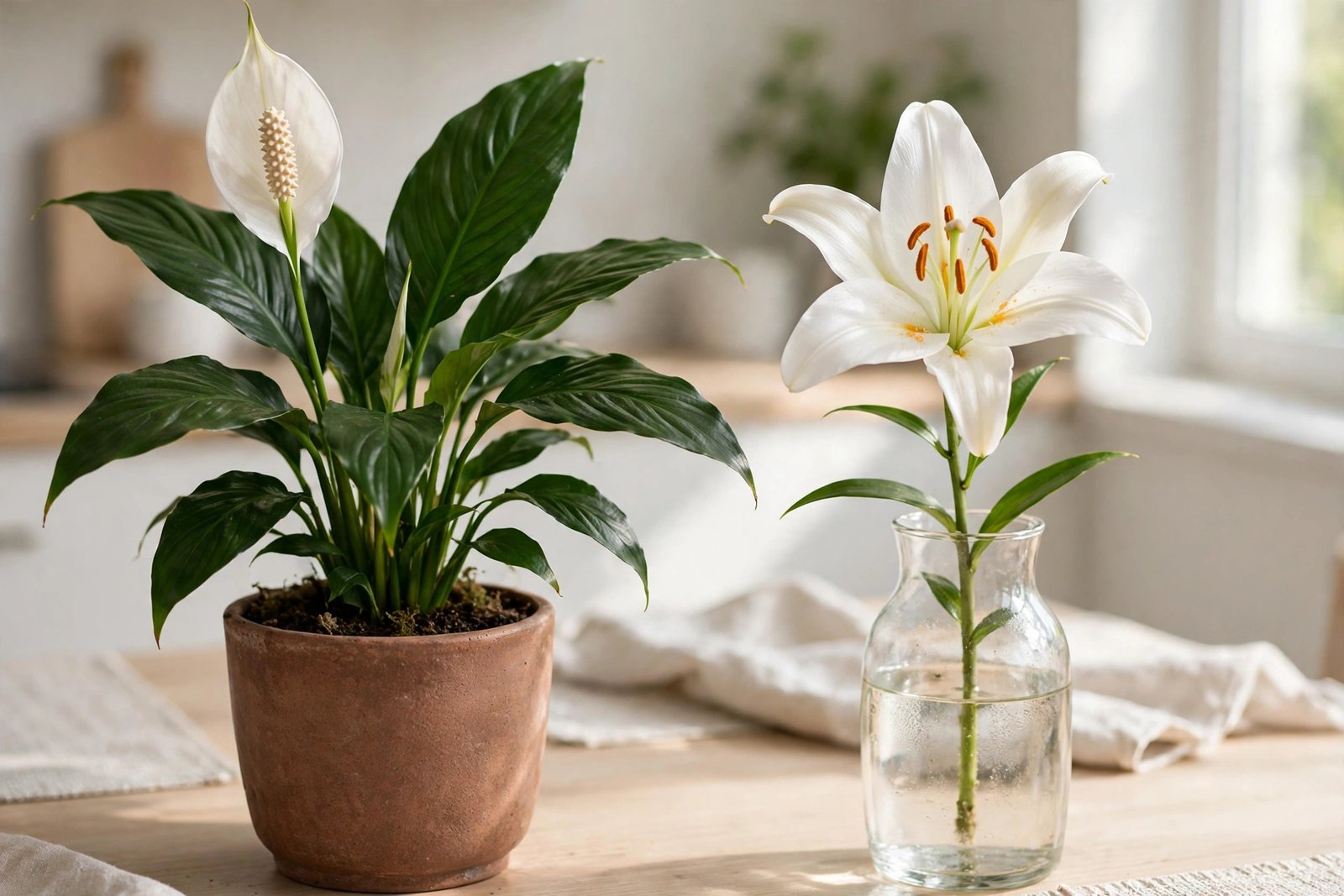
A peace lily (Spathiphyllum) is not a true lily. True lilies are Lilium species — Easter, Asiatic, Stargazer, Oriental, and tiger lilies — and daylilies are Hemerocallis species. They contain compounds that can cause sudden kidney failure in cats, even from a tiny nibble, pollen licked off fur, or vase water. The ASPCA states that all parts of a true lily are toxic, and treatment delayed longer than 18 hours is often fatal.
A peace lily does none of that. Its calcium oxalate crystals cause local irritation — a painful mouth, drooling, and vomiting — not organ damage. Pet Poison Helpline states this directly: a peace lily “does not result in kidney damage in cats.” If you only remember one thing about are peace lilies toxic to cats, remember this: a peace lily hurts the mouth, while a true lily can shut down the kidneys.
| Plant | Botanical name | Toxic principle | What it does to a cat |
|---|---|---|---|
| Peace lily | Spathiphyllum spp. | Insoluble calcium oxalate crystals | Mouth pain, drooling, vomiting; kidney damage does not occur |
| True lily | Lilium spp. | Unknown compounds | Sudden kidney failure, often fatal; even pollen or vase water is dangerous |
| Daylily | Hemerocallis spp. | Unknown compounds | Sudden kidney failure, like true lilies |
| Calla lily | Zantedeschia spp. | Insoluble calcium oxalate crystals | Mouth irritation, like a peace lily; not a true lily |
| Lily of the valley | Convallaria spp. | Cardiac glycosides | Stomach upset and irregular heartbeat; a different, serious mechanism |
That table is the fastest way to answer are peace lilies toxic to cats for any plant with “lily” in its name. The practical rule: a true lily or a daylily means a veterinarian immediately, even if the cat seems fine.
If you are not sure which kind of lily you have, treat it as uncertain and call for advice. For the full true lily guide, see Are Lilies Toxic to Cats? Types, Exposure Risks, and Urgent Steps.
Symptoms to Watch For
When owners search are peace lilies toxic to cats, they usually want to know what to watch for after a bite. Because the crystals act on contact, signs usually begin within minutes of the bite.
The ASPCA lists these signs for peace lilies: oral irritation, intense burning of the mouth, tongue and lips, excessive drooling, vomiting, and difficulty swallowing. Pet Poison Helpline adds gagging, and notes drooling, gagging, and vomiting as common signs. The ASPCA’s lily article also lists diarrhea.
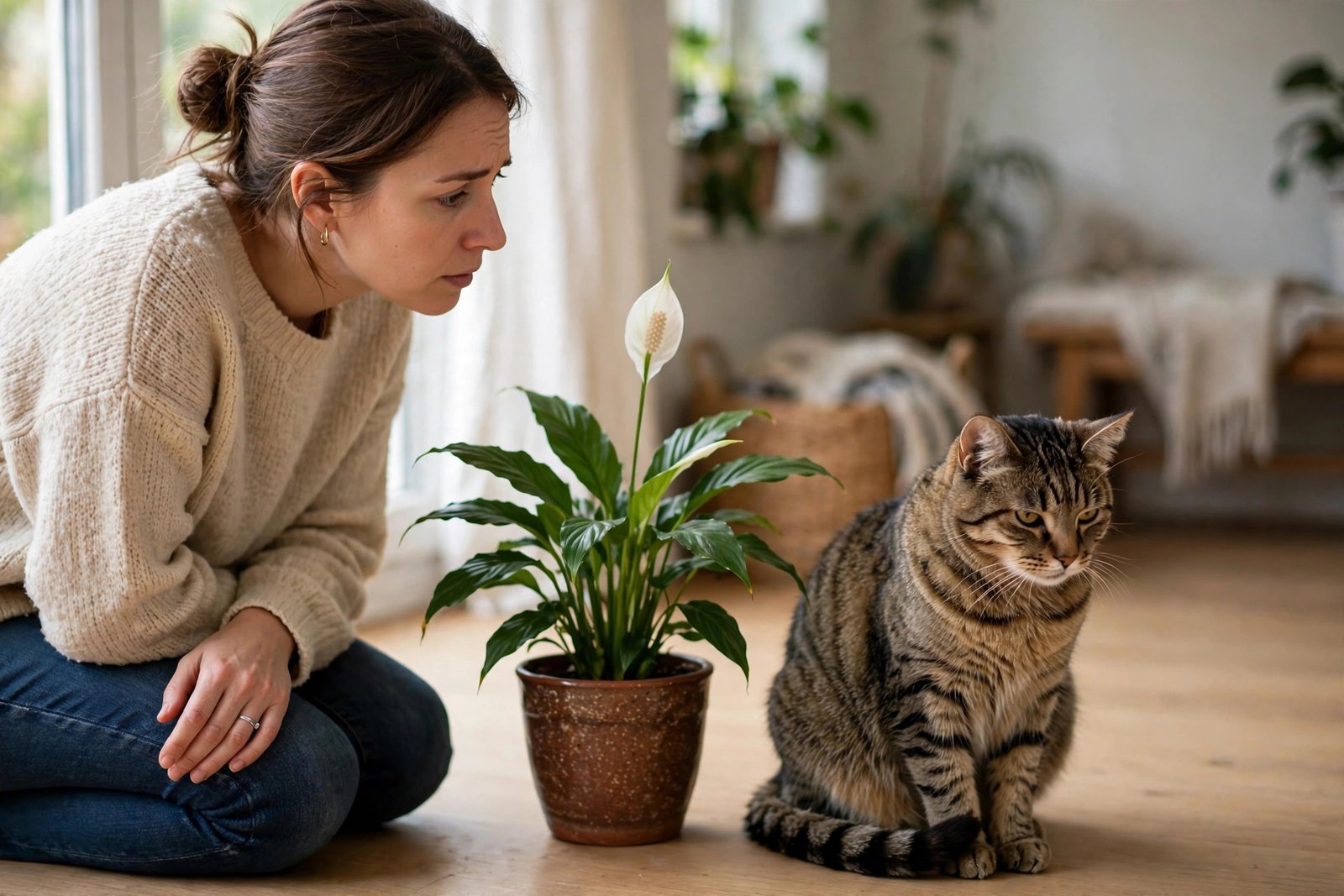
Early signs include drooling, pawing at the face, shaking the head, licking the lips, and refusing food or water. A cat may hide because its mouth hurts. Vomiting may follow if the cat swallowed leaf pieces. Rarely, swelling of the lips, tongue, or throat can make swallowing or breathing difficult — that needs a veterinary hospital right away.
If you find chewed leaves and are not sure how much your cat ate, treat it as an exposure and call for advice. Do not assume a single bite is harmless, and do not wait for symptoms to appear.
How Serious Is Peace Lily Poisoning?
For most cats, a peace lily exposure is mild to moderate and short-lived. That is the honest picture behind are peace lilies toxic to cats: painful, but not usually dangerous in the way true lilies are.
The honest answer to how serious are peace lilies toxic to cats exposures can be is that most cases stay mild with prompt advice. A large exposure that swells the throat is rare, but it is a genuine emergency — a cat struggling to breathe needs a veterinary hospital right away. Kittens, older cats, and unwell cats are more vulnerable. A mild typical case does not turn are peace lilies toxic to cats into a safe plant.
What to Do If Your Cat Chews a Peace Lily
Act promptly, even if your cat seems normal at first. Mouth pain can develop after the first bite, and early advice is better than waiting for vomiting to start. If you are reading are peace lilies toxic to cats because your cat just chewed a leaf, start with the steps below and call for advice now.
First, remove the plant and prevent more chewing. Pick up the plant and any fallen or trimmed leaves, and put them out of your cat’s reach. Fallen leaves still contain crystals, so check the floor and the saucer. If there is plant material in your cat’s mouth, remove it only if you can do so safely.
Second, call your veterinarian or poison control promptly — the ASPCA Animal Poison Control Center at (888) 426-4435, or Pet Poison Helpline at (855) 764-7661. A consultation fee may apply. Be ready to share the plant name or a photo, which part was chewed, how much and when, and your cat’s age and health.
Third, watch your cat closely for a few hours. Keep the cat indoors in a quiet room, with fresh water available. If the cat is drooling heavily, cannot swallow, is vomiting repeatedly, or has difficulty breathing, contact a veterinarian immediately. If the plant turns out to have been a true lily, say so at once — true lily exposure needs emergency hospital care.
What NOT to Do
A common mistake after asking are peace lilies toxic to cats is to try a home remedy first and call later. Do not do that. Do not induce vomiting. Never try to make your cat vomit at home unless a veterinarian specifically tells you to.
Do not give home remedies such as milk, oil, or activated charcoal. None of these treat calcium oxalate irritation, and some can cause harm. Do not rinse your cat’s mouth forcefully or squirt water into it, because that can cause choking. Do not wait for symptoms before calling, and do not assume one bite makes the plant safe to keep within reach.
Can You Keep a Peace Lily With a Cat?
A peace lily is not made safe by putting it on a high shelf: cats climb, and a fallen leaf can land on the floor where a cat finds it. Deciding whether to keep a peace lily when you know are peace lilies toxic to cats is a yes depends on your cat and your home.
If your cat has ever chewed a houseplant, can reach the plant from nearby furniture, or can enter the room when you are not home, rehome the peace lily or move it to a room your cat cannot enter. A closed door is the only reliable barrier. True lilies should not be in a home with a cat at all.
If you do keep one, use a closed room where possible, check below it daily, and use a heavy pot so it cannot tip over. A high shelf does not change the answer to are peace lilies toxic to cats into a safe setup — it only makes the next bite slightly less likely.
Safer Alternatives With a Similar Look
Once you know are peace lilies toxic to cats is a yes, the next question is what to grow instead. These alternatives are listed by the ASPCA as non-toxic to cats — which does not mean the plant is food. Check the botanical name on the label before you buy.
The African violet (Saintpaulia spp.) is the closest swap: small, compact, able to bloom for much of the year, and listed as non-toxic to cats. See Are African Violets Safe for Cats? Benefits, Risks, and Care Tips.
The moth orchid (Phalaenopsis spp.) gives elegant white blooms on arching stems. A calathea gives bold, patterned foliage for the same spot — see Are Calatheas Safe for Cats? Popular Varieties and Care Tips.
A spider plant (Chlorophytum comosum) is an easy swap that tolerates the same low light. See Are Spider Plants Safe for Cats? Benefits, Risks, and Care Tips.
Every plant above is a non-toxic answer to are peace lilies toxic to cats worries.

Frequently Asked Questions
Are peace lilies toxic to cats?
Yes. Peace lilies (Spathiphyllum spp.) are listed by the ASPCA as toxic to cats and dogs. The listed signs are oral irritation, intense burning of the mouth, tongue and lips, drooling, vomiting, and difficulty swallowing.
Do peace lilies cause kidney failure in cats?
No. Peace lilies do not cause kidney failure. Pet Poison Helpline states that a peace lily “does not result in kidney damage in cats.” That is why are peace lilies toxic to cats is not a kidney question. Kidney failure is the danger of true lilies (Lilium spp.) and daylilies (Hemerocallis spp.).
What happens if a cat eats a peace lily?
A cat that chews a peace lily usually develops a painful mouth, drooling, pawing at the face, and sometimes vomiting or diarrhea, often within minutes. Most cats stop chewing after the first bite because it hurts immediately. Rarely, swelling of the mouth or throat can cause difficulty swallowing or breathing, which is an emergency.
Is a small bite of peace lily dangerous for a cat?
A small bite often causes only brief mouth pain and drooling, but that is not a guarantee. The ASPCA does not publish a safe bite size, and the reaction depends on how much was eaten. Treat any chewing as an exposure and call for advice — and remember that are peace lilies toxic to cats is a question for your veterinarian or poison control, not a reason to wait and see.
What is a safe flowering alternative to a peace lily?
The African violet is the closest swap: it blooms for months, stays compact, and the ASPCA lists Saintpaulia spp. as non-toxic to cats. The moth orchid (Phalaenopsis spp.) is another non-toxic option with elegant white blooms. Remember that “non-toxic” does not mean edible.
Conclusion
So, are peace lilies toxic to cats? Yes — but they are not true lilies, and that distinction is the whole point.
Spathiphyllum spp. contain insoluble calcium oxalate crystals that cause a painful mouth, drooling, and vomiting when chewed. They do not cause the kidney failure that makes true lilies (Lilium spp.) and daylilies (Hemerocallis spp.) so dangerous.
If your cat has chewed a peace lily, move the plant out of reach and call your veterinarian or poison control now. The safest response to are peace lilies toxic to cats is always the same: move the plant, then call. If you are not sure the plant was really a peace lily, say so — a true lily needs emergency hospital care. If you cannot keep the plant reliably separate from your cat, rehome it and pick a non-toxic alternative.
Disclaimer: This article is for general information only and does not replace advice from a veterinarian. If your cat has chewed or eaten a peace lily, contact your veterinarian or an animal poison control service promptly. Do not use home remedies, induce vomiting, or give medication without veterinary advice.
Sources and References
- ASPCA Animal Poison Control Center — Toxic and Non-Toxic Plants: Peace Lily (Spathiphyllum). Lists the plant as toxic to cats and dogs, names the toxic principle as insoluble calcium oxalates, and lists oral irritation, intense burning and irritation of the mouth, tongue and lips, excessive drooling, vomiting, and difficulty swallowing as the clinical signs. https://www.aspca.org/pet-care/aspca-poison-control/toxic-and-non-toxic-plants/peace-lily
- ASPCA — Which Lilies Are Toxic to Pets? States that peace lilies contain insoluble calcium oxalate crystals released when chewed, causing oral pain, drooling, vomiting or diarrhea, and very rarely mouth swelling leading to difficulty breathing; notes it is very rare for peace lilies to cause serious or life-threatening problems, while true lilies and daylilies can cause severe kidney injury from small amounts, pollen, or vase water. https://www.aspca.org/news/which-lilies-are-toxic-pets
- Pet Poison Helpline — Peace Lily. Scientific name Spathiphyllum; alternate names Spathe Flower, White Sails. States that chewing releases microscopic crystals causing irritation and pain to the lips, oral cavity, and throat, with drooling, gagging, and vomiting as common signs, rare severe throat swelling, and that it does not result in kidney damage in cats. https://www.petpoisonhelpline.com/poison/mauna-loa-peace-lily/
- Cornell University College of Veterinary Medicine, Cornell Feline Health Center — Common Cat Hazards. Advises calling a veterinarian immediately after a suspected toxic ingestion and warns not to induce vomiting unless specifically directed to do so; notes lilies are especially toxic to cats and can cause life-threatening kidney failure even in tiny amounts. https://www.vet.cornell.edu/departments-centers-and-institutes/cornell-feline-health-center/health-information/feline-health-topics/common-cat-hazards