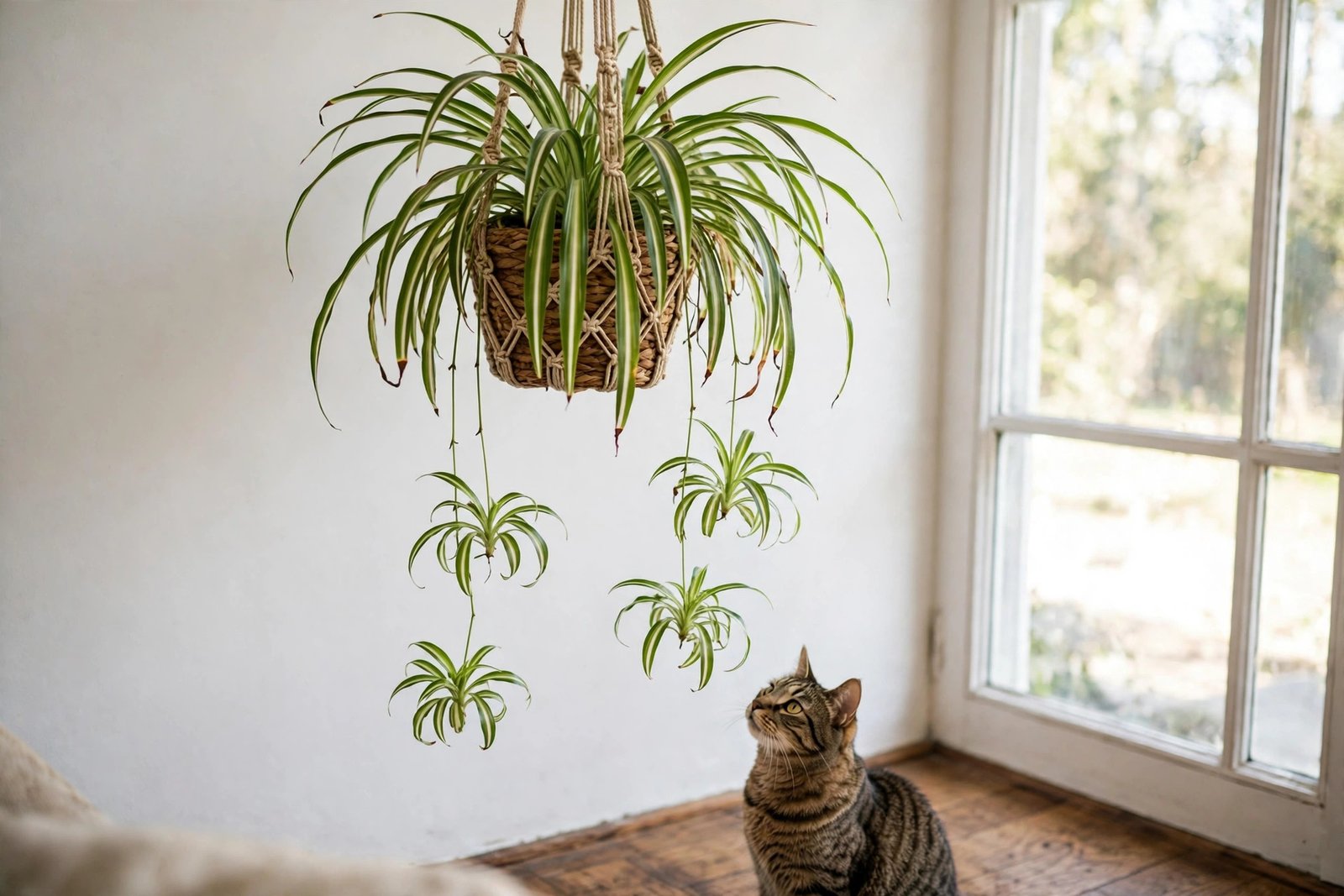
Hanging plants solve a problem every cat owner knows well. A cat can reach almost everything at floor level. A basket hung from the ceiling lifts the plant out of easy reach and fills an empty corner.
That height helps, but it does not make a plant safe on its own. Vines still dangle within reach of a jumping cat, and many popular trailing plants are toxic. This guide to cat safe hanging plants covers eight trailing plants regarded as non-toxic to cats, plus the popular hanging plants to keep out.
The Short Answer
The best cat safe hanging plants are the spider plant (Chlorophytum comosum), Boston fern (Nephrolepis exaltata), trailing peperomia (Peperomia spp.), wax plant or hoya (Hoya carnosa), string of hearts (Ceropegia woodii), burro’s tail (Sedum morganianum), Christmas cactus (Schlumbergera spp.), and lipstick plant (Aeschynanthus spp.). All eight are regarded as non-toxic to cats — seven are listed by the ASPCA, and string of hearts is widely regarded as non-toxic, with no veterinary source listing it as toxic.
Choosing cat safe hanging plants is only the first step, though. A hanging basket still needs a secure hook, a pot that cannot fall, and vines kept out of chewing range. A non-toxic vine chewed daily can still upset a cat’s stomach.
What “Non-Toxic” Means for a Hanging Plant
Non-toxic means the ASPCA has not identified compounds in the plant known to poison cats. A cat that nibbles a non-toxic trailing vine is not expected to be poisoned. Even a listed non-toxic plant can cause vomiting and stomach upset if eaten.
That warning matters more for cat safe hanging plants than for floor plants, because a trailing vine is a moving target. Cats bat at dangling vines, chew the ends, and pull at them. A swinging vine is far more tempting than a still leaf.
It also does not cover sprays and soil additives. Many hanging plants are treated with pesticides before sale, and fertilizer can be a problem if a cat digs in the soil or drinks drainage water. Ask whether a new plant was treated.
8 Cat-Safe Hanging Plants
The plants below are regarded as non-toxic to cats — seven are listed by the ASPCA, and string of hearts is widely regarded as non-toxic. Check the botanical name on the label before you buy, because common names are unreliable. The eight cat safe hanging plants in this guide cover a range of light levels.
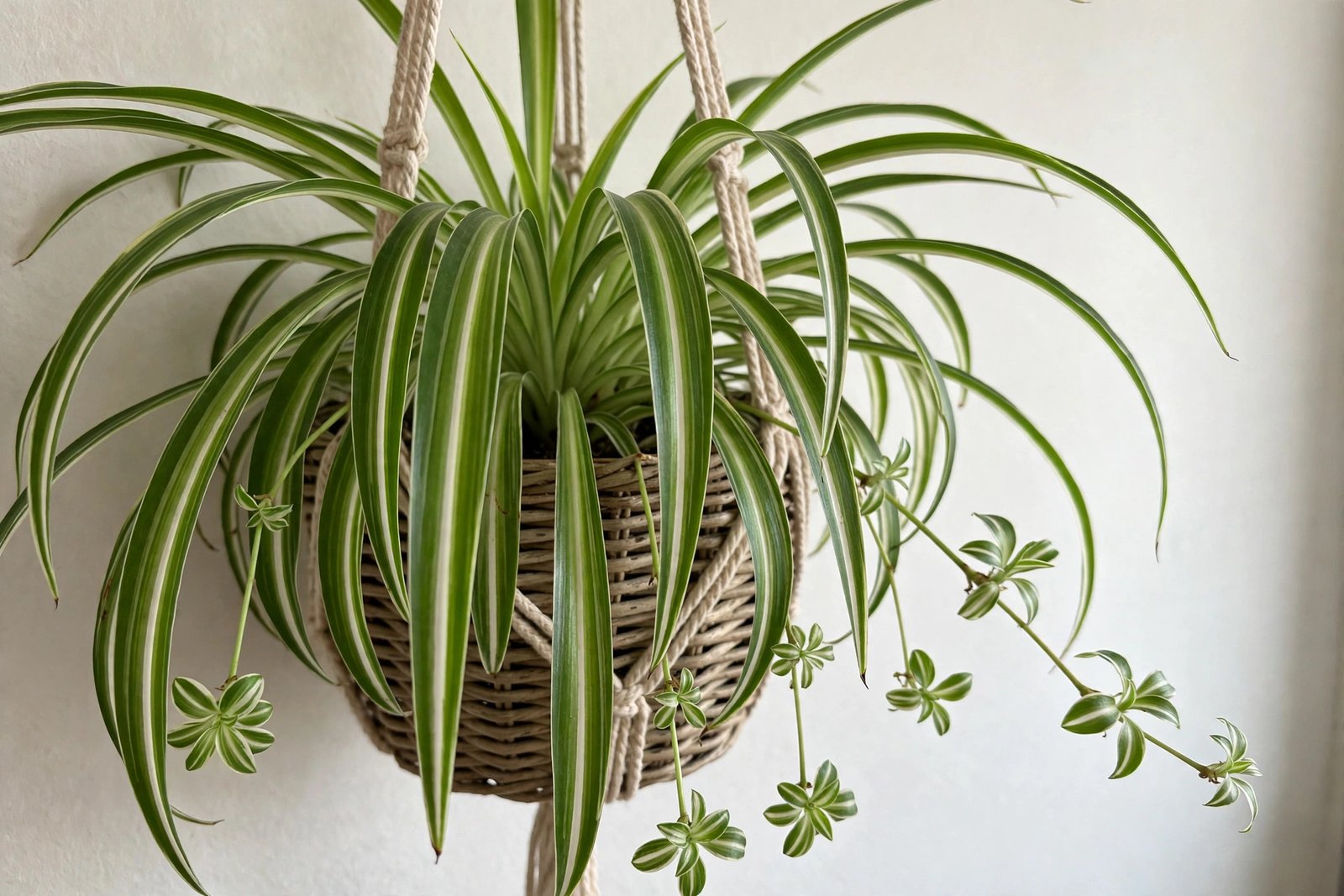
1. Spider Plant (Chlorophytum comosum)
The spider plant is the classic hanging plant, and the easiest one to keep in a cat home. The ASPCA lists it as non-toxic to cats, dogs, and horses. Its long, arching, striped leaves cascade from a hanging basket.
It likes bright, indirect light and water when the top inch of soil feels dry. Of all cat safe hanging plants, the spider plant is the most likely to be chewed, so hang it out of easy reach. Full guide: Are Spider Plants Safe for Cats? Benefits, Risks, and Care Tips.
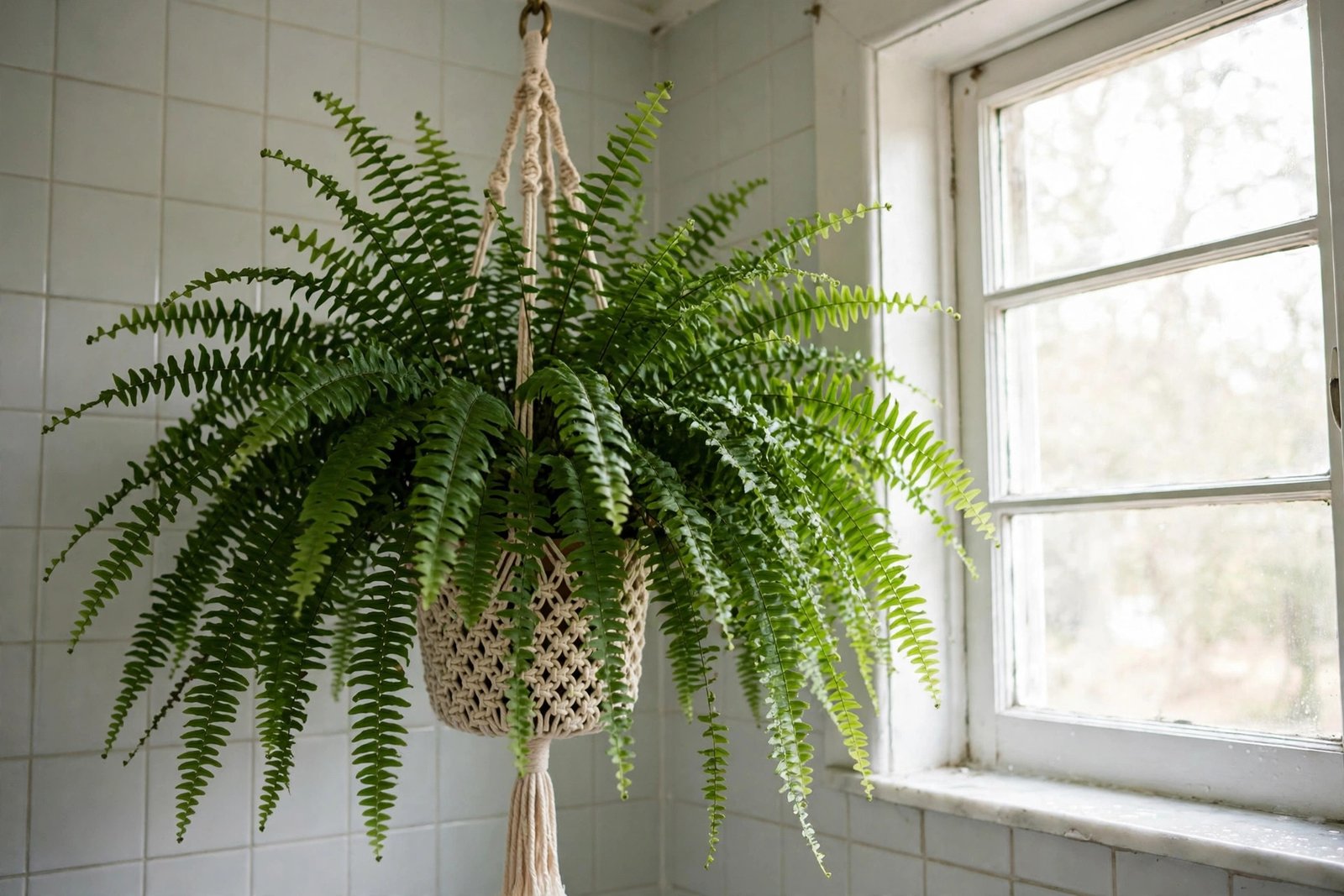
2. Boston Fern (Nephrolepis exaltata)
The Boston fern is the lush, feathery fern of old-fashioned hanging baskets, listed by the ASPCA as non-toxic to cats. Its arching fronds fill a basket fast and soften a bare corner.
It needs bright, indirect light, soil kept evenly moist, and regular misting or a humid room. Of the cat safe hanging plants in this guide, the Boston fern is the thirstiest, so a bathroom or a kitchen window suits it. Full guide: Are Boston Ferns Safe for Cats? A Complete Plant Guide.
3. Trailing Peperomia (Peperomia spp.)
Peperomias are compact, easy-care houseplants, and several trail well from a hanging basket. Peperomia hope and Peperomia scandens are the ones most often sold for hanging. The ASPCA lists peperomia as non-toxic to cats.
Be honest about the limit: the trailing kinds sold for baskets have no separate ASPCA entries, so safety rests on the genus and its common species. Give it bright, indirect light and water only when the top soil is dry. It is one of the neatest cat safe hanging plants for a small room.
4. Wax Plant (Hoya carnosa)
The wax plant, or hoya, is the best trailing substitute for toxic pothos. The ASPCA lists the wax plant (Hoya carnosa) as non-toxic to cats and dogs, and its thick, waxy leaves trail much like pothos, without the crystals that make pothos painful to chew. It also produces clusters of fragrant, star-shaped flowers.
Hoyas like bright light with some direct sun, water only when the soil is dry, and a slightly tight pot. Among cat safe hanging plants, hoya is the closest match to pothos in looks.
5. String of Hearts (Ceropegia woodii)
String of hearts is a delicate trailing plant with small, heart-shaped leaves on thin, wiry stems. It is widely regarded as non-toxic to cats, and no veterinary source consulted lists it as toxic.
It likes bright, indirect light and a pot that dries out between waterings. Its stems are thin, so a cat can snap a length off in one tug. Hang it high: it is one of the prettiest cat safe hanging plants, but also one of the most fragile.
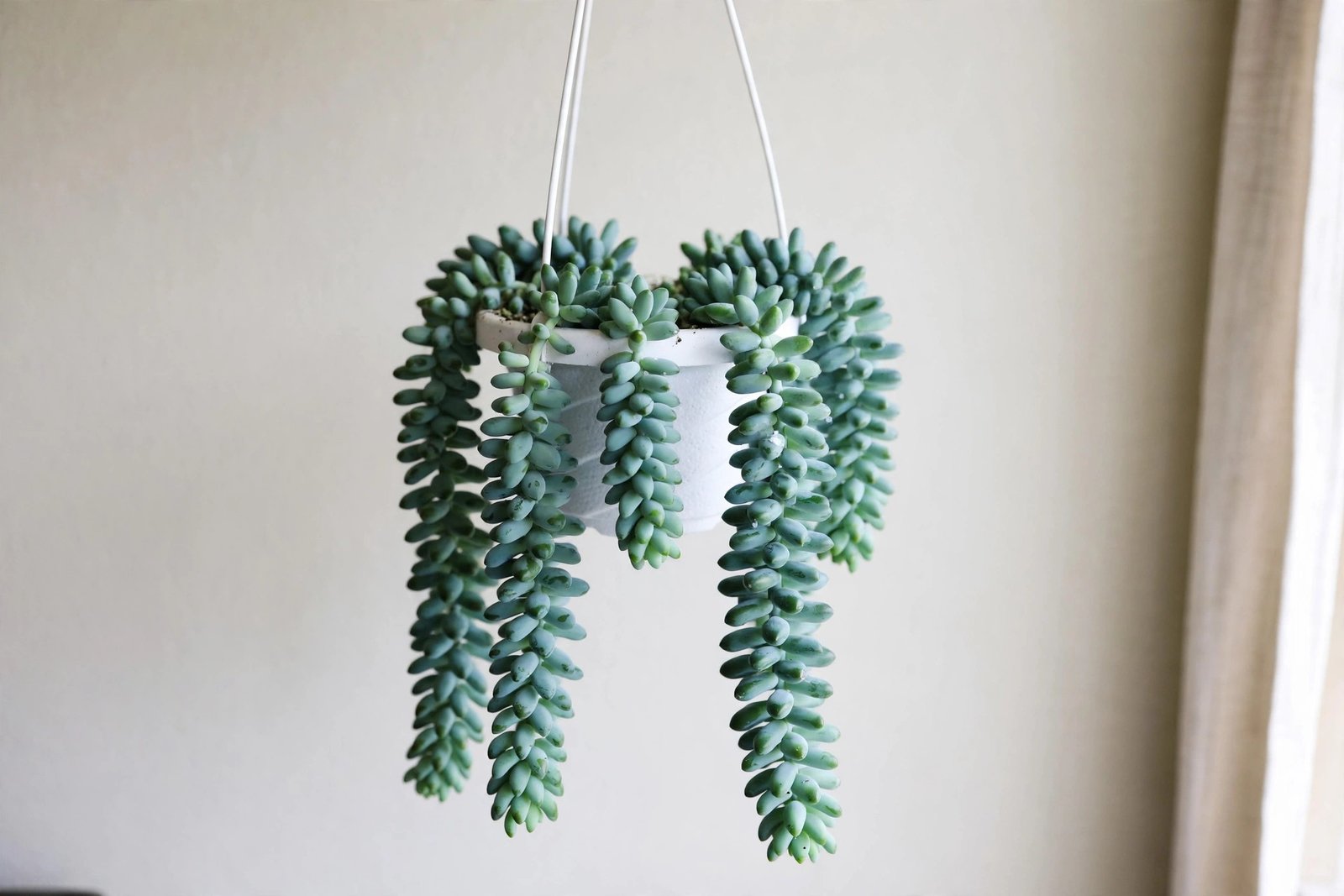
6. Burro’s Tail (Sedum morganianum)
Burro’s tail, also sold as donkey’s tail, is a trailing succulent with plump, blue-green, teardrop leaves on stems that can hang two to four feet. The ASPCA lists it as non-toxic to cats, dogs, and horses. It is the safe trailing succulent to choose instead of string of pearls, which looks similar and is toxic.
It needs bright light with some direct sun and very little water, in a gritty cactus mix with drainage holes. Burro’s tail is the heaviest succulent among the cat safe hanging plants here once its stems grow long, so the hook matters.
7. Christmas Cactus (Schlumbergera spp.)
The Christmas cactus is a trailing cactus with flat, segmented stems and bright pink, red, or white flowers in winter. The ASPCA lists the Christmas cactus as non-toxic to cats and dogs. Unlike a desert cactus, it has no sharp spines.
It likes bright, indirect light, regular watering while growing, and humidity, so a bathroom window suits it. The Christmas cactus is one of the calmest cat safe hanging plants to live with.
8. Lipstick Plant (Aeschynanthus spp.)
The lipstick plant is a trailing plant with glossy leaves and bright red, tube-shaped flowers that look like lipstick emerging from a dark tube. The ASPCA lists it as non-toxic to cats, so check the label.
It likes bright, indirect light and regular watering in the growing season. It rounds out the cat safe hanging plants in this guide as the boldest flowering choice.
Hanging Safety: The Basket Matters as Much as the Plant
A non-toxic plant in a badly hung basket is still a hazard. A falling pot can injure a cat and spill soil everywhere. Hang it from a ceiling joist or a solid beam, on a hook rated for more than the pot’s wet weight. The cat safe hanging plants in this guide are only as safe as the basket they hang in.
Never hang from a plasterboard anchor alone. A watered basket is heavy, and a cat that leaps at it adds sudden force, so check the hook, chain, and hanger every few months for rust or wear.
Hanging Height: High Enough, Not Too High
Keep the basket high enough that the cat cannot sit on a nearby shelf and reach the vines, but low enough that you can water it without a ladder. The vine ends should stay at least a foot above the nearest surface a cat can stand on. Check the length of your cat safe hanging plants every few weeks.
Planter Weight and Stability
Use a lightweight plastic or fabric pot rather than heavy ceramic for anything hung above a cat’s favourite spot. A wet ceramic pot can weigh several kilos, and if it falls it can hurt a cat badly. A light pot also puts less strain on the hook. A swinging basket invites a cat to bat at it, which is the last thing you want with cat safe hanging plants overhead.
Cats Climb to Reach Hanging Plants
Cats climb curtains, jump from a tall bookcase, and walk along a picture rail to reach a plant they want. A shelf or a windowsill within jumping distance becomes a launch pad.
If your cat is a keen climber, keep the vines short and the basket high, and give the cat a tall scratching post nearby. The most determined climbers will still test cat safe hanging plants, so the room layout matters as much as the hook. For more on safe placement, see Where to Place Houseplants in a Home With Cats.
Hanging Plants to Avoid in a Cat Home
Some of the most popular trailing plants are toxic, and hanging them high does not make them safe. That is the rule that matters most when you shop for cat safe hanging plants.
Pothos (Epipremnum aureum) contains calcium oxalate crystals that cause mouth pain, drooling, and vomiting. String of pearls (Senecio rowleyanus, now Curio rowleyanus) is toxic to cats, causing vomiting, diarrhea, drooling, and lethargy, while the sap irritates skin. English ivy (Hedera helix) is toxic to cats, and causes vomiting, diarrhea, and abdominal pain. Philodendron (Philodendron spp.) contains the same crystals as pothos. Inch plant (Tradescantia zebrina) is listed by the ASPCA as toxic to cats, and causes dermatitis.
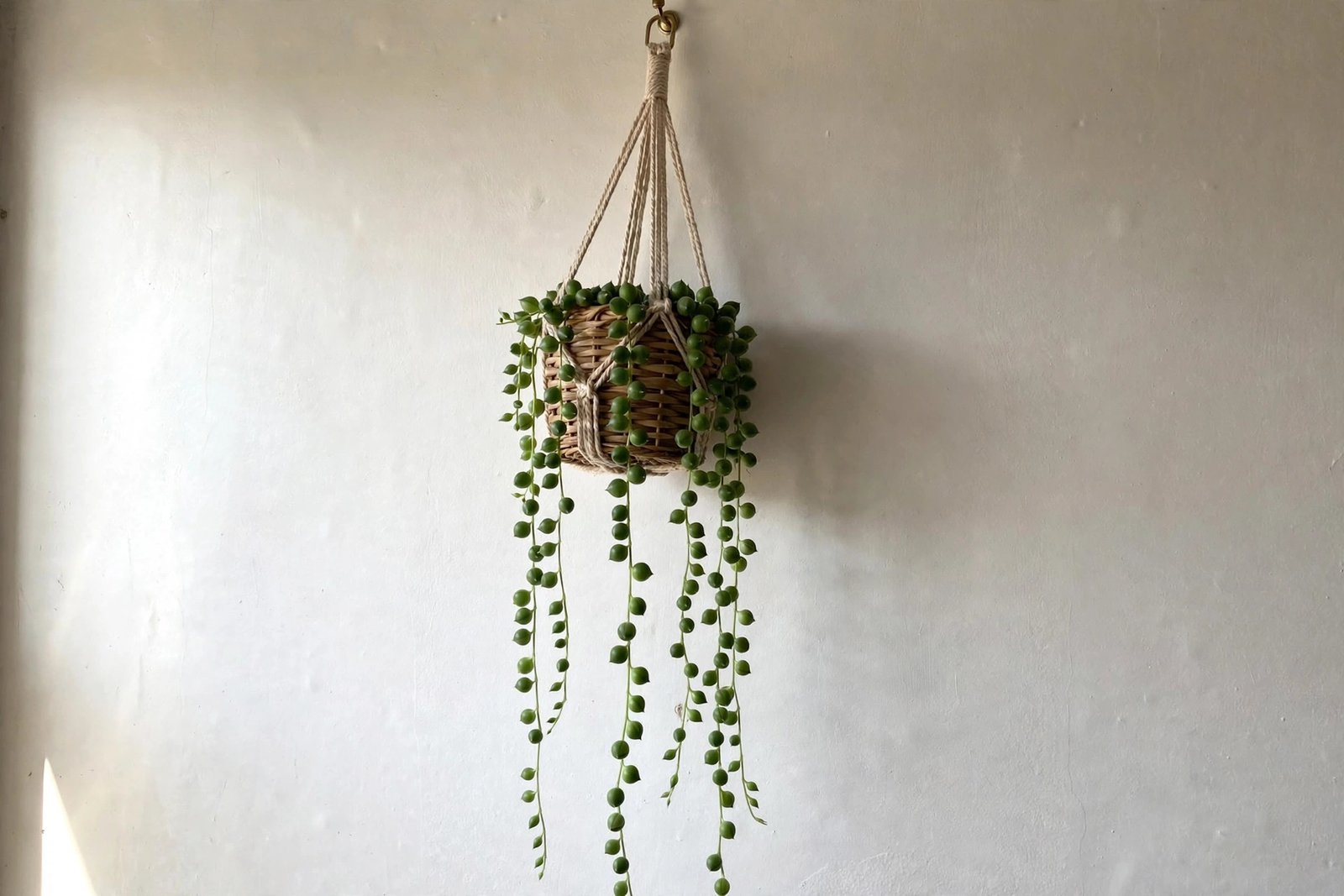
String of pearls deserves a special warning because it looks so much like burro’s tail. Both are trailing succulents with bead-like leaves. String of pearls has round, pea-like beads on thin stems, while burro’s tail has plump, pointed, teardrop leaves on thicker stems. If you cannot tell them apart, do not buy the plant until the botanical name is confirmed.
The same care applies to the look-alikes for the other plants in this guide. The botanical name on the label is the check that keeps your cat safe. The safest cat safe hanging plants are the ones you have identified by that name, not by looks alone.
What to Do If Your Cat Chews a Hanging Plant
First, find out what the plant is: check the label or take a photo of the plant and its tag. If it is one of the cat safe hanging plants in this guide, a small nibble is usually not an emergency, but watch the cat for the rest of the day. Contact your veterinarian if the cat eats a large amount or seems unwell.
If the plant is toxic or unknown, treat it as an exposure and call your veterinarian or poison control promptly. In the United States, the ASPCA Animal Poison Control Center is at (888) 426-4435, and Pet Poison Helpline is at (855) 764-7661. Do not wait for symptoms, do not try a home remedy, and do not try to make your cat vomit.
Frequently Asked Questions
What are the safest hanging plants for cats?
Spider plant, Boston fern, trailing peperomia, hoya, string of hearts, burro’s tail, Christmas cactus, and lipstick plant are all regarded as non-toxic to cats — seven are listed by the ASPCA, and string of hearts is widely regarded as non-toxic. The safest cat safe hanging plants are the ones whose botanical name you have checked.
Is hanging a toxic plant high up safe?
No. Cats climb, jump, and knock things down, and vines fall or get pulled. Move it out of the home, and choose one of the cat safe hanging plants above instead.
Can my cat reach a hanging spider plant?
A spider plant is non-toxic, so a nibble is not a poisoning risk, but cats love to chew spider plants, and a cat that chews it daily will get stomach upset and destroy the plant. The best cat safe hanging plants still need to be hung out of grazing range.
What is the best cat-safe alternative to pothos?
The wax plant (Hoya carnosa) is the closest match. It trails like pothos, has thick waxy leaves, and is listed by the ASPCA as non-toxic to cats, while pothos contains calcium oxalate crystals. As a cat safe hanging plants swap, hoya gives you the trailing look without the risk.
Is string of pearls safe for cats?
No. String of pearls (Senecio rowleyanus, now Curio rowleyanus) is toxic to cats. Eating it can cause vomiting, diarrhea, drooling, and lethargy. Burro’s tail looks similar, so check the botanical name before you buy.
How do I stop my cat chewing my hanging plants?
Hang the basket out of jumping range, trim vines that dangle within reach, and give the cat something it is allowed to chew, such as a pot of cat grass placed nearby. For more ideas, see How to Keep Cats Out of Houseplants Without Harming Them.
Conclusion
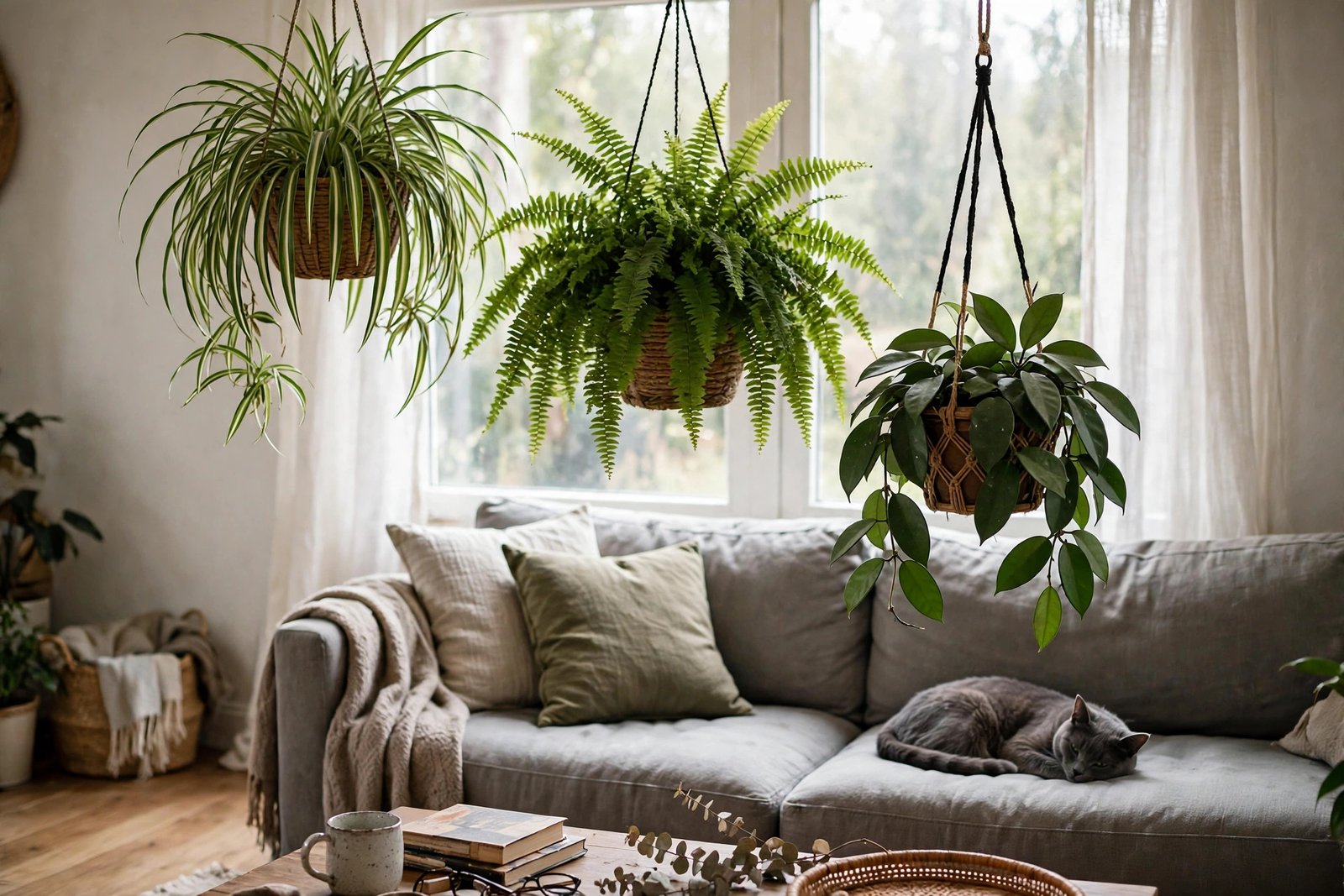
A hanging basket is one of the best ways to keep plants in a cat home, as long as the plant in it is non-toxic and the basket itself is hung safely. Start with a spider plant or a wax plant, check the botanical name against the ASPCA list before you buy. The eight cat safe hanging plants in this guide give you a full, trailing display without the toxicity worry.
Read the label: if it says Chlorophytum, Nephrolepis, Peperomia, Hoya, Ceropegia, Sedum, Schlumbergera, or Aeschynanthus, it is one of the safe ones. That one check, plus a solid hook and vines kept out of reach, is what makes cat safe hanging plants work in a real home.
For more help building a safe indoor space, see Cat-Friendly Indoor Plant Space and 15 Cat-Safe Houseplants. To offer your cat a safe plant to chew, see Cat Grass vs. Houseplants.
Disclaimer: This article is for general information only and does not replace advice from a veterinarian. If your cat eats a plant and seems unwell, contact your veterinarian or an animal poison control service promptly.
Sources
- ASPCA Animal Poison Control Center. “Toxic and Non-Toxic Plants: Spider Plant.” Lists Chlorophytum comosum as non-toxic to cats.
- ASPCA Animal Poison Control Center. “Toxic and Non-Toxic Plants: Boston Fern.” Lists Nephrolepis exaltata as non-toxic to cats.
- ASPCA Animal Poison Control Center. “Toxic and Non-Toxic Plants: Wax Plant.” Lists Hoya carnosa as non-toxic to cats.
- ASPCA Animal Poison Control Center. “Toxic and Non-Toxic Plants: Burro’s Tail.” Lists Sedum morganianum as non-toxic to cats.
- ASPCA Animal Poison Control Center. “Toxic and Non-Toxic Plants: Christmas Cactus.” Lists Schlumbergera bridgesii as non-toxic to cats.
- ASPCA Animal Poison Control Center. “Toxic and Non-Toxic Plants: Lipstick Plant.” Lists Aeschynanthus humilis as non-toxic to cats.
- Pet Poison Helpline. “String of Pearls.” Lists string of pearls as toxic to cats.
- Cornell University College of Veterinary Medicine, Cornell Feline Health Center. “Feline Behavior Problems: Destructive Behavior.” Chewing houseplants is usually normal investigation and play.