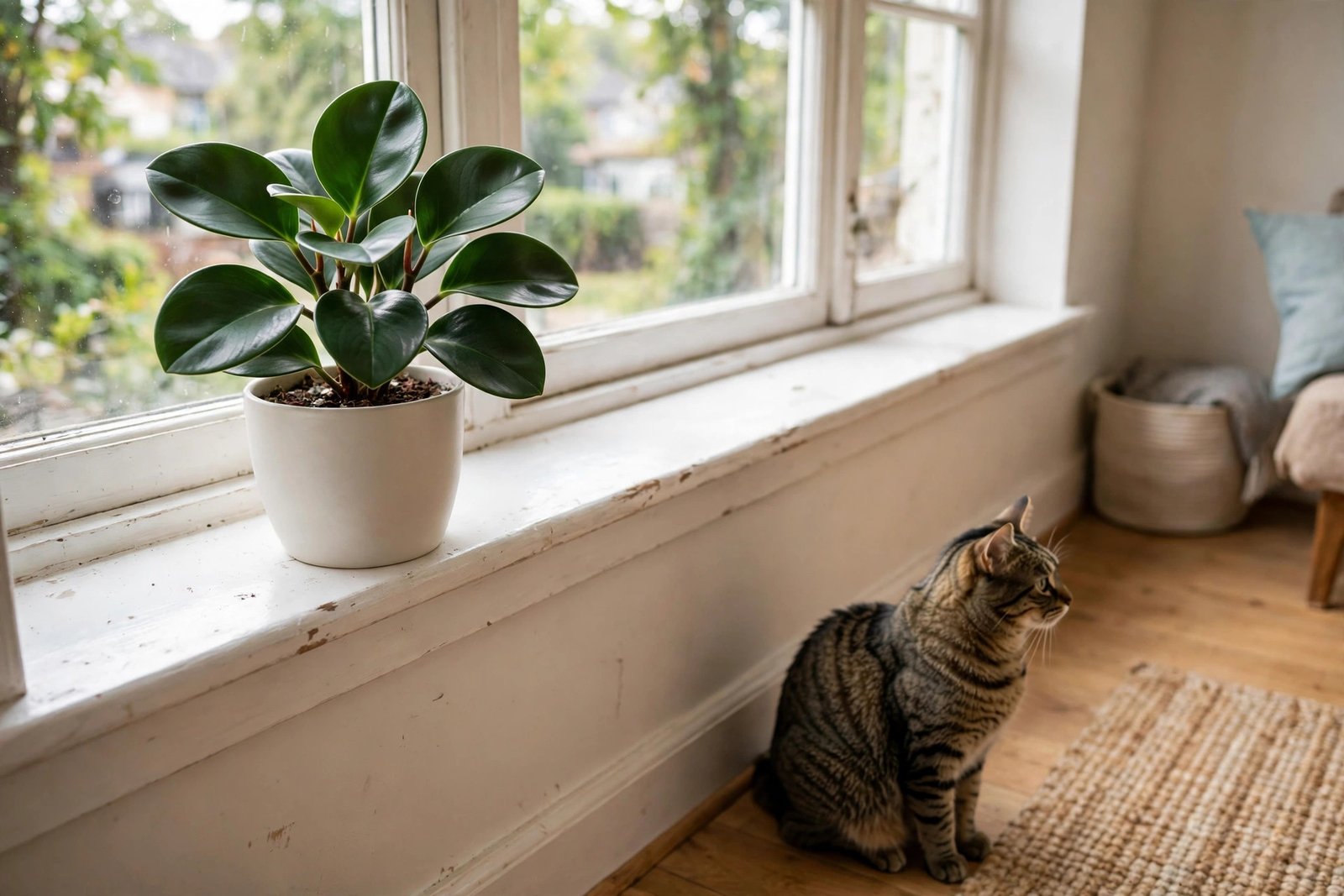
Are peperomia plants safe for cats? Yes — the ASPCA Animal Poison Control Center lists peperomias as non-toxic to cats and dogs. The baby rubber plant (Peperomia obtusifolia), the best-known one, has its own ASPCA entry listing it as non-toxic to dogs and cats, and emerald ripple peperomia (Peperomia caperata) and watermelon peperomia (Peperomia argyreia) are listed the same way.
That makes peperomia one of the easiest safe foliage plants for a cat home: compact, slow-growing, and available in dozens of leaf shapes and colors. It is no surprise the question “are peperomia plants safe for cats” is one of the most asked about this genus. It does not mean a cat should eat it — non-toxic is not the same as safe to chew — and the name needs checking.
The Short Answer
Are peperomia plants safe for cats? For most households, yes. The ASPCA lists the baby rubber plant as non-toxic to dogs and cats, with no toxic principle or clinical signs named. It separately lists emerald ripple peperomia as non-toxic to dogs, cats, and horses, and watermelon peperomia as non-toxic to dogs and cats.
Peperomia is a very large genus — over a thousand species — and not every one has its own ASPCA entry. So the careful answer to “are peperomia plants safe for cats” is: the named species are, and anything unusual needs its own check.
True lilies (Lilium species) and daylilies (Hemerocallis species) are especially dangerous to cats — even pollen or vase water can cause kidney failure — and they should not be in a home with a cat at all. If a bouquet or a mixed arrangement comes into your home, check every stem, not just the peperomia.
Learn the exact types in Are Lilies Toxic to Cats? Types, Exposure Risks, and Urgent Steps.
For plants that are not suitable for cats, see Common Houseplants That Are Toxic to Cats: What to Avoid.
What Is a Peperomia?
A peperomia is a small, compact houseplant grown for its leaves.
The baby rubber plant, Peperomia obtusifolia, is the most common one. North Carolina State Extension describes it as a tropical evergreen shrub, erect and bushy, up to 2 feet tall, with glossy, cupped, oval leaves and pink-tinged leaf stalks. It is also the peperomia behind most searches asking “are peperomia plants safe for cats.”
How to Identify a Peperomia

Check the leaves first: peperomia leaves are thick and slightly fleshy, often glossy, and grow on short stalks from branched stems.
The emerald ripple has deeply ridged, heart-shaped leaves, and the watermelon peperomia has round leaves striped silver and green, like a watermelon rind. Read the label for Peperomia and the species name.
Without that name, “are peperomia plants safe for cats” is a question nobody can answer for you.
What “Non-Toxic” Really Means
When you ask “are peperomia plants safe for cats,” the ASPCA’s “non-toxic” label answers the poisoning question only. Non-toxic means the ASPCA has not identified compounds in the plant known to poison cats, and a cat that nibbles a peperomia leaf is not expected to be poisoned by the plant itself. The ASPCA notes that eating any plant material may cause vomiting and stomach upset in cats, even when the plant is listed as non-toxic.
The leaves are thick and fibrous, so a large amount may cause vomiting or loose stool. It also does not cover sprays and soil additives, which can be a problem if a cat digs.
The Name Trap: Baby Rubber Plant vs. True Rubber Plant
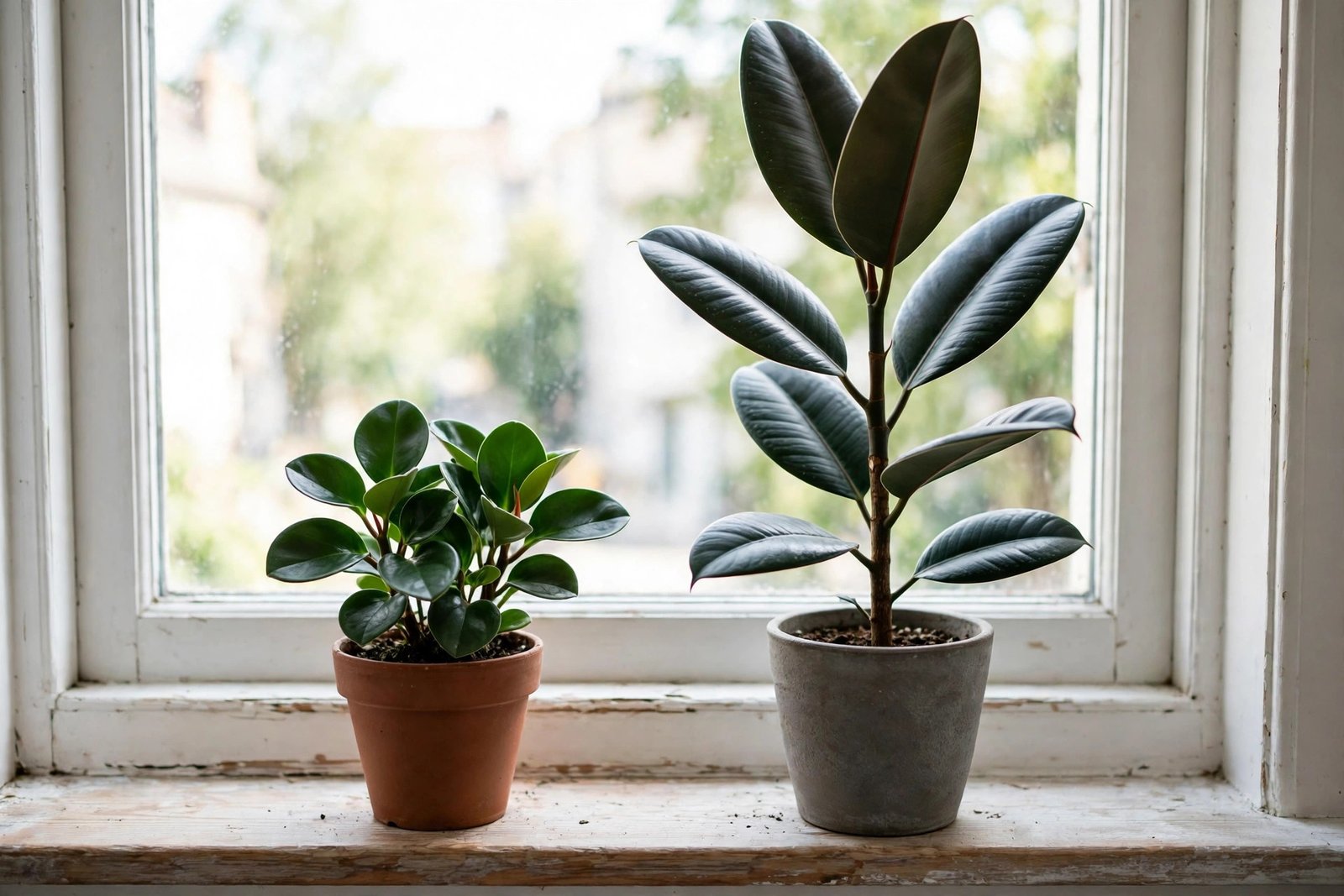
This is the most important confusion behind the question “are peperomia plants safe for cats,” and it is the reason the label matters. The baby rubber plant is Peperomia obtusifolia — a small peperomia, listed as non-toxic to cats and dogs. The true rubber plant is Ficus elastica — a large tree with thick, glossy leaves and milky white latex sap, and it is toxic to cats and dogs.
Both are sold as “rubber plant,” and both have thick, glossy leaves, so a shopper can easily buy the wrong one. That mix-up is the reason “are peperomia plants safe for cats” needs the botanical name, not just the common one.
The difference is in the plant itself: a baby rubber plant stays small, while a true rubber plant grows into a tall tree, with large, smooth, dark green leaves on a single woody trunk, and it bleeds sticky white sap when cut. Peperomia has no milky sap.
The ASPCA’s toxicity picture matches the split. Its genus-level Ficus entry (weeping fig, filed under Ficus sp., also listed as “Indian rubber plant”) is toxic to dogs, cats, and horses, with toxic principles given as a proteolytic enzyme (ficin) and psoralen (ficusin). There is no separate ASPCA entry under the name Ficus elastica itself, so that genus-level listing is the relevant one; North Carolina Extension separately flags Ficus elastica for cats and dogs.
Chewing a true rubber plant can cause oral irritation, drooling, vomiting, and loss of appetite. The rule is simple: if the label says Peperomia, it is the safe one. If it says Ficus, or only “rubber plant” with no botanical name, do not buy it for a cat home until the species is confirmed.
Popular Peperomia Varieties
Not every peperomia has its own ASPCA entry — check the exact species before buying. That gap is why “are peperomia plants safe for cats” has no single yes-or-no answer for the whole genus: it depends on the species on the label.
Baby rubber plant (Peperomia obtusifolia). The most common peperomia, with glossy, cupped, dark green oval leaves. Also sold as pepper face or American rubber plant. ASPCA-listed as non-toxic to dogs and cats.
Emerald ripple peperomia (Peperomia caperata). Deeply ridged, heart-shaped leaves in green, silver, or burgundy. Compact, usually under 8 inches tall. ASPCA-listed as non-toxic to dogs, cats, and horses.
Watermelon peperomia (Peperomia argyreia). Round leaves striped silver and green like a watermelon rind, on red stalks. Compact, usually under 8 inches tall. ASPCA-listed as non-toxic to dogs and cats.
Red edge peperomia (Peperomia clusiifolia). Thick, glossy leaves with red edges, sometimes sold as ‘Ginny’ or ‘Jelly’. No individual ASPCA entry — check the species before buying.
String of turtles (Peperomia prostrata). A trailing peperomia with tiny, round, turtle-shell-patterned leaves on thin stems. No individual ASPCA entry — check the species before buying.
Cupid peperomia (Peperomia scandens). A trailing peperomia with heart-shaped, light green leaves, sometimes variegated with cream. No individual ASPCA entry — check the species before buying.
A variety name such as ‘Rosso’ or ‘Marble’ is a cultivar, not a species — ask which species it belongs to. That one check settles “are peperomia plants safe for cats” for the exact plant in your hand.
Benefits in a Cat Household
A peperomia is one of the few houseplants that is small, easy, and listed as non-toxic to cats all at once. Small, forgiving, and non-toxic is a rare combination, which is why “are peperomia plants safe for cats” gets asked so often by renters and first-time plant owners.
Peperomia Care
Peperomias are low-maintenance, but they have one hard rule: do not overwater them. Good care does not change the answer to “are peperomia plants safe for cats” — the ASPCA listing settled that — but it does decide whether the plant is still alive in a year.
Light
Give bright, indirect light — near an east- or north-facing window, or a few feet back from a south- or west-facing window. They tolerate low light for months, but grow slowly and lose color.
Water

Let the soil dry out between waterings — North Carolina Extension calls them intolerant of wet soil. Water thoroughly, let the excess drain away completely, and do not water again until the top inch or two of soil feels dry.
New owners who ask “are peperomia plants safe for cats” sometimes assume a safe plant is also a tough plant.
Humidity and Temperature
Peperomias prefer medium to low relative humidity — they do not need a humidifier. Keep the plant warm, ideally 65 to 80 degrees Fahrenheit (18 to 27 degrees Celsius), and avoid cold below about 55 degrees Fahrenheit (13 degrees Celsius) and drafty sites. That easygoing nature is another reason “are peperomia plants safe for cats” has such a reassuring answer for most homes.
Soil, Feeding, and Repotting
Use a loose, well-draining mix — standard houseplant mix lightened with perlite or orchid bark — and a pot with drainage holes. Their small root systems suit a small pot, and repotting every two to three years is enough. Feed lightly in spring and summer with a balanced liquid fertilizer diluted to half strength, about once a month, and do not feed in winter.
A pot with drainage holes matters more than any fertilizer, and it has nothing to do with “are peperomia plants safe for cats” — it is pure plant care.
Common Problems
Yellow leaves are the most common complaint, and overwatering is the usual cause — let the soil dry out, check that the pot drains, and remove any soft, rotted stems.
Before you blame the plant, remember that “are peperomia plants safe for cats” is a safety question, not a care guarantee: a stressed peperomia is still non-toxic, it is just unhappy. Pests are uncommon, but watch for mealybugs in leaf joints, spider mites in dry air, and whiteflies under the leaves. Isolate an infested plant and use only a product labeled for indoor houseplants, keeping cats away until it is dry.
Placement in a Home With Cats
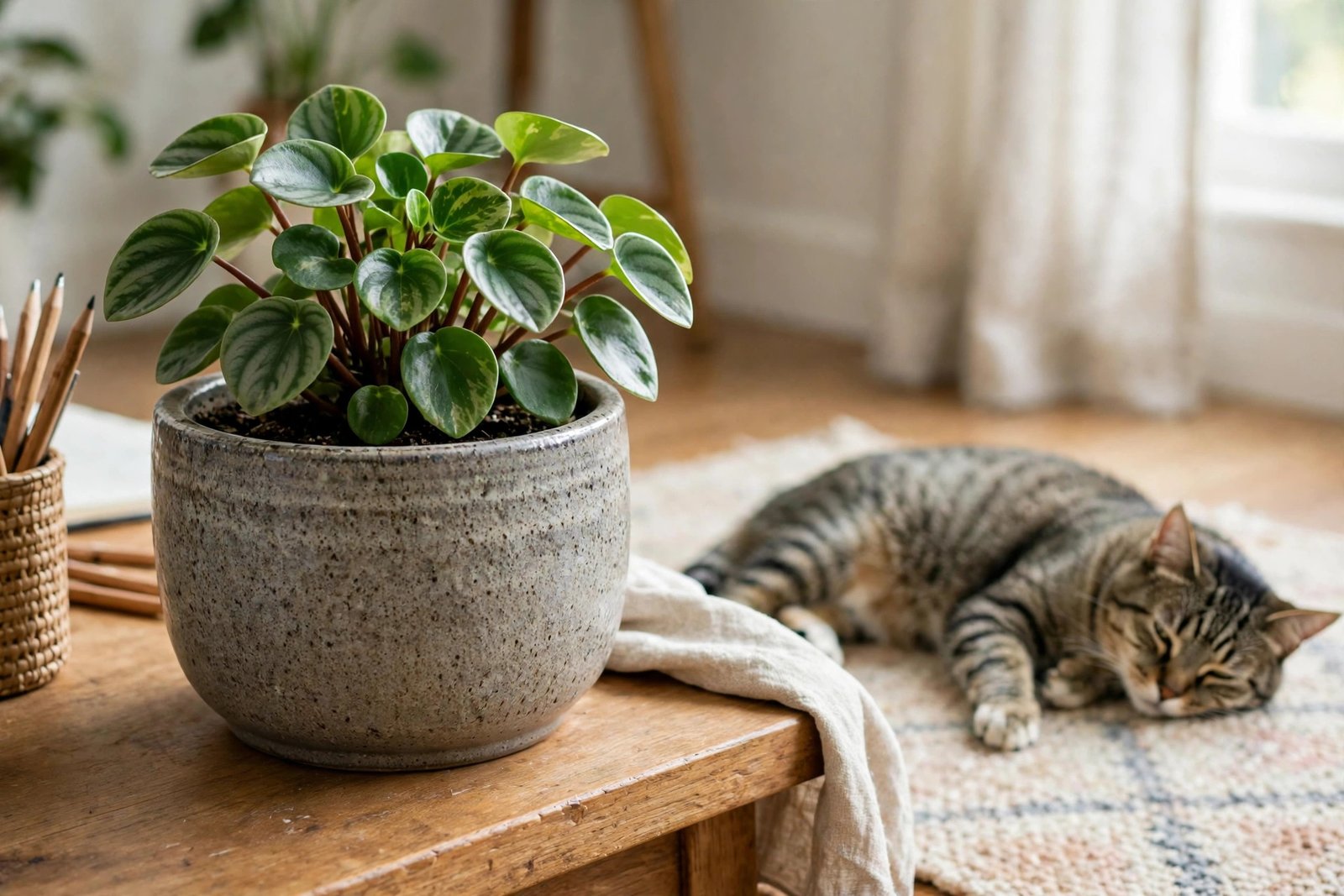
The real question is whether your cat will chew the thick leaves, knock the small pot over, or dig in the soil. The question behind “are peperomia plants safe for cats” is settled; the placement question is about the plant surviving your cat.
Good spots include a desk, a stable shelf in bright, indirect light, or a windowsill. Because the pot is small and light, use a heavier outer cache pot or a tray so it cannot tip over.
For hanging setup details and more ideas, see Are Hanging Planters Safe in Homes With Cats? and Where to Place Houseplants in a Home With Cats.
Are peperomia plants safe for cats? Yes — and a cat that cannot reach the plant cannot chew it either.
If your cat digs in the soil, cover it with large, smooth stones too big to swallow. For more ideas, see How to Keep Cats Out of Houseplants Without Harming Them.
What to Do If Your Cat Chews a Peperomia
Most cases are not emergencies, because the plant is listed as non-toxic. Still, take chewing seriously: move the cat away calmly, note what part was eaten, roughly how much, and when, and watch the cat for the rest of the day.
Contact your veterinarian or an animal poison control service promptly if your cat eats a large amount, vomits repeatedly, has diarrhea that does not settle, drools heavily, seems lethargic, refuses food or water, or has difficulty breathing. In the United States, the ASPCA Animal Poison Control Center is available at (888) 426-4435, and Pet Poison Helpline is available at (855) 764-7661; a consultation fee may apply.
Do not try a home remedy, do not try to make your cat vomit, and do not give medication, milk, or oil unless a veterinarian tells you to. If you are unsure whether the plant was really a peperomia — for example, if it was sold only as a “rubber plant” — treat it as uncertain and call for advice, because “are peperomia plants safe for cats” only holds when the plant is actually a peperomia. For a fuller guide, see What to Do If Your Cat Eats a Toxic Plant: A Safety Guide.
Buying Checklist
Check the botanical name first: Peperomia plus the species name. If the label gives no botanical name, ask for it — and walk away from any plant sold only as “rubber plant.” That single habit is the practical answer to “are peperomia plants safe for cats”: confirm the name, then enjoy the plant.
Ask whether it was treated with pesticides, and keep it out of your cat’s reach for a few days. A plant kept out of reach for a few days also gives you time to double-check “are peperomia plants safe for cats” against the ASPCA list before your cat meets it.
FAQs About Peperomia Plants and Cats
Are peperomia plants safe for cats?
Yes, in the ASPCA sense. The baby rubber plant (Peperomia obtusifolia), emerald ripple (Peperomia caperata), and watermelon peperomia (Peperomia argyreia) are listed as non-toxic to cats and dogs. That does not mean a cat should eat them — a large amount can still cause mild stomach upset.
Can my cat chew peperomia leaves?
A cat may chew a few leaves without being poisoned, but chewing should still be discouraged — it can cause mild stomach upset and damage the plant. Offer cat grass instead, and move the plant out of easy reach.
Is a baby rubber plant the same as a rubber plant?
No. The baby rubber plant is Peperomia obtusifolia, a small peperomia listed as non-toxic to cats. The true rubber plant is Ficus elastica, a large tree with milky sap, and it is toxic to cats.
How often should I water a peperomia?
Let the soil dry out between waterings — usually about once every one to two weeks in spring and summer, less often in winter. Water thoroughly and let it drain completely.
What should I do if my cat eats a lot of peperomia?
Move the cat away, note how much was eaten and when, and watch for vomiting, diarrhea, or lethargy. Contact your veterinarian or an animal poison control service promptly if the cat eats a large amount or shows any worrying change — and remember that “are peperomia plants safe for cats” assumes the plant was correctly identified, so say exactly what the plant was when you call.
Conclusion
So, are peperomia plants safe for cats? For the ASPCA-listed species — baby rubber plant, emerald ripple, and watermelon peperomia — yes.
Treat “non-toxic” as a starting point, not a guarantee: confirm the botanical name, watch out for the true rubber plant, discourage chewing. If you remember one thing, let it be this: “are peperomia plants safe for cats” is a question you answer at the label, not after a nibble.
Disclaimer: This article is for general information only and does not replace advice from a veterinarian. Plant safety listings can change, and individual cats can react differently. If your cat eats a plant and seems unwell, contact your veterinarian or an animal poison control service promptly.
Sources and References
- ASPCA Animal Poison Control Center. “Toxic and Non-Toxic Plants: Baby Rubber Plant.” Scientific name Peperomia obtusifolia; listed as non-toxic to dogs and cats, with no toxic principle or clinical signs named. https://www.aspca.org/pet-care/animal-poison-control/toxic-and-non-toxic-plants/baby-rubber-plant
- ASPCA Animal Poison Control Center. “Toxic and Non-Toxic Plants: Emerald Ripple Peperomia.” Scientific name Peperomia caperata; listed as non-toxic to dogs, cats, and horses. https://www.aspca.org/pet-care/animal-poison-control/toxic-and-non-toxic-plants/emerald-ripple-peperomia
- ASPCA Animal Poison Control Center. “Toxic and Non-Toxic Plants: Watermelon Peperomia.” Scientific name Peperomia argyreia; listed as non-toxic to dogs and cats. https://www.aspca.org/pet-care/animal-poison-control/toxic-and-non-toxic-plants/watermelon-peperomia
- ASPCA Animal Poison Control Center. “Toxic and Non-Toxic Plants.” https://www.aspca.org/pet-care/animal-poison-control/toxic-and-non-toxic-plants — The ASPCA database used to check plant toxicity listings for cats, including the note that eating any plant material may cause vomiting and stomach upset.
- North Carolina Cooperative Extension, Plant Toolbox. “Peperomia obtusifolia.” Native range, identification, light, water, humidity, and common problem guidance for the baby rubber plant. https://plants.ces.ncsu.edu/plants/peperomia-obtusifolia/
2 thoughts on “Are Peperomia Plants Safe for Cats? Types and Care Advice”