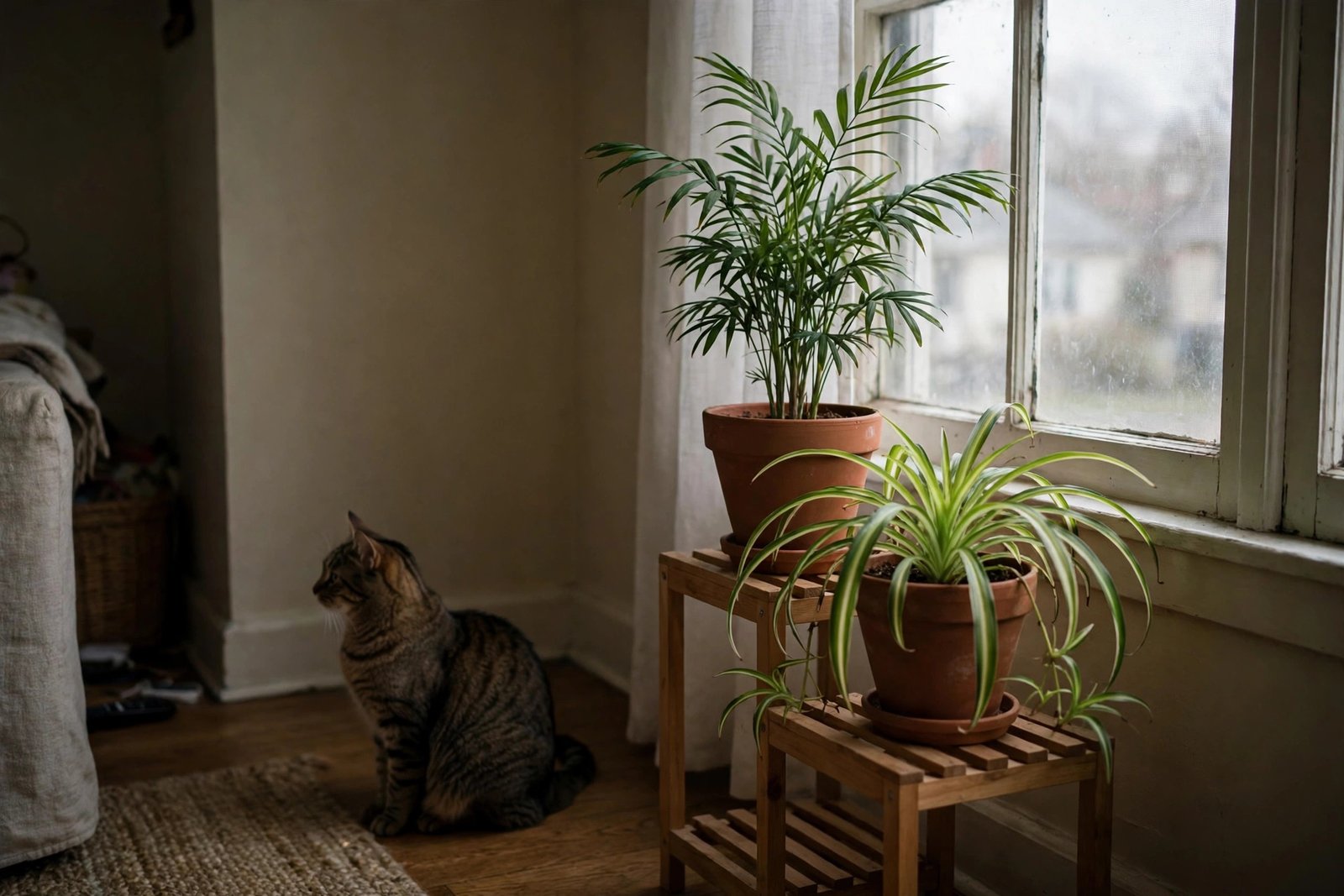
A dark room does not have to be plant-free, and a cat home does not have to be either. The trouble is that the plants famous for surviving low light include some of the most toxic for cats, such as snake plants, ZZ plants, and pothos. That is why cat safe plants for low light deserve a shortlist.
Several genuinely shade-tolerant plants are listed by the ASPCA Animal Poison Control Center as non-toxic to cats. This guide covers seven of the best cat safe plants for low light, explains what “low light” means, and names the popular low-light plants to avoid.
The Short Answer
The best cat safe plants for low light are the parlor palm (Chamaedorea elegans), cast iron plant (Aspidistra elatior), spider plant (Chlorophytum comosum), prayer plant (Maranta leuconeura), peperomia (Peperomia spp.), Boston fern (Nephrolepis exaltata), and African violet (Saintpaulia spp.). Each is listed by the ASPCA as non-toxic to cats, but “non-toxic” does not mean “safe to eat without limit,” and “low light” does not mean “no light.”
Of the seven, the parlor palm and the cast iron plant handle the darkest spots best. The other five need at least medium-low light, so treat this list of cat safe plants for low light as a ranking. The further a plant sits from a window, the slower it grows, and the more carefully you must water it.
What “Low Light” Really Means
“Low light” is one of the most misunderstood labels in houseplant care. It does not mean a windowless room or a corner where you cannot read. It means a spot with no direct sun but still usable daylight, such as a few feet from a north-facing window. Even the toughest cat safe plants for low light need that daylight to live.
Judge a spot with the shadow test: hold your hand a foot above a white piece of paper there, at midday. A sharp, dark shadow means bright light; a soft, fuzzy shadow means medium light; only a faint shadow, or none at all, means low light, and only the toughest cat safe plants for low light will manage there, slowly. If you cannot read a book comfortably there, no plant will thrive without a grow light. In low light, plants grow more slowly and drink less, so check the soil first.
7 Cat-Safe Plants for Low-Light Rooms
The seven cat safe plants for low light below are all listed by the ASPCA as non-toxic to cats. Check the botanical name before you buy: common names are unreliable.
1. Parlor Palm (Chamaedorea elegans)
The parlor palm is the best of all cat safe plants for low light. The ASPCA lists it as non-toxic to cats and dogs, and it tolerates low light better than almost any houseplant. It grows slowly in a north-facing window, and its soft fronds suit a dark corner or a small-window bathroom.
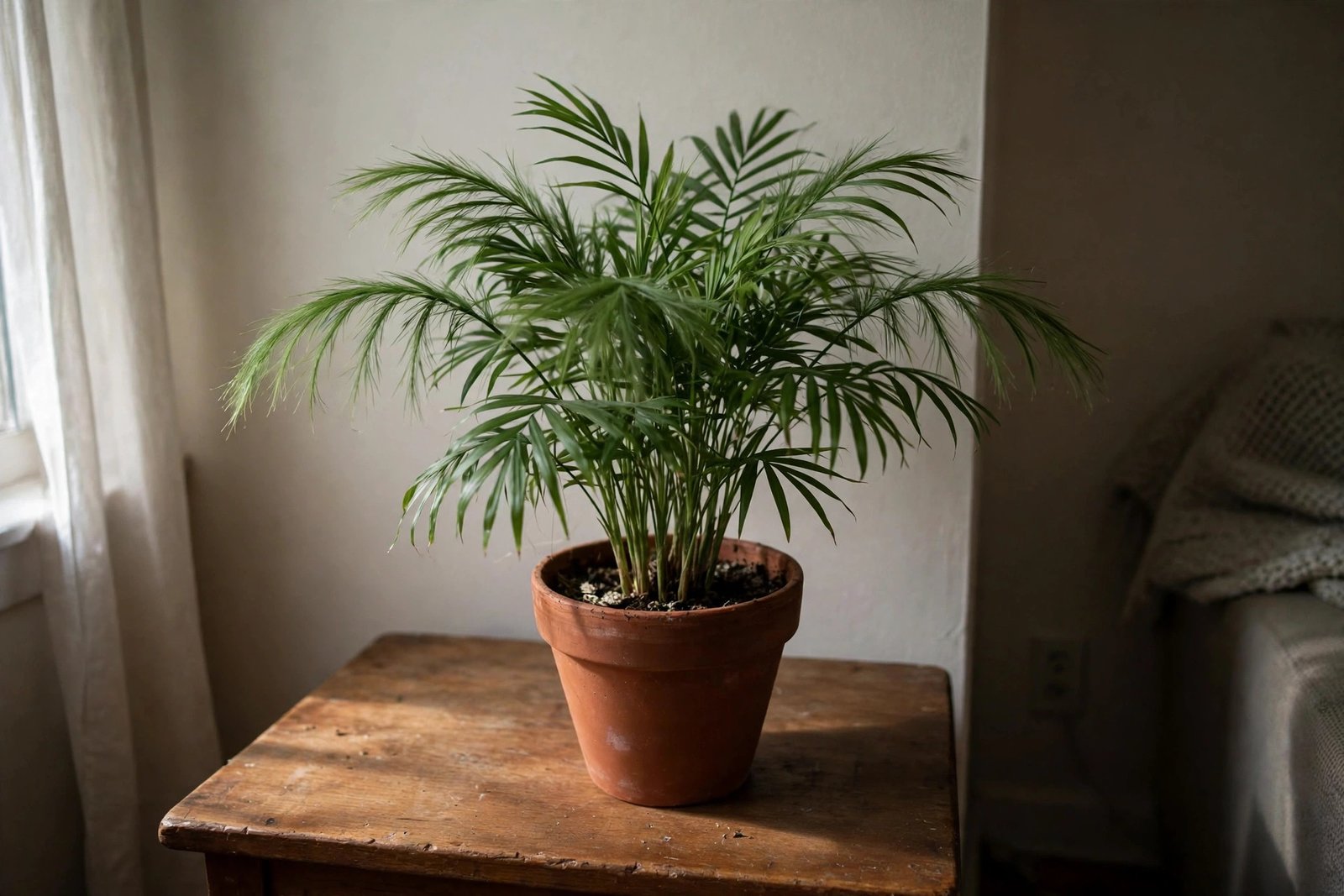
Few cat safe plants for low light are as forgiving: water when the top inch of soil feels dry, never let it sit in standing water, and wipe the fronds so dust does not block light. Full guide: Are Parlor Palms Safe for Cats?.
2. Cast Iron Plant (Aspidistra elatior)
The cast iron plant earned its name honestly: it survives neglect, deep shade, dry air, and irregular watering better than almost any houseplant. The ASPCA lists Aspidistra elatior as non-toxic to cats, dogs, and horses. Among cat safe plants for low light, it is the toughest of all.
Its broad, dark green, leathery leaves grow upright in a full clump. Water only when the soil has dried out, because overwatering is the one thing that will kill it, and keep it out of direct sun. Note: the ASPCA files it under Liliaceae, but it is not a true lily (Lilium spp.).
3. Spider Plant (Chlorophytum comosum)
The spider plant is the classic beginner plant, and it earns its place among cat safe plants for low light because it tolerates low light, though it prefers bright indirect light. The ASPCA lists it as non-toxic to cats and dogs. Its long, arching, striped leaves cascade from a hanging basket, with baby plantlets dangling below.
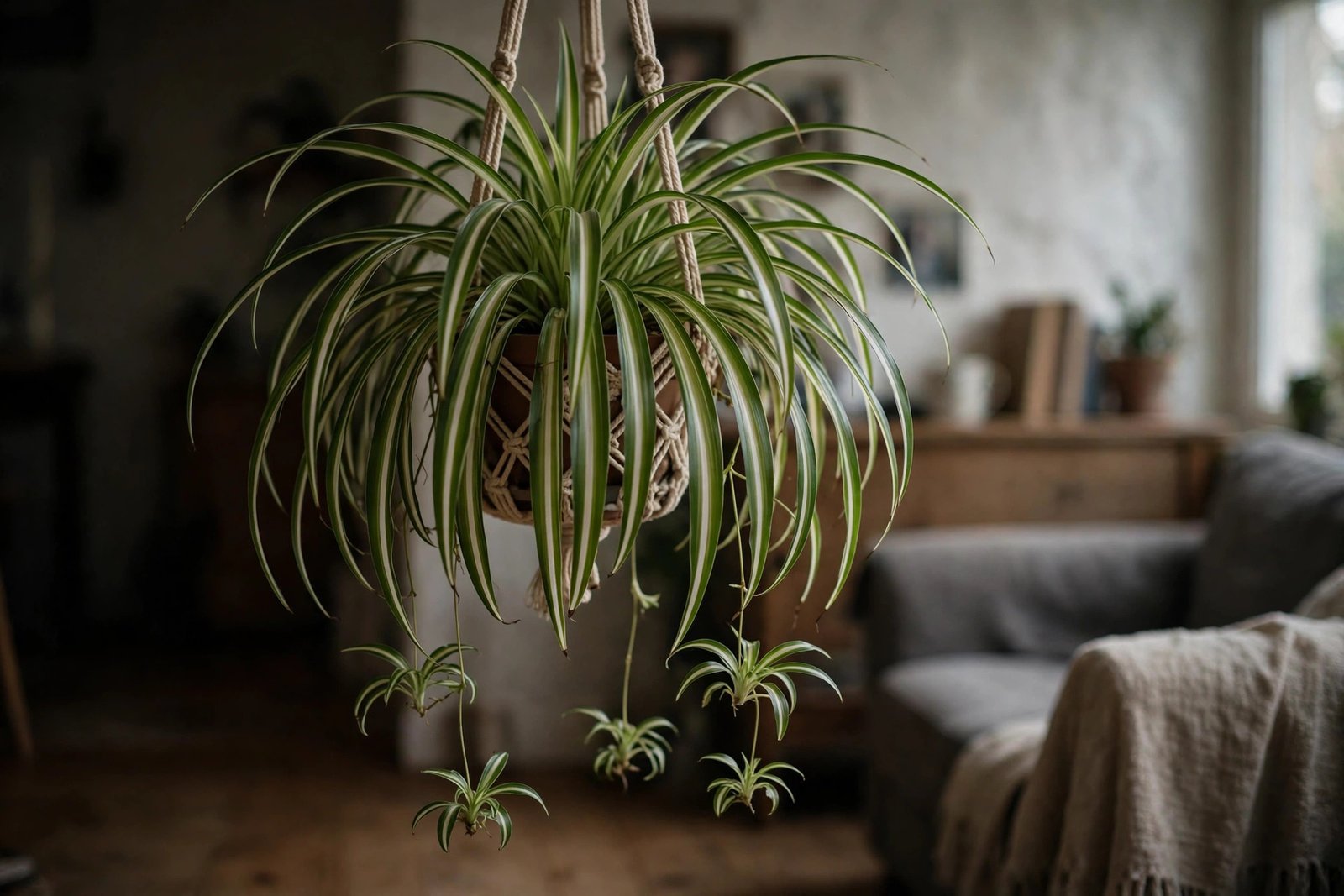
Of all the cat safe plants for low light, the spider plant is the one cats notice first: they bat at the dangling plantlets and chew the leaf tips, so hang it out of easy reach, and offer cat grass nearby instead. Water when the top inch of soil feels dry. Full guide: Are Spider Plants Safe for Cats?.
4. Prayer Plant (Maranta leuconeura)
The prayer plant is a low, spreading plant whose leaves fold upward at night like hands in prayer, and it is one of the few patterned plants that tolerates lower light. It likes medium to low light and humid air, so it suits a bathroom with a small window or a shaded corner. Of all the cat safe plants for low light here, it needs humidity most.
Note the ASPCA naming detail: its “Prayer Plant” entry is filed under Calathea insignis, while the true prayer plant is Maranta leuconeura. Both are listed as non-toxic to cats, so check the label. Use filtered or rainwater if the leaf edges brown.
5. Peperomia (Peperomia spp.)
Peperomias are compact, easy-care houseplants with thick, fleshy leaves, and several types tolerate medium to lower light. The ASPCA lists peperomia as non-toxic to cats, with entries for Peperomia obtusifolia, P. caperata, and P. argyreia. That makes it a solid pick among cat safe plants for low light.
One gap: trailing peperomias sold for baskets have no separate ASPCA entries, so safety rests on the genus. No veterinary source consulted lists any peperomia as toxic, but check the botanical name. Water only when the top of the soil is dry. Full guide: Are Peperomia Plants Safe for Cats?.
6. Boston Fern (Nephrolepis exaltata)
The Boston fern is the lush, feathery fern of old-fashioned hanging baskets, listed by the ASPCA as non-toxic to cats. It tolerates medium light, but it is the thirstiest of the cat safe plants for low light and struggles in a truly dark room. Cats generally leave the fine fronds alone.

Give it the brightest spot in the low-light room, keep the soil evenly moist, and raise humidity with misting. A dry fern drops fronds a cat may chew. If your darkest room has only a tiny north-facing window, choose the cast iron plant or parlor palm. Full guide: Are Boston Ferns Safe for Cats?.
7. African Violet (Saintpaulia spp.)
The African violet is the best flowering option for a lower-light room, and the ASPCA lists it as non-toxic to cats, dogs, and horses. It blooms for months and stays small, suiting a shaded desk or a north-facing sill. It is the only flowering plant among the cat safe plants for low light in this guide.

Be realistic about the blooms: in low light, an African violet will survive, but it will flower less, or not at all, until it gets more light. Water lightly from below, and keep water off the leaves. The genus moved to Streptocarpus, but the ASPCA still lists it as Saintpaulia spp. Full guide: Are African Violets Safe for Cats?.
Low-Light Plants to Avoid in a Cat Home
Some of the most popular low-light plants are toxic to cats, and a dark room makes the risk worse: the plant sits where the cat naps, and a bored indoor cat chews whatever is within reach. Never trust the “low light” label as a safety signal.
The worst offenders are the snake plant (Dracaena trifasciata) and the ZZ plant (Zamioculcas zamiifolia), sold everywhere as “unkillable low-light plants,” yet both toxic to cats. Pothos (Epipremnum aureum) and philodendron (Philodendron spp.) are the other classic pair: both tolerate low light, and both contain calcium oxalate crystals that cause mouth pain, drooling, and vomiting.
Chinese evergreen (Aglaonema modestum) looks harmless, but the ASPCA lists it as toxic to cats. The peace lily (Spathiphyllum spp.) tolerates low light too, but it is toxic as well, and not a true lily: do not confuse it with Lilium species, which can cause kidney failure.
If you already own one of these and have a cat, move it out of the cat’s reach or give it away, and replace it with one of the cat safe plants for low light in this guide. A parlor palm or cast iron plant gives you the same low-light toughness without the risk. For a fuller list, see Common Houseplants That Are Toxic to Cats.
Care Tips for Dark Rooms
Water less, and check first. In low light, soil dries out much more slowly. Check the soil before watering: if it still feels damp, wait. Overwatering is the most common cause of death in dark rooms: yellow leaves, a sour smell, or a plant that falls apart at the base. With cat safe plants for low light, this matters even more, because a rotting plant drops leaves a cat may chew.
Do not overfeed. A plant in low light is barely growing, so it barely needs fertilizer. Feed lightly in spring and summer only, at half strength, and do not feed at all in winter. Fertilizer does not fix low light, and it can burn roots in wet soil.
Consider a grow light. If your room is truly dark, a small LED grow light on a timer for 8 to 12 hours a day is the fix. Place it 12 to 18 inches above the plant, and keep the cord out of the cat’s reach. A grow light turns a room no plant could survive in into a room where cat safe plants for low light can grow.
Place them out of reach. Dark rooms are often the rooms cats love most: a quiet corner to nap in. Place cat safe plants for low light where the cat cannot easily reach them, but still in the light they need: a high shelf, a hanging planter, or a stable stand. Use a heavy outer pot, and cover the soil with large stones too big to swallow, because cats dig in potting soil.
What to Do If Your Cat Chews a Plant
First, find out what the plant is: check the label or take a photo of it. If it is one of the cat safe plants for low light in this guide, a small nibble is usually not an emergency, but watch the cat for the rest of the day. Contact your veterinarian if the cat eats a large amount or vomits repeatedly.
If the plant is toxic, or you are not sure what it is, treat it as an exposure and call your veterinarian or poison control promptly. In the United States, the ASPCA Animal Poison Control Center is at (888) 426-4435, and Pet Poison Helpline is at (855) 764-7661.
Do not wait for symptoms, do not try a home remedy, and do not make your cat vomit. Cornell’s Feline Health Center advises calling a veterinarian immediately, and warns not to induce vomiting unless a veterinarian directs you to.
Frequently Asked Questions
What are the best cat safe plants for low light?
Parlor palm, cast iron plant, spider plant, prayer plant, peperomia, Boston fern, and African violet: these cat safe plants for low light are all ASPCA-listed as non-toxic to cats. The first two handle the darkest spots best.
Can any plant survive in a room with no windows?
No. Every plant needs some light to live, and “low light” still means daylight. A windowless room needs a grow light on a timer for 8 to 12 hours a day, or the plant will slowly starve.
Is a snake plant safe for cats in low light?
No. Snake plants (Dracaena trifasciata) are toxic to cats, and low light does not change that. They are a common mistake in dark rooms because they are sold as unkillable low-light plants. Replace one with a cast iron plant, one of the toughest cat safe plants for low light.
Why is my low-light plant stretching toward the window?
It needs more light. Stretching, pale leaves, and wide gaps between leaves mean the plant is reaching for light it is not getting. Move it closer to the window, clean the leaves, or add a grow light.
How often should I water plants in low light?
Less often than the same plant in a bright window. Check the soil with your finger an inch deep, and water only when it feels dry at that depth. In a dark room, most plants on this list need water every two to three weeks.
Conclusion
A low-light room and a cat can share the same plants, as long as you pick from the right list. Start with a parlor palm or a cast iron plant, check the botanical name, run the shadow test where the plant will live, and water less than you think. Keep the toxic low-light plants out of the home entirely. Choose only from proven cat safe plants for low light.
Before you buy, read the label: Chamaedorea, Aspidistra, Chlorophytum, Maranta, Peperomia, Nephrolepis, or Saintpaulia means safe. If it says Dracaena, Zamioculcas, Epipremnum, Philodendron, Aglaonema, or Spathiphyllum, put it back, and stick to cat safe plants for low light. For more help, see 15 Cat-Safe Houseplants for a Greener, Pet-Friendly Home.
Disclaimer: This article is for general information only and does not replace advice from a veterinarian. If your cat eats a plant and seems unwell, contact your veterinarian promptly.
Sources
- ASPCA — Cast Iron Plant: Aspidistra elatior, non-toxic to dogs, cats, and horses.
- ASPCA — Parlor Palm: Chamaedorea elegans, non-toxic to dogs and cats.
- ASPCA — Prayer Plant: filed under Calathea insignis, non-toxic to dogs, cats, and horses.
- ASPCA — Spider Plant: Chlorophytum comosum, non-toxic to dogs and cats.
- ASPCA — African Violet: Saintpaulia spp., non-toxic to dogs, cats, and horses.
- ASPCA — Chinese Evergreen: Aglaonema modestum, toxic to dogs, cats, and horses.
- ASPCA — Toxic and Non-Toxic Plant List, Cats: the ASPCA database.
- Cornell Feline Health Center — Common Cat Hazards: advises calling a veterinarian immediately.
3 thoughts on “Cat Safe Plants for Low Light Rooms: Options and Care Tips”