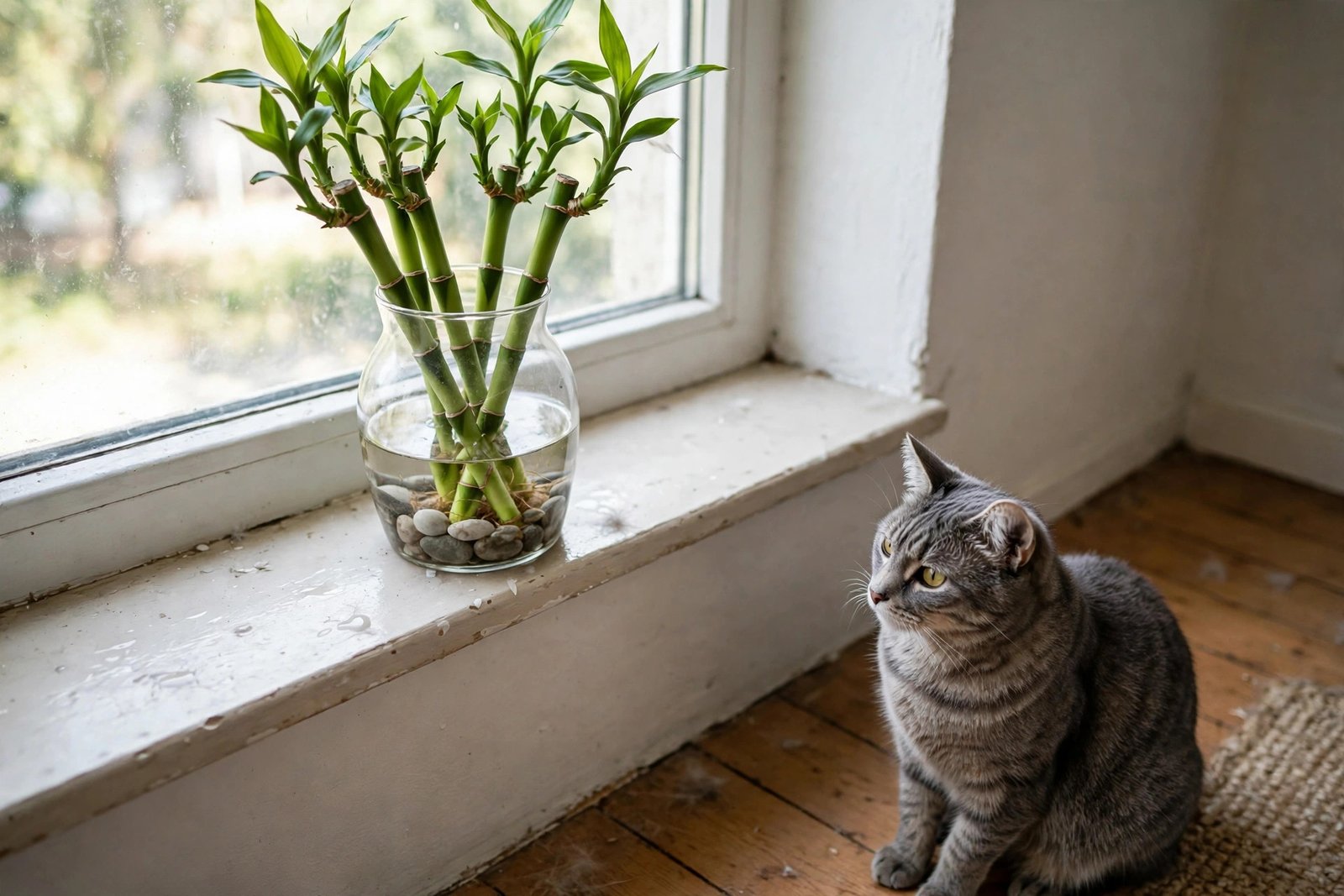
If you are asking is lucky bamboo safe for cats, the short answer is no — and the reason surprises most plant owners. Lucky bamboo is not bamboo at all. It is a Dracaena, a tropical plant sold in glass vases and small pots in almost every grocery store, gift shop, and plant aisle, and the ASPCA lists Dracaena species as toxic to cats and dogs.
The confusion is understandable. The plant looks like bamboo, it is sold as bamboo, and plenty of well-meaning articles call it pet-safe. But the name on the label is a marketing name, not a botanical one, and the plant inside the vase carries compounds that can make a cat sick. So is lucky bamboo safe for cats in every situation? No — and this guide explains why, what the risks look like, and which genuinely safe plants give you the same look.
Is Lucky Bamboo Safe for Cats?
When people ask is lucky bamboo safe for cats, the ASPCA entry is the first place to check. The ASPCA lists Dracaena — the genus lucky bamboo belongs to — as toxic to cats, dogs, and horses, and names saponins as the toxic principle. That listing covers lucky bamboo, Dracaena sanderiana, and its close relative Dracaena braunii, which some shops sell under the same name.
That is why the answer to is lucky bamboo safe for cats is no. Every part — leaves, stems, and roots — contains saponins, so no part is safe to chew. The ASPCA records vomiting (occasionally with blood), depression, loss of appetite, drooling, and dilated pupils in cats.
Most cases stay mild to moderate — a miserable cat for a day, not a dying one — but that still means a vet visit. For a direct comparison, read our guide to common houseplants that are toxic to cats and our guide to whether lilies are toxic to cats.
True bamboo is a completely different plant: the ASPCA lists bamboo, Bambusa vulgaris, as non-toxic to cats, dogs, and horses. The two plants share a name and a look, but not a safety rating.
What Is Lucky Bamboo, Really?
Lucky bamboo is Dracaena sanderiana, a tropical evergreen from Central Africa in the asparagus family, Asparagaceae. It is a relative of the corn plant and the Madagascar dragon tree. The “bamboo” in its name comes from its slim, jointed green stalks, which resemble bamboo canes.
In shops it is sold as bare stalks in water in a glass vase, often with pebbles, or potted in a small container. Growers shape young stalks into spirals, braids, and tiered towers, and the leaves are narrow, glossy, and lance-shaped. Knowing what you are looking at matters, because is lucky bamboo safe for cats only matters once you know the plant is a Dracaena.
The plant is popular because it needs almost no care, grows in water or soil, tolerates low light, and fits on a desk. It is also cheap, so it turns up as a housewarming gift, an office decoration, and a starter plant — which is why it ends up in so many homes with cats. That popularity is exactly why the question is lucky bamboo safe for cats gets asked so often.
Lucky Bamboo vs. True Bamboo: The Key Differences
One is a grass; the other is a Dracaena. One is listed as non-toxic; the other is listed as toxic.
| Feature | Lucky bamboo | True bamboo |
|---|---|---|
| Botanical name | Dracaena sanderiana | Bambusa or Phyllostachys species |
| ASPCA listing | Toxic to cats and dogs | Non-toxic to cats and dogs |
| Toxic compounds | Steroidal saponins | None identified |
| Leaves | Narrow, glossy, lance-shaped | Long, papery, grass-like |
If you want the bamboo look without the risk, buy true bamboo — but read the label first, since a plant called “bamboo” is very often lucky bamboo. The botanical name is the reliable check: Dracaena sanderiana means the answer to is lucky bamboo safe for cats is no, while Bambusa or Phyllostachys means a real bamboo the ASPCA lists as non-toxic.
What Makes Lucky Bamboo Toxic to Cats?
The reason the answer to is lucky bamboo safe for cats is no is a group of compounds called steroidal saponins. Saponins are natural chemicals the plant produces as a defense against being eaten, and they irritate the lining of a cat’s mouth, stomach, and intestines on contact. The irritation starts as soon as the saponins touch the mouth lining, which is why drooling is often the first sign.
Saponins are in every part of the plant — leaves, stems, and roots — and in every form sold: fresh stalks, cut pieces, and dried material are all equally hazardous. The vase water is a risk too, since compounds leach from the cut stems.
There is no published minimum toxic dose for cats, and no safe amount to chew. A small nibble often causes only mild drooling and one bout of vomiting, while a larger mouthful can lead to repeated vomiting, diarrhea, lethargy, and dilated pupils.
Symptoms to Watch For
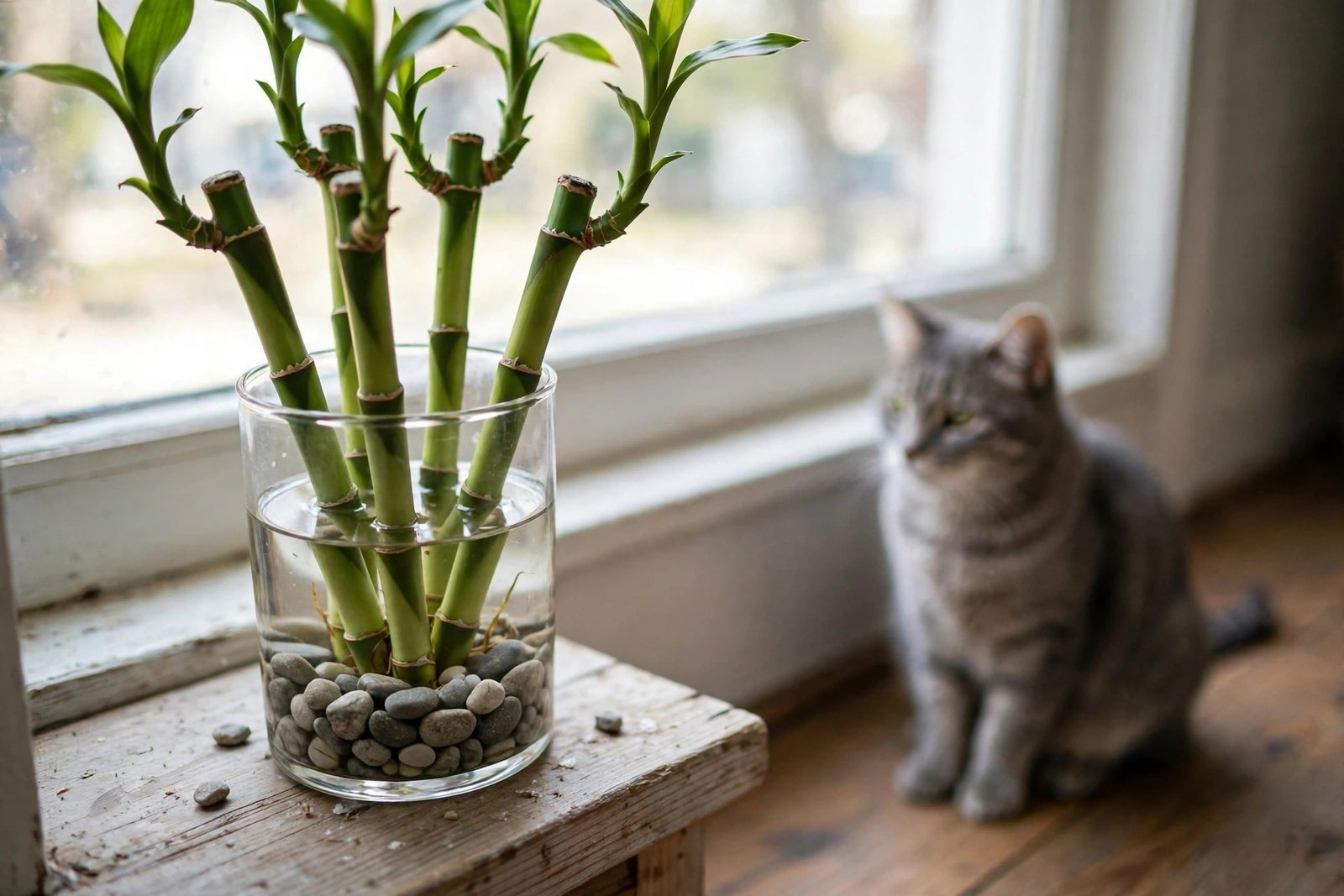
If your cat chews lucky bamboo, signs usually appear within minutes to a few hours. Drooling and pawing at the mouth come first, as the saponins irritate the mouth. Vomiting often follows within 30 to 60 minutes, sometimes repeated over the next few hours, and it may occasionally contain blood.
Watch for loss of appetite, lethargy, weakness, and depression over the next 12 to 24 hours — a cat that hides, refuses food, or moves less than usual is showing the plant’s effect. Cats may also develop dilated pupils and a wobbly walk with larger ingestions. For the full picture, see our guide to the symptoms of plant poisoning in cats.
Most cats recover with veterinary care. Serious signs are vomiting that does not stop, ongoing diarrhea, refusal to eat or drink, marked lethargy, tremors, or disorientation. If you see any of those, the question is no longer is lucky bamboo safe for cats — it is how fast you can reach a veterinarian.
What to Do If Your Cat Chews Lucky Bamboo
Stay calm and remove the plant from your cat’s reach. Check what your cat ate — leaves, stem, or vase water — and note the time, because your veterinarian will ask. Gently wipe plant material from your cat’s mouth if you can do so safely, and offer fresh water.
Contact your veterinarian or the ASPCA Animal Poison Control Center at (888) 426-4435 right away, even if your cat seems fine — early signs can be subtle, and a professional can tell you what to watch for and whether your cat needs to be seen. If your vet is unavailable, the poison control line is staffed around the clock. Keep the plant or a photo of it, including any label, so the vet can confirm the species. See our guide on what to do if your cat eats a toxic plant for the same steps in more detail.
Do not try a home remedy, and never try to make your cat vomit unless a veterinarian tells you to. The right response is a phone call to a vet or poison control, prompt transport if they advise it, and close watching for the next 12 to 24 hours.
How to Tell Lucky Bamboo From True Bamboo
The fastest check is the label. Lucky bamboo is sold as bare stalks in water or in a small pot, with a tag that says “lucky bamboo” and, if you are lucky, the botanical name Dracaena sanderiana. True bamboo is sold as a potted grass with tall canes, and its tag should name Bambusa or Phyllostachys. If the tag gives no botanical name, ask the seller.
A second check is the stem: lucky bamboo stalks are smooth, fleshy, and bright green, and they bend easily when young — that is how growers twist them into spirals and braids. True bamboo canes are woody and hollow, with hard joints, and do not bend into spirals.
If the “bamboo” on the shelf bends like a soft stem and sits in a vase of water, it is a Dracaena — use these checks before you buy, because is lucky bamboo safe for cats is a question best answered in the shop, not at the vet.
Can You Keep Lucky Bamboo in a Home With Cats?
The honest answer is that it depends on your cat, but the safest answer is no. Some owners keep lucky bamboo in a room the cat never enters, on a high shelf inside a closed cabinet, or in a hanging planter the cat cannot reach. Those arrangements can work, but they depend on a door staying shut and a cat that never gets curious. That is why is lucky bamboo safe for cats is best answered by removing the plant, not by finding a higher shelf.
If you already own lucky bamboo, move it to a cat-free room, give it to a friend without pets, or replace it with a safe plant that gives you the same look — a tall plant stand does not solve the problem, since a cat can climb a stand as easily as a shelf.
The vase water deserves its own warning too: even if your cat never chews a leaf, a cat that drinks from the vase is exposed to saponins leached from the cut stems. For placement ideas that work with cats, see our guides to where to place houseplants in a home with cats and how to keep cats out of houseplants.
Safe Alternatives to Lucky Bamboo
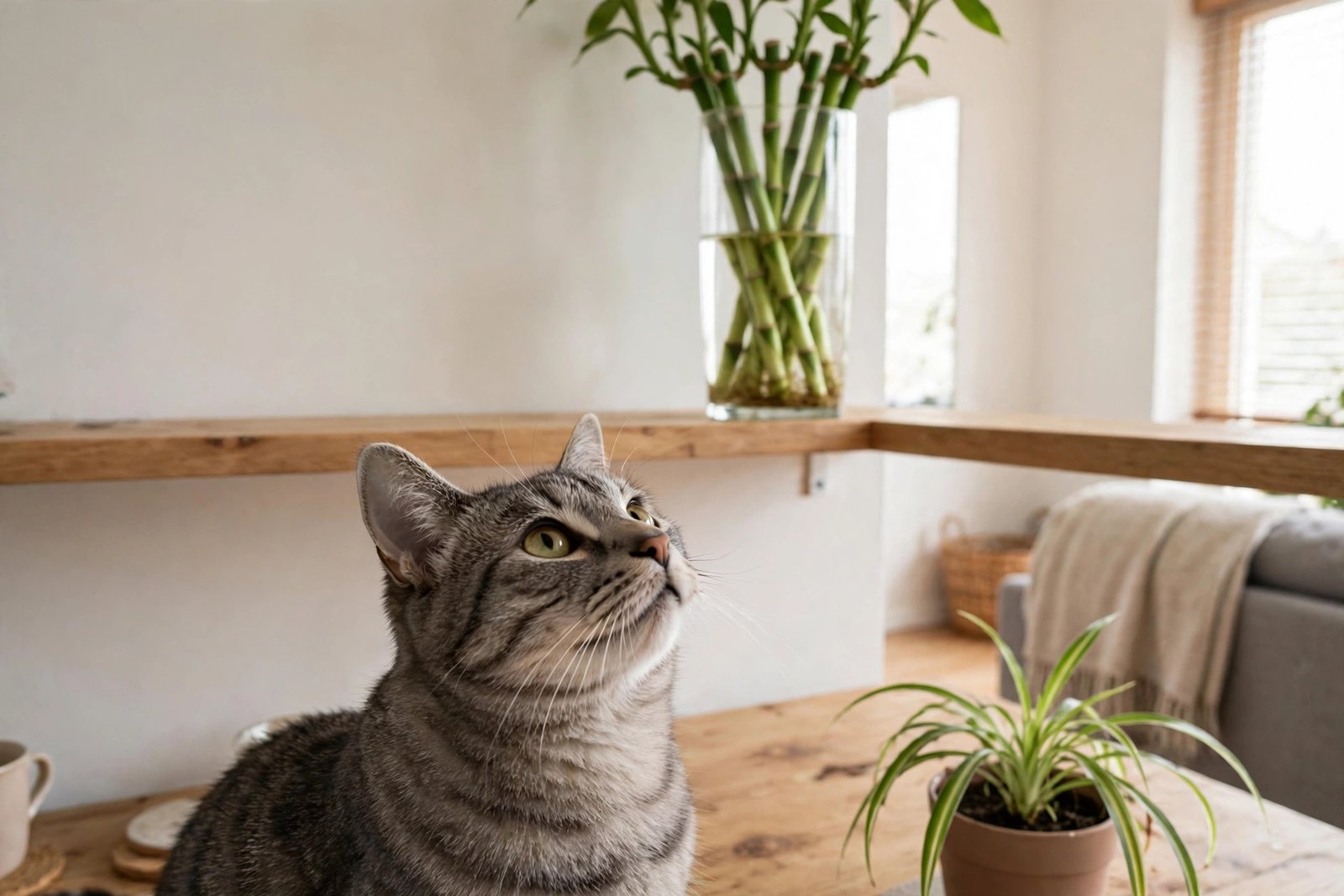
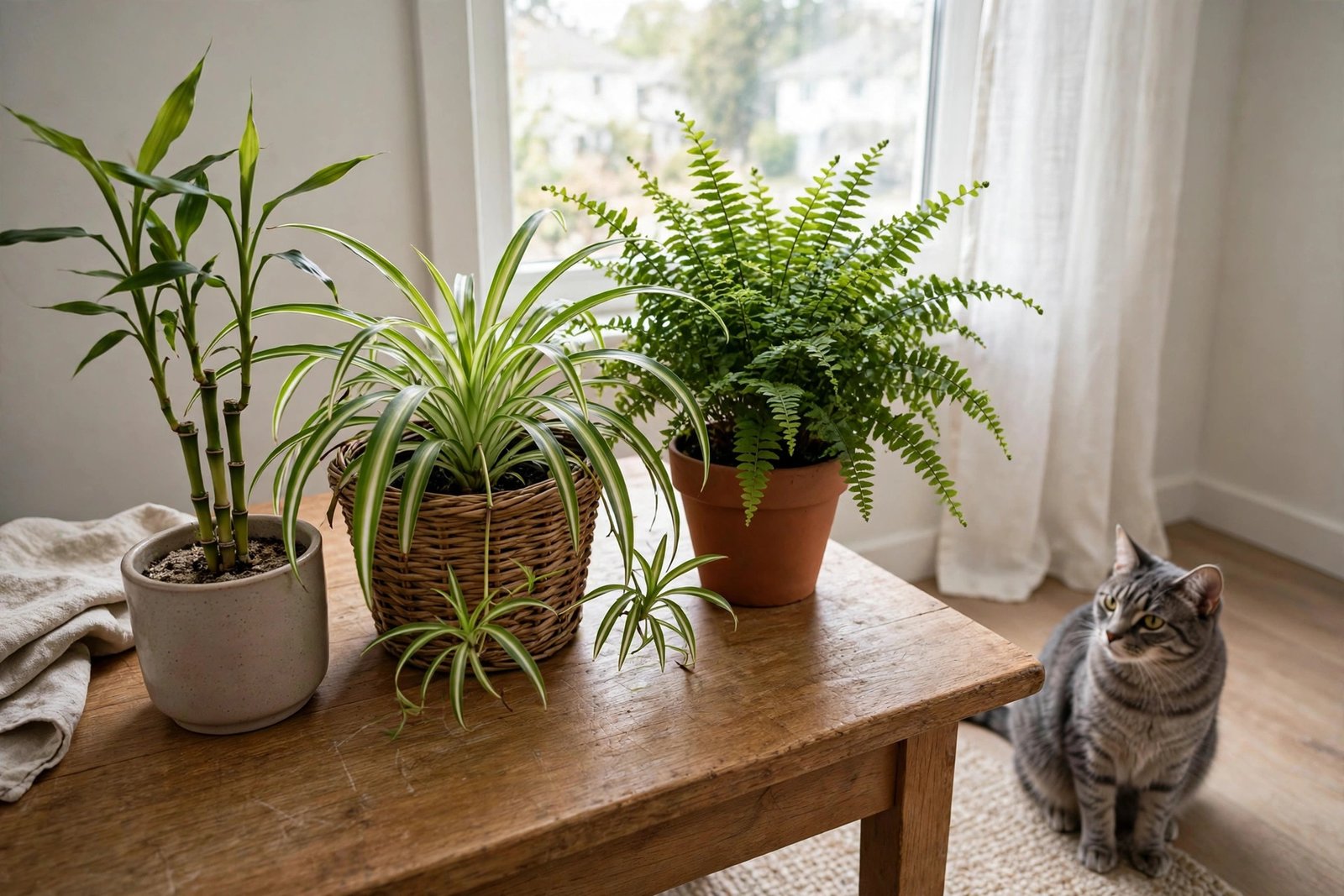
If you love the look of lucky bamboo — tall green stalks, a clean vase, a plant that thrives in water — you do not have to give it up, only switch species. The plants below give you the same style with none of the risk, and every one is listed as non-toxic by the ASPCA. If you have been asking is lucky bamboo safe for cats and hoping for a yes, these plants are the yes you were looking for.
| Alternative | Why it works | Care level |
|---|---|---|
| True bamboo (Bambusa or Phyllostachys) | The real thing — tall canes, grass-like leaves, non-toxic | Moderate; needs bright light and space |
| Spider plant (Chlorophytum comosum) | Arching green-and-white leaves, very forgiving | Easy; tolerates low light |
| Parlor palm (Chamaedorea elegans) | Compact, elegant, safe for cats and small spaces | Easy; tolerates low light |
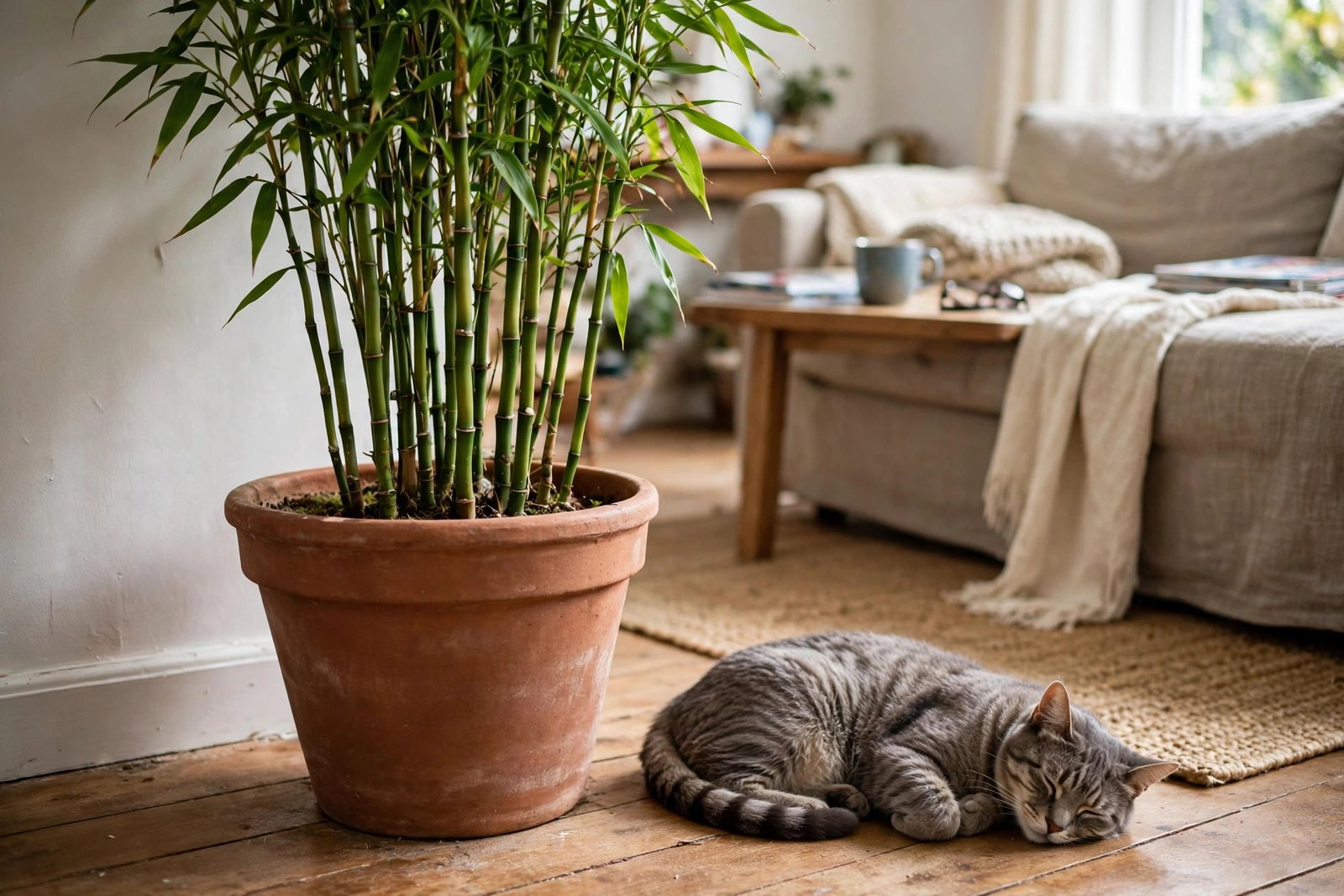
True bamboo is the closest match in looks, but it grows fast and needs space, so it suits a large pot on the floor rather than a desk vase. For a desk or a shelf, a spider plant or a parlor palm gives you the same green height in a cat-safe package. See our comparison of cat grass versus houseplants and our guide on how to stop cats chewing houseplant leaves for more on giving your cat a safe outlet.
True Bamboo Care Basics for Beginners
True bamboo needs bright light — near a south- or west-facing window, or a few feet from an east-facing one. It grows fast and can reach several feet tall indoors, so choose a pot with room to grow and a heavy base a cat cannot tip over. Keep it above 55°F and away from cold drafts and heating vents.
Water when the top inch of soil feels dry, and water thoroughly until it drains from the bottom, then empty the saucer so the roots never sit in water. Bamboo likes humidity around 50 percent or higher, so a pebble tray under the pot helps if the leaf tips turn brown. Feed lightly at half strength once a month in spring and summer.
Frequently Asked Questions
Is lucky bamboo safe for cats if my cat only nibbles a leaf?
No — is lucky bamboo safe for cats is a no even for a small nibble. The leaves contain saponins, and even a small bite can cause drooling and vomiting. A nibble is less dangerous than a large mouthful, but it is still worth a call to your veterinarian.
Is lucky bamboo toxic to cats or just irritating?
It is toxic. The ASPCA lists Dracaena species as toxic to cats, and names saponins as the toxic principle. The saponins irritate the mouth and gut, and in larger amounts they can cause depression, dilated pupils, and loss of coordination — “irritating” understates it.
Can I keep lucky bamboo if my cat never touches plants?
You can, but it depends on your cat never changing its habits — a plant ignored for a year can become interesting overnight. That is why is lucky bamboo safe for cats stays a no even for cats that usually ignore plants. If you keep it, put it in a room your cat cannot enter — or replace it with true bamboo and remove the risk entirely.
Is the water in a lucky bamboo vase dangerous for cats?
Yes, it can be. Compounds from the cut stems leach into the vase water, and a cat that drinks from it is exposed to the same saponins. Keep the vase where your cat cannot drink from it, and change the water regularly.
What is a safe bamboo I can buy instead?
True bamboo — look for the botanical names Bambusa or Phyllostachys on the label. The ASPCA lists bamboo as non-toxic to cats, dogs, and horses. Check the label before you buy, because a plant sold simply as “bamboo” in a shop is very often lucky bamboo instead.
My cat chewed lucky bamboo yesterday and seems fine now — should I still call the vet?
Yes. Symptoms can appear within a few hours but can also linger, and a cat that seems fine may still be mildly ill. A quick call to your veterinarian or the ASPCA Animal Poison Control Center at (888) 426-4435 costs nothing and tells you exactly what to watch for.
Conclusion
So, is lucky bamboo safe for cats? No — lucky bamboo is Dracaena sanderiana, not a bamboo at all, and the ASPCA lists Dracaena species as toxic to cats because of the saponins in every part of the plant. A cat that chews it can drool, vomit, lose its appetite, and show dilated pupils. The name is the trap: it looks like bamboo, it is sold as bamboo, and it is not bamboo.
Before you buy any plant sold as bamboo, check the botanical name: Dracaena sanderiana means toxic; Bambusa or Phyllostachys means a true bamboo the ASPCA lists as non-toxic. If you already own lucky bamboo, move it to a cat-free room or replace it with true bamboo, a spider plant, or a parlor palm. If a friend asks is lucky bamboo safe for cats, you can now answer no — and explain the Dracaena behind the name. To build a wider collection, continue with our list of 15 cat-safe houseplants.
Disclaimer: This article is for general information only and does not replace advice from a veterinarian. Plant safety can depend on the exact species, the amount eaten, and the individual cat. If your cat is unwell after chewing or eating any plant, contact your veterinarian or an animal poison control service promptly.