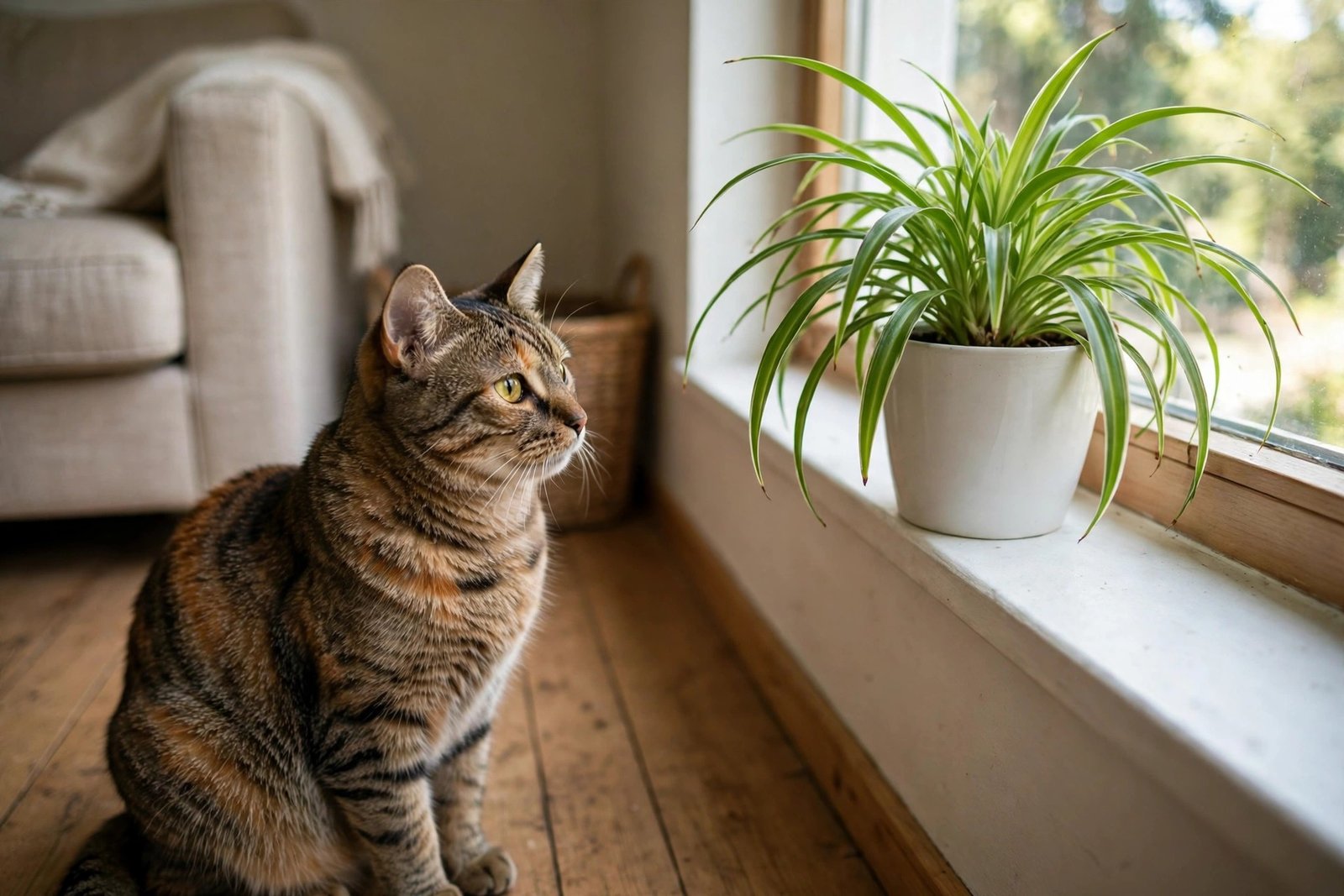
A new houseplant should be exciting, not stressful — but in a home with a cat, it is also a new object to sniff, bat, and chew. If it turns out to be toxic, one curious bite can become an emergency. Introducing houseplants to cats safely is a short routine: check the plant, quarantine it, and place it well.
The Short Answer
Before a new plant enters your home, confirm its exact identity — common name and botanical name — and check the ASPCA plant list. Quarantine it separately for one to two weeks, place it out of easy reach, offer something safe to chew, and watch the first few days closely.
Introducing houseplants to cats in this order matters, because each step protects the next one: a checked plant cannot surprise you, and a quarantined plant cannot bring pests or treated leaves into the living room.
Step 1: Check the Plant’s Safety Before You Buy It
The most important safety check happens in the shop: a plant’s safety listing follows its botanical name, not the tag. Introducing houseplants to cats starts with knowing exactly what the plant is.
Get the Botanical Name
Read the label for the Latin name, such as Chlorophytum comosum for a spider plant. If the label gives only a common name, ask the seller — and if nobody can tell you, do not buy the plant. A “palm” could be a parlor palm, listed as non-toxic, or a sago palm, which is highly toxic — and not even a true palm.
A “lily” could be a peace lily, which irritates the mouth, or a true lily (Lilium species), which can cause life-threatening kidney failure. When you are introducing houseplants to cats, the botanical name is the one detail worth slowing down for — photograph the label. For the full lily guide, see Are Lilies Toxic to Cats? Types, Exposure Risks, and Urgent Steps.
Check the ASPCA List
Search the botanical name on the ASPCA plant list for cats. Do not trust the shop tag — check the name yourself before the plant comes home. Introducing houseplants to cats without this check is a gamble: the shop tag is a sales label, not a safety certificate.
Remember What “Non-Toxic” Means
A plant listed as non-toxic is not the same as a plant that is safe to chew: non-toxic means the ASPCA has found no compounds in it known to poison cats. A cat that eats a lot of any plant material can still get stomach upset. That is why introducing houseplants to cats still means protecting even a non-toxic plant. For plants that pass the safety check, see 15 Cat-Safe Houseplants for a Greener, Pet-Friendly Home.
Red Flags in the Shop
Walk away if the label gives no botanical name, the seller cannot confirm what it is, or it is sold only as “assorted foliage” or “mini palm.” Gift plants and bouquets often arrive with no label — if you cannot identify every stem, keep it away from your cat until you have checked each one, because introducing houseplants to cats safely depends on knowing exactly what you bought. See Common Houseplants That Are Toxic to Cats: What to Avoid for the plants most often involved.
Step 2: Quarantine the New Plant for One to Two Weeks
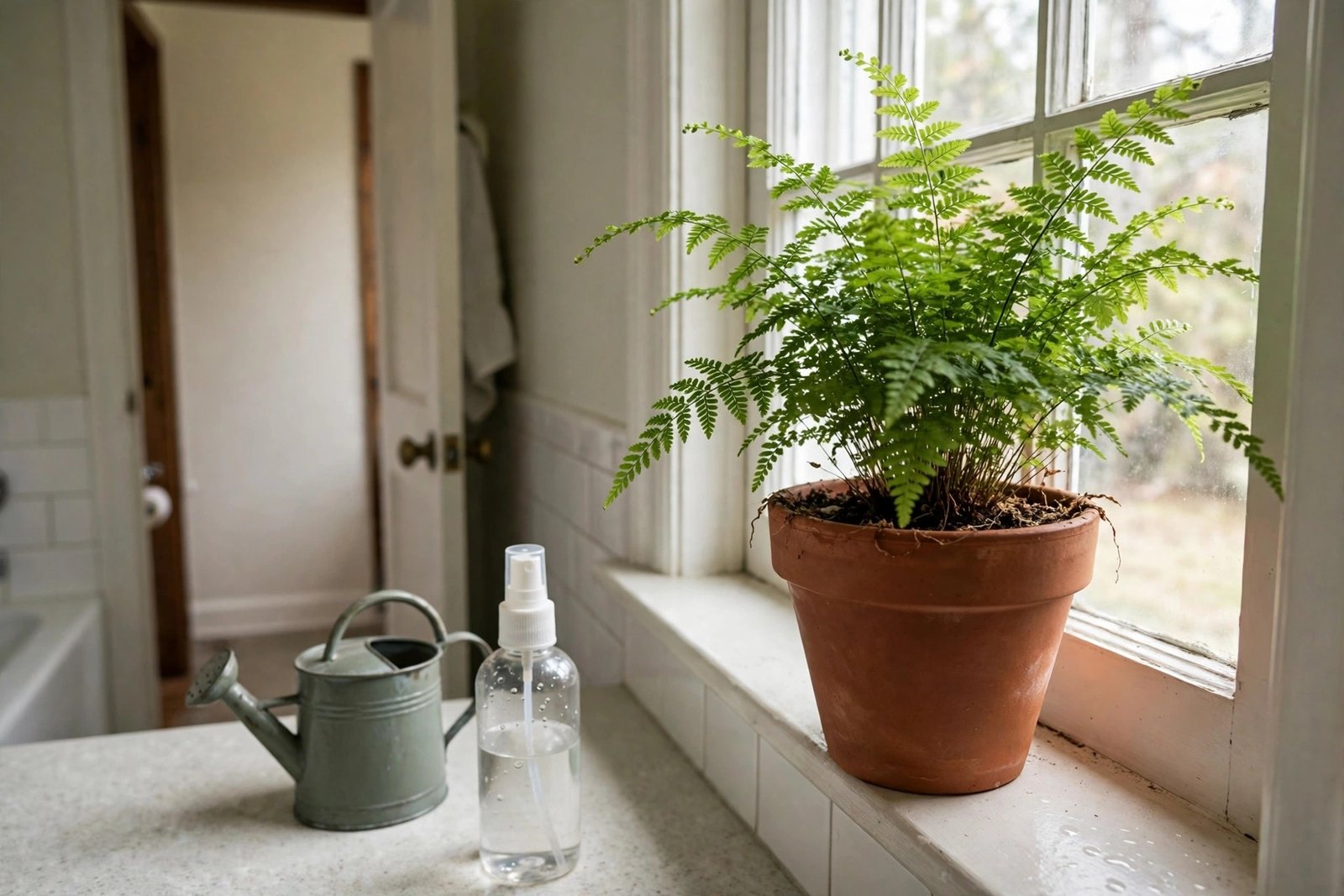
Even a safe plant should not go straight onto your shelf: new plants can carry pests and are often treated with pesticides. A short quarantine protects your other plants and your cat. Introducing houseplants to cats goes far more smoothly when the plant has already spent two quiet weeks alone.
Put the new plant in a separate room your cat cannot enter — a spare bedroom, bathroom, or laundry room — for one to two weeks. During that time, check the leaves, especially the undersides, for insects, webbing, or white cottony clumps. Water it normally, do not spray it, and do not move it into the living area until the quarantine period is over and the plant looks healthy. Introducing houseplants to cats is easier when the placement is decided before the cat ever sees the plant.
Step 3: Choose the Right Spot
Light First, Then Reach
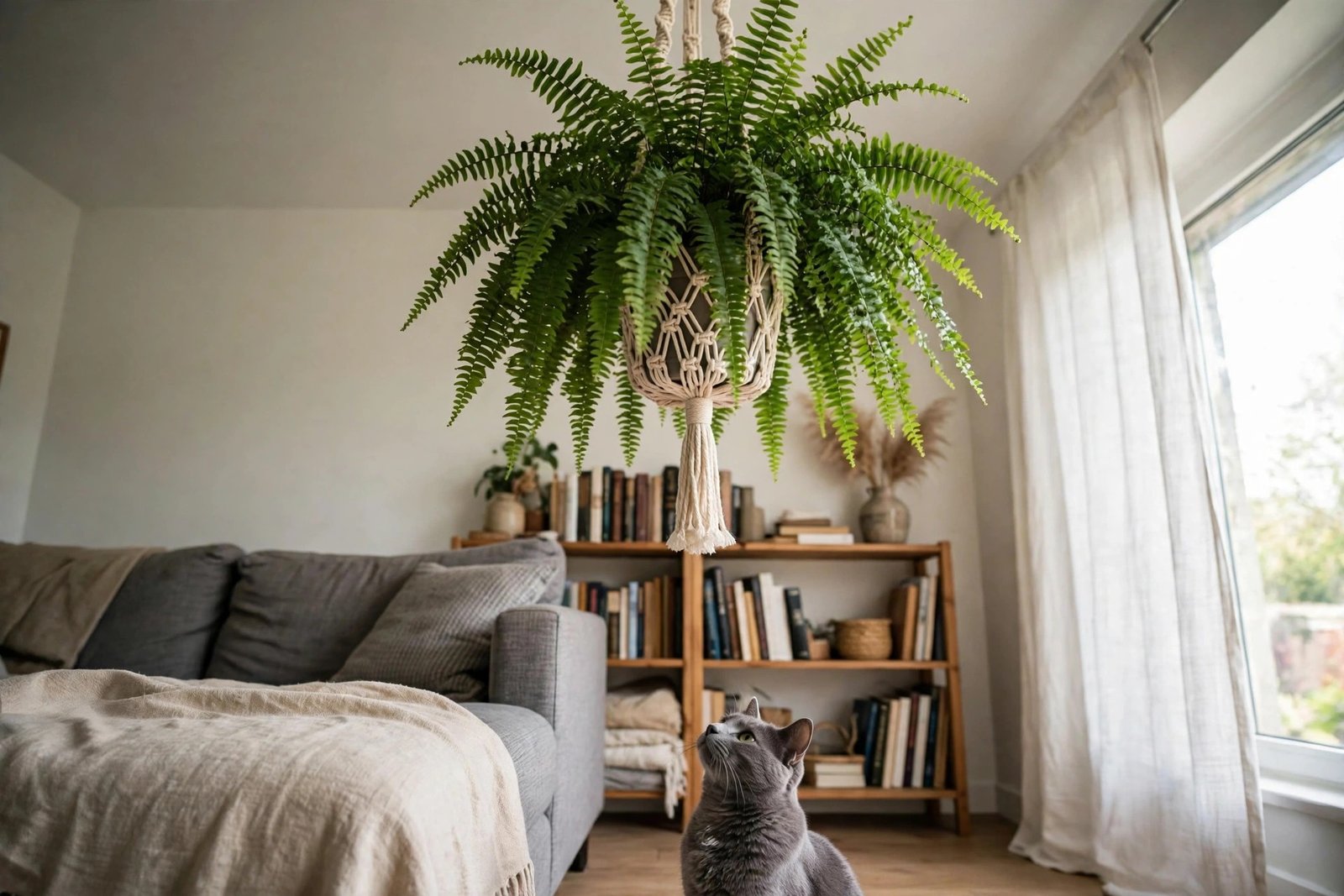
Start with the plant’s light needs. Once you know the light it needs, look for the hardest spot for your cat to reach in that light zone — a high shelf, a hanging planter, or a room the cat rarely enters. Introducing houseplants to cats is a balance between light and reach. See Where to Place Houseplants in a Home With Cats and How to Create a Cat-Friendly Indoor Plant Space for detailed placement ideas.
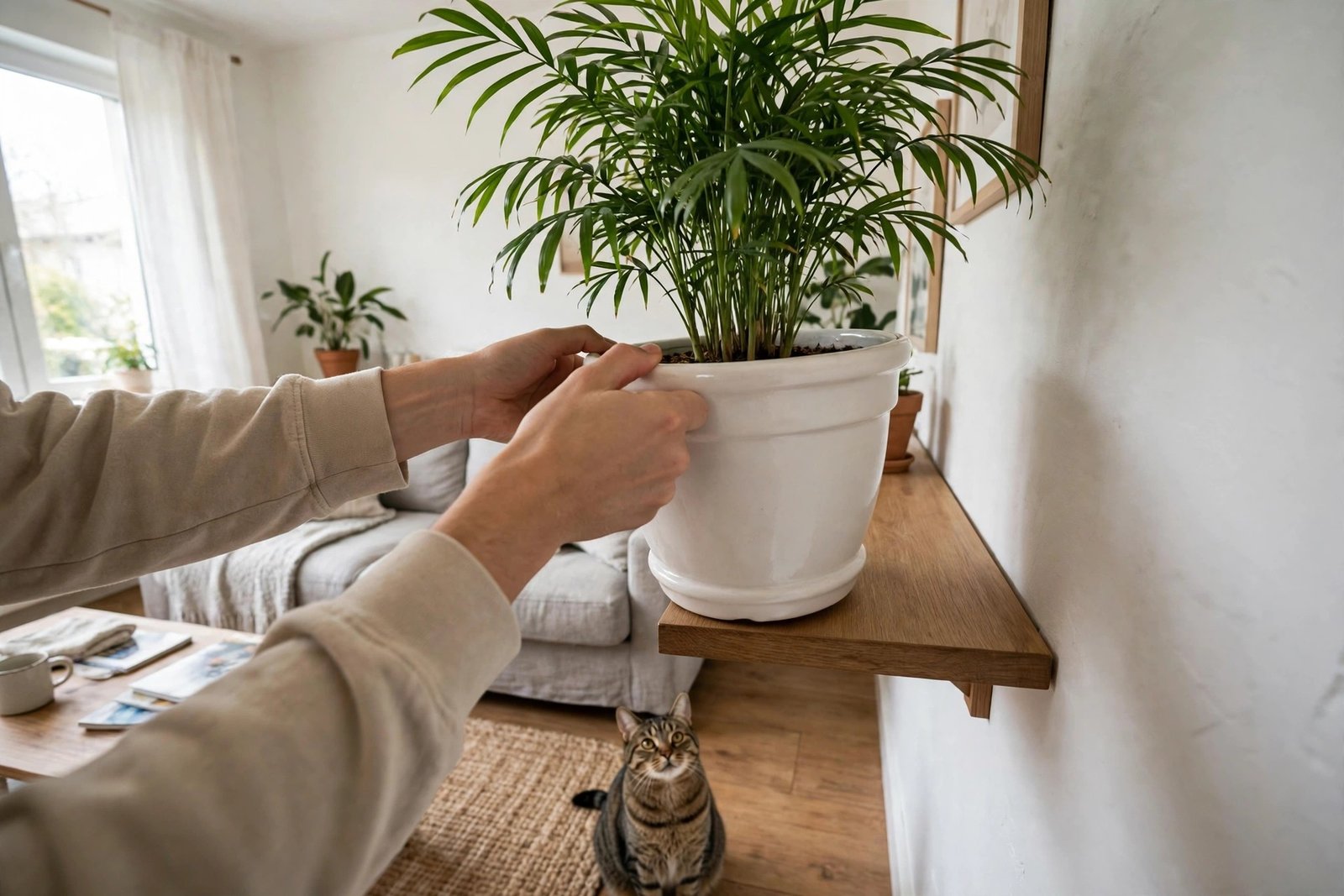
Introducing houseplants to cats successfully means finding a spot that satisfies both the plant and the cat. A high shelf only works if the cat cannot reach it from a nearby chair, bookcase, or curtain. Cats are excellent climbers, so when you are introducing houseplants to cats, check the spot from the cat’s point of view.
Make the Pot Hard to Tip Over
Cats knock small pots over, so use a heavy cache pot or a pot with a broad base. For a small, light plant, a heavy pot matters more than a high shelf. When you are introducing houseplants to cats, treat the pot as part of the plant’s safety system: nudge it firmly — if it rocks, it is not stable enough yet.
Cover the Soil
Many cats dig in potting soil. Cover the soil with large, smooth stones too big to swallow, or a mesh grid cut to fit the pot. Do not use small pebbles a cat could swallow, or cocoa shell mulch, which is toxic to pets.
Step 4: Let Your Cat Meet the Plant
The first meeting matters. Cats investigate new objects with their mouths — chewing is usually normal investigation and play, or a sign the cat is craving vegetable matter, according to Cornell. Introducing houseplants to cats works best when the first meeting happens while you are home and watching.
The First Few Days
If the cat starts to chew, redirect calmly to a scratching post or a toy. Do not chase, yell, or spray — Cornell is clear that punishment only teaches fear. Introducing houseplants to cats with calm redirection teaches the cat what to do instead of chewing, which is far more useful than teaching it what not to do.
Watch for the Cat’s Pattern
Some cats lose interest after one sniff; others return every day. Watch the first week. Cats chew most when bored or alone, so a daily ten-minute play session can reduce chewing. If your cat targets one plant repeatedly, move it to a harder spot. Introducing houseplants to cats is not a one-day event, and the first week tells you more than the first hour.
Step 5: Redirect Chewing and Digging
Put the allowed thing where the habit is. Introducing houseplants to cats is much easier when the cat already has a plant of its own. Even with alternatives offered, a cat may still snack on houseplants — only blocking access protects it.
Offer Cat Grass
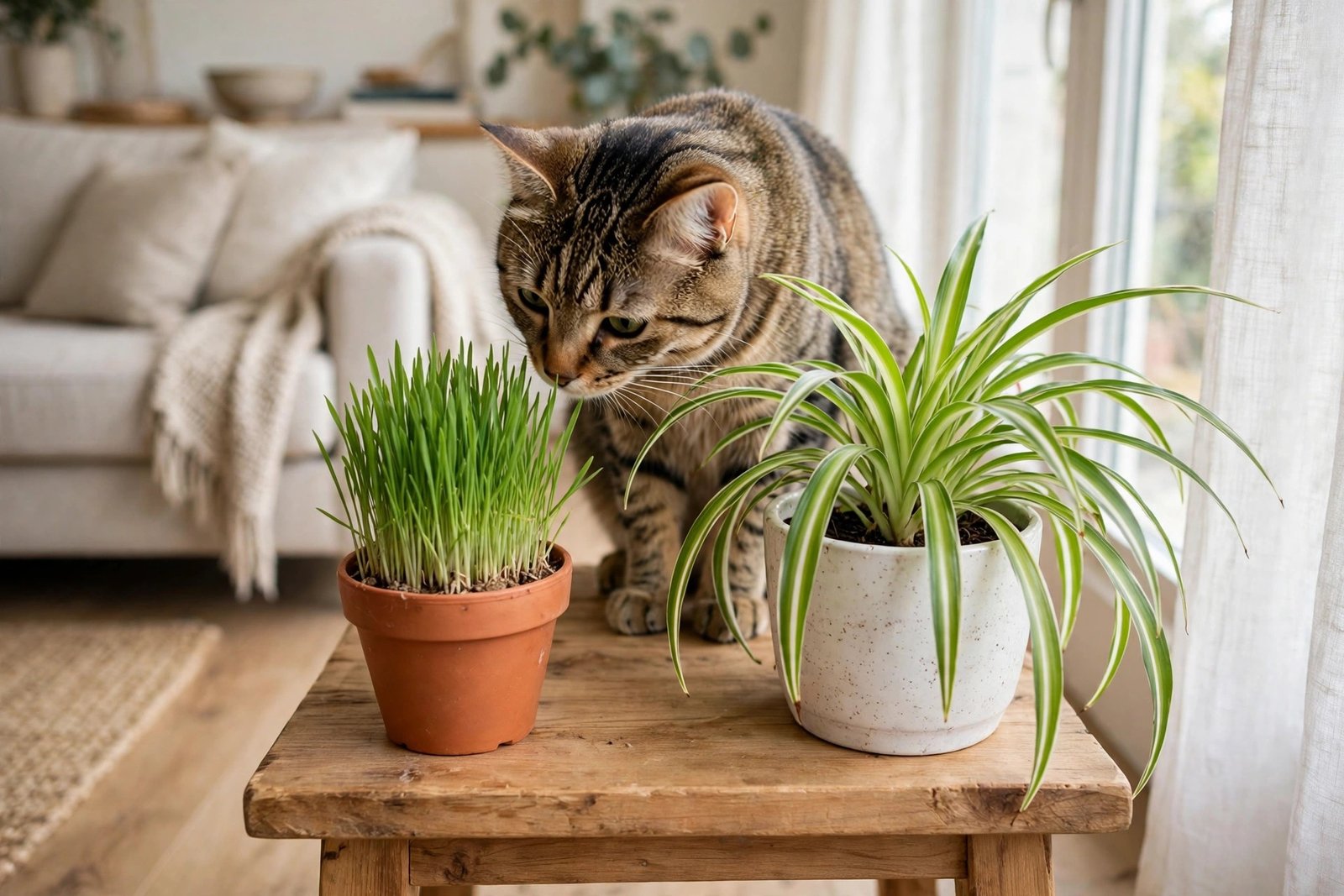
A pot of cat grass — young cereal grass grown from untreated seed — is a plant your cat may chew. Place it next to the houseplant your cat targets most. When you catch the cat chewing the houseplant, move it calmly to the grass. Reward the right choice with a treat or a stroke. See Cat Grass vs. Houseplants: What Cat Owners Should Know for the full guide.
Introducing houseplants to cats alongside a pot of cat grass also tests what the cat actually wants. If the cat happily chews the grass and leaves the houseplant alone, the craving was probably for greens; if it ignores the grass, the attraction may be the plant’s texture or movement.
What to Do If Your Cat Chews a New Plant
Introducing houseplants to cats always carries a small risk, and this is the part of the routine that covers it — know the steps before you need them. First, move the plant out of reach and pick up any fallen leaves. If there is plant material in your cat’s mouth, remove it only if you can do so safely — do not force the mouth open.
Second, call your veterinarian or poison control promptly. In the United States, call the ASPCA Animal Poison Control Center at (888) 426-4435 or Pet Poison Helpline at (855) 764-7661; a fee may apply. Be ready to share the plant’s name or a photo, which part your cat ate, and how much and when. Do not wait for symptoms before calling. Cornell advises calling a veterinarian immediately after a suspected toxic ingestion, and warns against inducing vomiting unless a veterinarian directs you to.
Third, watch your cat closely for the next few hours, indoors in a quiet room, with fresh water available. If the cat vomits repeatedly, has diarrhea that does not settle, drools heavily, seems lethargic, or has difficulty breathing, contact a veterinarian immediately.
Do not try a home remedy, do not give milk, oil, food, or activated charcoal, and do not try to make your cat vomit. For a fuller emergency guide, see What to Do If Your Cat Eats a Toxic Plant: A Safety Guide.
Common Mistakes When Introducing New Plants
Introducing houseplants to cats fails most often at the first step, when the plant is bought on looks alone, or at the third, when it goes straight onto a low shelf the cat can reach.
| Mistake | Why it causes trouble | What to do instead |
|---|---|---|
| Buying on looks alone | The plant may be toxic and you will not know it | Check the botanical name on the ASPCA list first |
| Skipping quarantine | Pests spread, and treated leaves reach the cat | Keep the plant in a cat-free room for one to two weeks |
| Putting it at cat height | The cat can chew, dig, and tip it over on day one | Place it high or behind a barrier, in a heavy pot |
| Keeping a toxic plant “just out of reach” | Cats climb and knock things down | Move toxic plants behind a closed door or out of the home |
When to Move a Plant Back Out
Move a plant back out of reach — or out of the home — if your cat chews it every day despite redirecting, digs in the soil constantly, or shows any sign of illness — or if the plant is toxic and your cat can reach it. Introducing houseplants to cats sometimes ends with the honest answer that this plant does not belong in this home — a good outcome, because you chose the cat.
Frequently Asked Questions
How long should I quarantine a new houseplant from my cat?
One to two weeks in a room your cat cannot enter — long enough to spot most pests and let store sprays wear off. Do not shorten it because the plant looks healthy; pests and residues are not always visible on day one.
How do I check if a new plant is safe for my cat?
Get the botanical name, then search the ASPCA plant list for cats. Introducing houseplants to cats starts with this check: the botanical name is the only reliable way to look a plant up. If the label gives no botanical name, or the seller cannot confirm it, do not buy the plant — a common name alone is not enough.
Should I keep a new plant in a separate room at first?
Yes. A separate room protects your other plants from pests, keeps treated leaves away from your cat, and gives you time to choose the spot.
Why does my cat chew every new plant I bring home?
Chewing is usually normal investigation and play, or a sign the cat is craving vegetable matter, according to Cornell. Introducing houseplants to cats means expecting this curiosity: offer cat grass, add a daily play session, and move targeted plants out of easy reach.
What should I do if my cat chews a plant I have not identified yet?
Treat it as an exposure. Introducing houseplants to cats means treating an unidentified plant as a possible exposure: move the plant out of reach, keep the label or a photo, and call your veterinarian or poison control promptly — the ASPCA Animal Poison Control Center at (888) 426-4435 or Pet Poison Helpline at (855) 764-7661. Do not wait for symptoms or try a home remedy, and do not try to make your cat vomit.
Can I keep a toxic plant if my cat never chews plants?
It is still a risk. Cats change: a cat that ignores plants for years may start chewing after a move or a new routine. Toxic plants — especially true lilies — should not be in a home with a cat. If you receive one as a gift, keep it away from your cat or give it away.
Conclusion
Introducing houseplants to cats is a short routine, not a gamble: check the botanical name against the ASPCA list, quarantine the plant, place it out of easy reach, and give your cat something safe to chew instead. Watch the first few days closely, and call your veterinarian or poison control if your cat eats a plant you have not identified.
Introducing houseplants to cats is a habit that gets easier every time you do it. Start with the next plant you bring home: read the label, look up the botanical name, and quarantine it. That one habit — checking before buying — prevents most plant emergencies.
Disclaimer: This article is for general information only and does not replace advice from a veterinarian. If your cat eats a plant and seems unwell, contact your veterinarian or an animal poison control service promptly.
Sources and References
- ASPCA Animal Poison Control Center. “Toxic and Non-Toxic Plant List — Cats.” The searchable database used to check plant toxicity listings for cats by botanical name. https://www.aspca.org/pet-care/animal-poison-control/cats-plant-list
- Cornell University College of Veterinary Medicine, Cornell Feline Health Center. “Feline Behavior Problems: Destructive Behavior.” Cats that chew houseplants are usually indoor cats with little access to grass; chewing is usually normal investigation and play, or a sign the cat is craving vegetable matter; the only guaranteed protection is blocking access; cats do not respond well to punishment. https://www.vet.cornell.edu/departments-centers-and-institutes/cornell-feline-health-center/health-information/feline-health-topics/feline-behavior-problems-destructive-behavior
- Cornell University College of Veterinary Medicine, Cornell Feline Health Center. “Common Cat Hazards.” Advises calling a veterinarian immediately after a suspected toxic ingestion and warns not to induce vomiting unless specifically directed to do so; notes lilies can cause life-threatening kidney failure in cats even in tiny amounts. https://www.vet.cornell.edu/departments-centers-and-institutes/cornell-feline-health-center/health-information/feline-health-topics/common-cat-hazards
- ASPCA Animal Poison Control Center. “Toxic and Non-Toxic Plants.” The ASPCA database used to check plant toxicity listings, including the note that eating any plant material may cause vomiting and stomach upset. https://www.aspca.org/pet-care/animal-poison-control/toxic-and-non-toxic-plants
- Pet Poison Helpline. “Cat Poisoning: What to Do.” Guidance on gathering the plant name, the part eaten, the amount, and the time of exposure before calling, and on not inducing vomiting without veterinary direction. https://www.petpoisonhelpline.com/poison/cat-poisoning/
4 thoughts on “Introducing Houseplants to Cats: How to Do It Safely at Home”