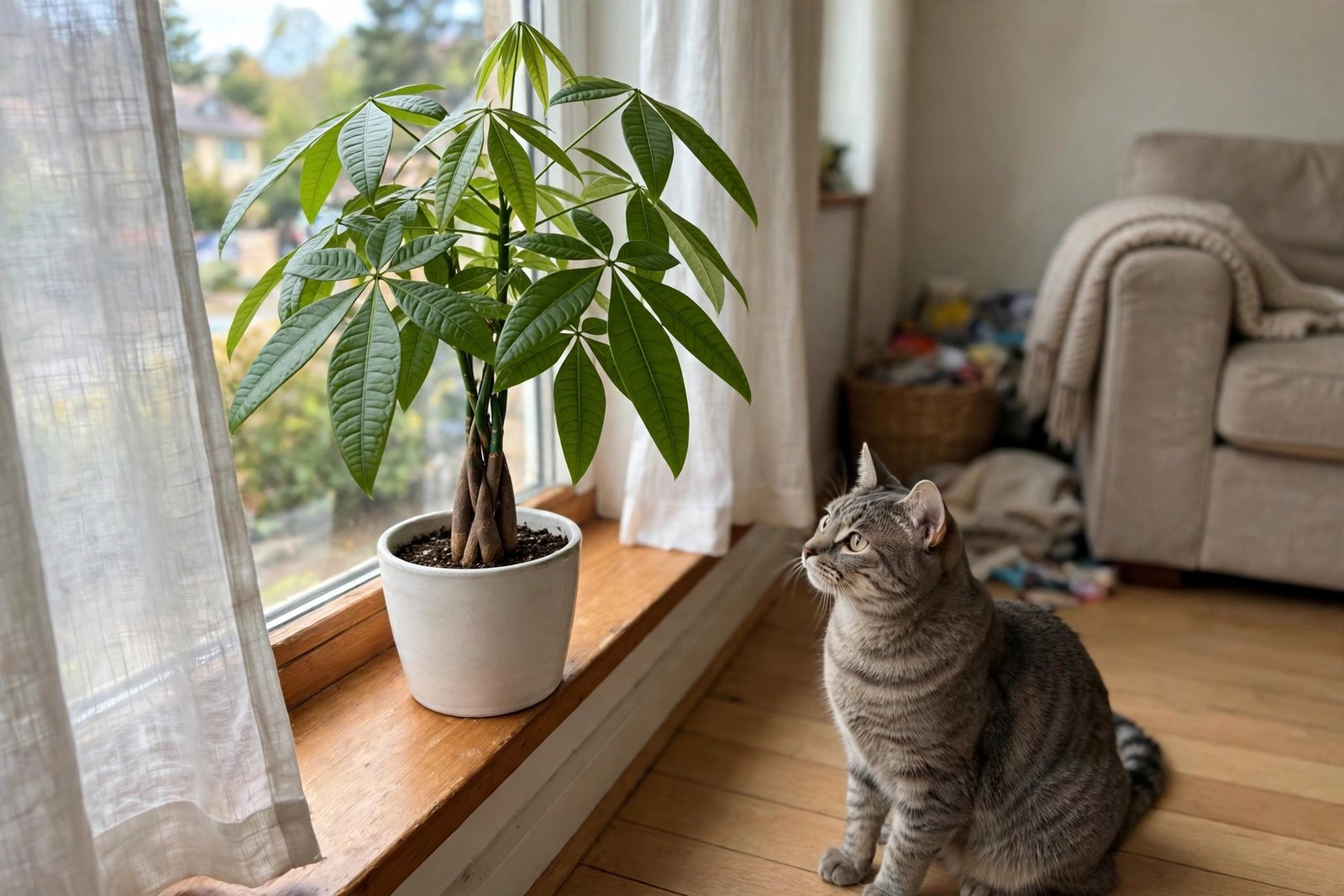
If you are asking are money trees safe for cats, the short answer is yes — with one honest caveat. The ASPCA Animal Poison Control Center lists the money tree, Pachira aquatica, as non-toxic to cats, dogs, and horses. That makes it one of the safest large houseplants for a home with cats, and one of the most popular: its braided trunk and glossy green leaves turn up in living rooms, offices, and plant shops everywhere.
Still, “non-toxic” and “safe to eat” are not the same thing. A cat that chews a lot of money tree leaves can end up with mild stomach upset, even though no poison is involved. So are money trees safe for cats in every situation? Mostly yes — but the details matter if your cat is a determined chewer, if the plant was recently sprayed or fertilized, or if the plant on your shelf is not actually a money tree at all.
Are Money Trees Safe for Cats?
When people ask are money trees safe for cats, the ASPCA entry is the first place to check. It lists the money tree as Pachira aquatica, in the family Malvaceae, and lists no toxic principle — no poison has been identified in the plant.
That is why the answer to are money trees safe for cats is yes in the toxicology sense. No part of a money tree — leaves, stems, trunk, or roots — is known to poison a cat. The ASPCA does list nausea, vomiting, and loose stool as possible clinical signs, because eating any plant material may cause vomiting and stomach upset. That is a stomach reaction to fiber, not poisoning.
True lilies, by contrast, can cause kidney failure in cats from even a small exposure. For a direct comparison, read our guide to common houseplants that are toxic to cats and our guide to whether lilies are toxic to cats.
One more detail is worth knowing. The North Carolina State University Extension database notes that money tree seeds contain cyclopropenoid fatty acids and lists the seeds as a low-severity poison. Indoor money trees almost never produce seeds — the pods only form on mature outdoor trees in warm climates — so the leaves your cat can reach are the part the ASPCA lists as non-toxic.
How to Identify a Money Tree
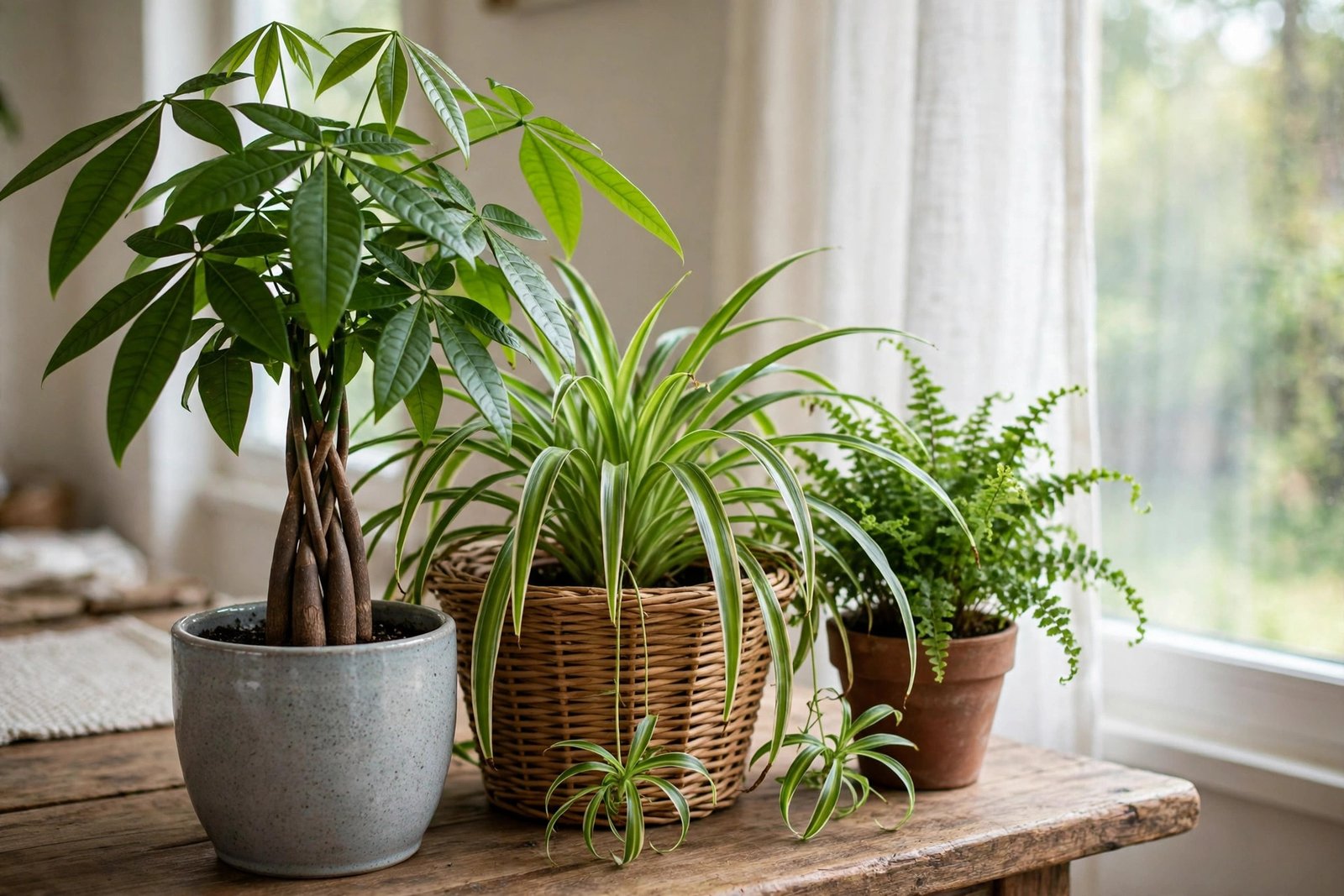
A money tree is a tropical wetland tree from Central and South America, usually sold as a young plant in a small pot with a braided trunk. The leaves are the giveaway: each leaf is made of five to seven long, glossy leaflets that spread out from a single point like the fingers of a hand. Knowing what you are looking at is the first step, because are money trees safe for cats only applies when the plant really is a money tree.
The braided trunk is the plant’s trademark. Growers braid several young stems together while they are still flexible, and the braid stiffens as the plant grows. The braid is purely decorative — it changes nothing about the plant’s safety for cats — but it is the feature most shoppers recognize first.
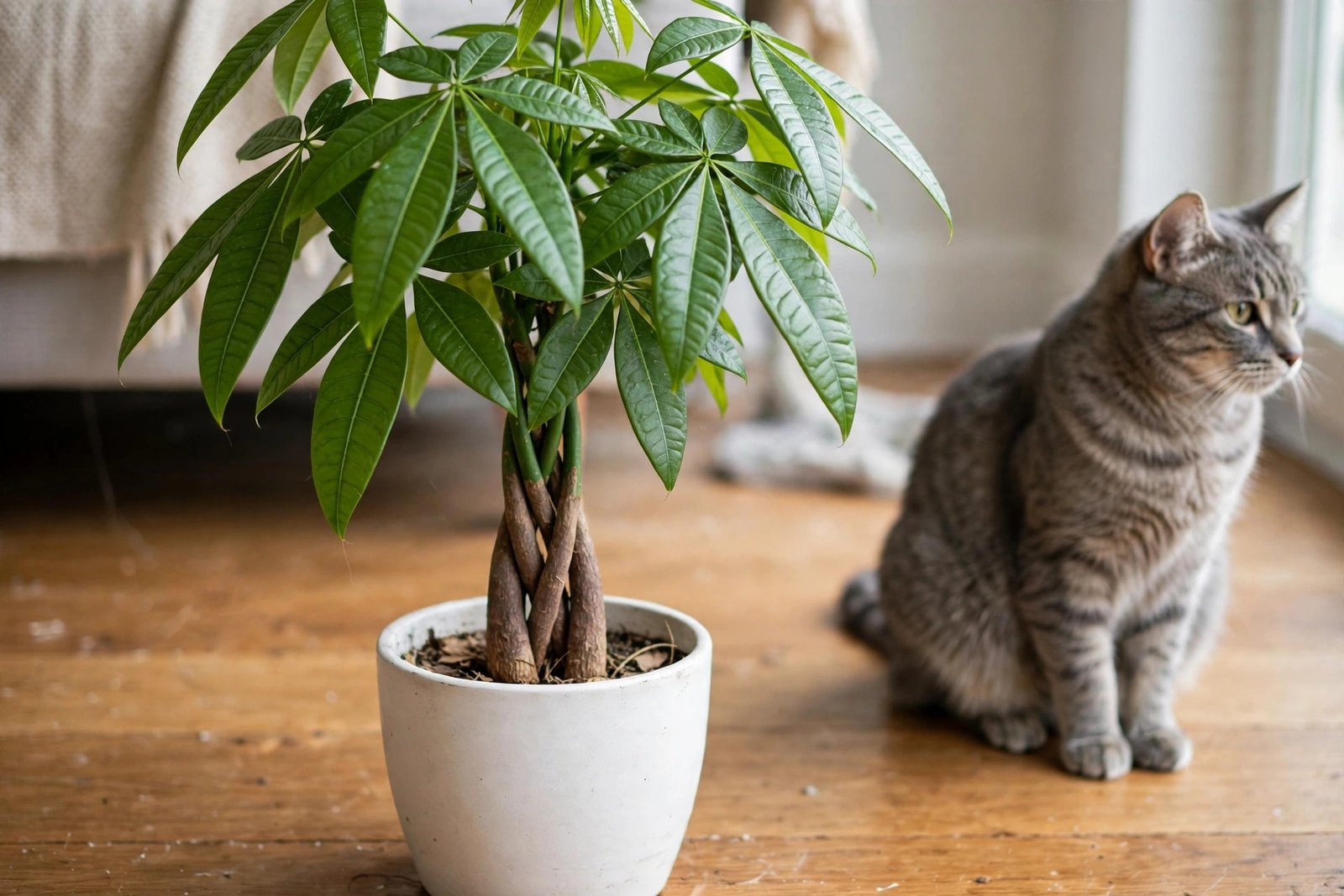
Check the botanical name before you buy: the label should say Pachira aquatica, the name the ASPCA listing covers. A nickname alone is not a safety check. Some shops also sell Pachira glabra, a close relative that looks almost identical, but the ASPCA entry that answers are money trees safe for cats is written for Pachira aquatica. Once the label matches, the question is one you can stop worrying about.
Which Money Tree Varieties Are Safe for Cats?
The money tree sold in shops is almost always Pachira aquatica, and the differences between plants are in size and shape, not in species. A braided plant, a single-trunk plant, and a variegated plant are all the same species, so every form below shares the same non-toxic status.
| Form | What it looks like | Safety for cats |
|---|---|---|
| Braided money tree | Several stems braided together, classic gift plant | Non-toxic (ASPCA) |
| Single-trunk money tree | One straight trunk, tree-like shape | Non-toxic (ASPCA) |
| Variegated money tree | Green leaves with cream or white markings | Non-toxic (ASPCA) |
| Large floor money tree | Tall plant, 4–6 feet, in a heavy pot | Non-toxic (ASPCA) |
| Mini money tree | Small tabletop plant, 6–12 inches | Non-toxic (ASPCA) |
| Pachira glabra | Close relative, nearly identical leaves | Widely listed as non-toxic |
If you want a guaranteed-safe money tree, ask for a Pachira aquatica by name. For the close relative Pachira glabra, confirm the exact species with the seller and check it against the ASPCA list before you bring it home. That simple habit is what makes are money trees safe for cats a question with a reliable answer rather than a guess.
Money Tree vs. Lookalikes: Plants People Confuse With Money Trees
The most dangerous confusion is the jade plant. Jade, Crassula ovata, is also called a money tree or money plant in some shops and markets — and unlike the true money tree, jade is toxic to cats and dogs. A cat that eats jade can vomit, become lethargic, and lose coordination. The two plants look nothing alike once you know the difference: jade has thick, fleshy, coin-shaped leaves on stubby stems, while a money tree has thin, glossy, finger-like leaflets on a braided trunk.
The golden pothos is the second lookalike. Epipremnum aureum is also sold as a money plant in some regions, and it is toxic to cats because it contains insoluble calcium oxalate crystals that irritate the mouth and throat. Read our guide to whether pothos plants are toxic to cats before you buy any trailing plant on looks alone. The rule is simple: a plant called a money tree is only safe when its label says Pachira aquatica.
| Plant | Also called | Botanical name | Safety for cats |
|---|---|---|---|
| Money tree | Money plant | Pachira aquatica | Non-toxic (ASPCA) |
| Jade plant | Money tree, money plant | Crassula ovata | Toxic to cats |
| Golden pothos | Money plant, devil’s ivy | Epipremnum aureum | Toxic to cats |
| Chinese money plant | Money plant | Pilea peperomioides | Non-toxic (ASPCA) |
| Umbrella tree | — | Schefflera arboricola | Toxic to cats |
What Non-Toxic Does Not Mean
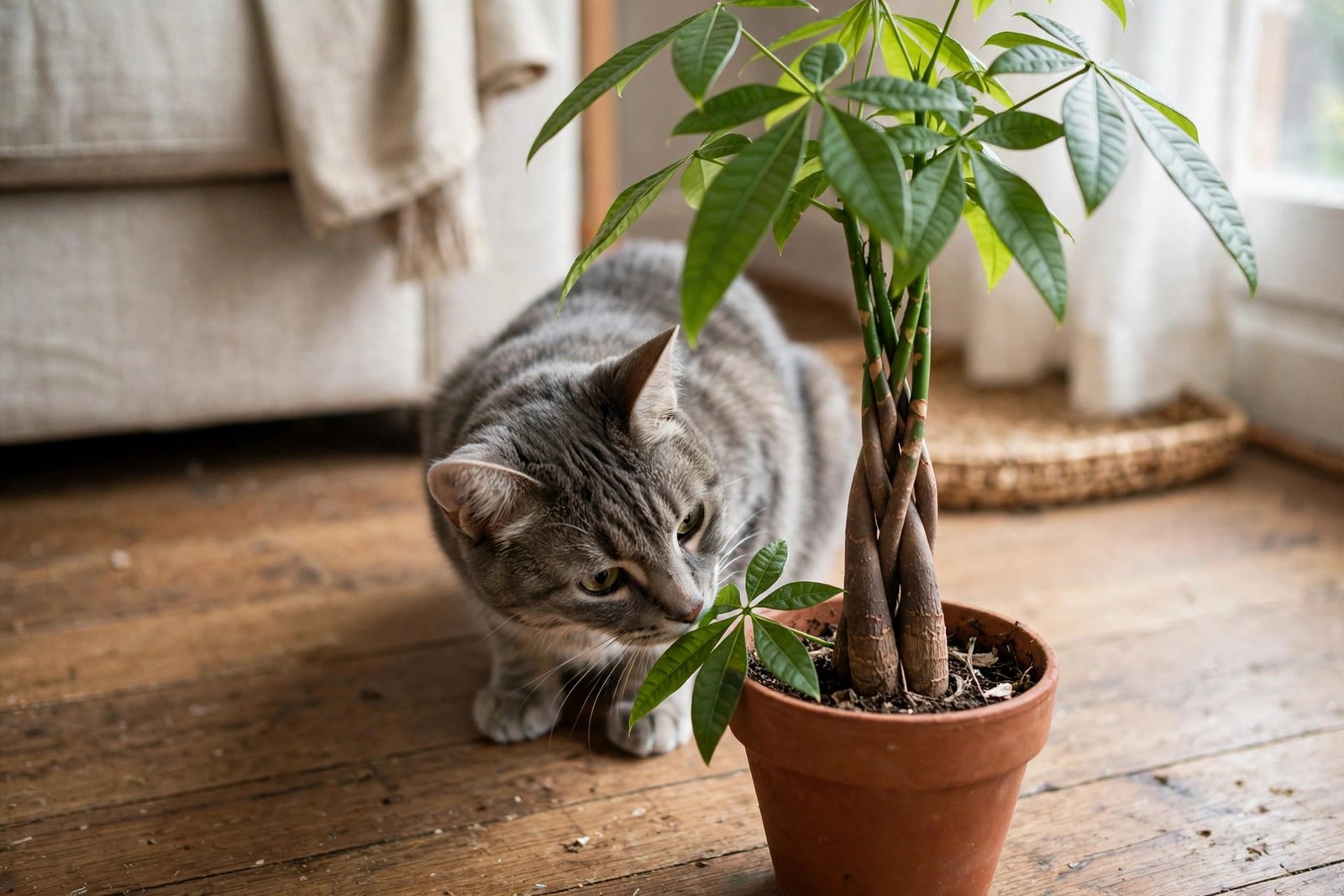
The most likely effect of eating money tree leaves is mild digestive upset: drooling, vomiting, loose stools, or a short loss of appetite. In most cases the upset passes on its own. The answer to are money trees safe for cats stays yes — but it is a yes with a chewing limit.
The pot and the water are often a bigger risk than the plant. Money trees are usually sold in a peat-based mix with fertilizer granules, and a treated plant can expose a cat to chemicals that are not part of the plant, so ask whether a new money tree has been treated and rinse the leaves with plain water before bringing it inside. A systemic insecticide applied to the soil can also make a non-toxic plant unsafe to chew for weeks, so keep the treatment label and follow its pet-safety instructions.
Symptoms to Watch For
If your cat chews on a money tree, watch for mild drooling, a single episode of vomiting, soft stools, or a temporary loss of appetite. These signs usually appear within a few hours and settle within a day, because the cause is fiber irritation rather than poisoning.
Watch for repeated vomiting, ongoing diarrhea, lethargy, hiding, or refusal to eat or drink. These are the signs that mean the question is no longer are money trees safe for cats, but whether your cat needs a vet. If you see them, contact your veterinarian or an animal poison control service promptly — do not wait, and do not try a home remedy. Never try to make a cat vomit unless a veterinarian tells you to.
What to Do If Your Cat Chews a Money Tree
Stay calm and check what your cat actually ate. If it was a leaf from a Pachira aquatica, the answer to are money trees safe for cats is still yes: the plant itself is not poisonous, and most cats need nothing more than watching. Gently remove any plant material from your cat’s mouth if you can do so safely.
Watch your cat closely for the next 12 to 24 hours, keep fresh water available, and keep the money tree out of reach. If your cat vomits repeatedly, has ongoing diarrhea, becomes lethargic, or seems in pain, contact your veterinarian or the ASPCA Animal Poison Control Center at (888) 426-4435 right away.
How to Display Money Trees So Cats Leave Them Alone
Money trees grow tall, so height alone will not keep a cat away forever — a floor plant is within reach of any cat. The simplest protection is placement: put the money tree in a corner behind furniture your cat does not climb, or in a room your cat visits less often, and make sure the pot is heavy enough that a cat leaning against it cannot tip it over. Our guide to where to place houseplants in a home with cats covers the same idea in more detail.
A tall plant stand can help for a young money tree, as long as the stand is stable and the pot cannot slide off. For a large floor plant, a heavy ceramic pot and a wide base matter more than elevation. For more ideas, see our guides to hanging planters in homes with cats and cat-friendly plant shelves.
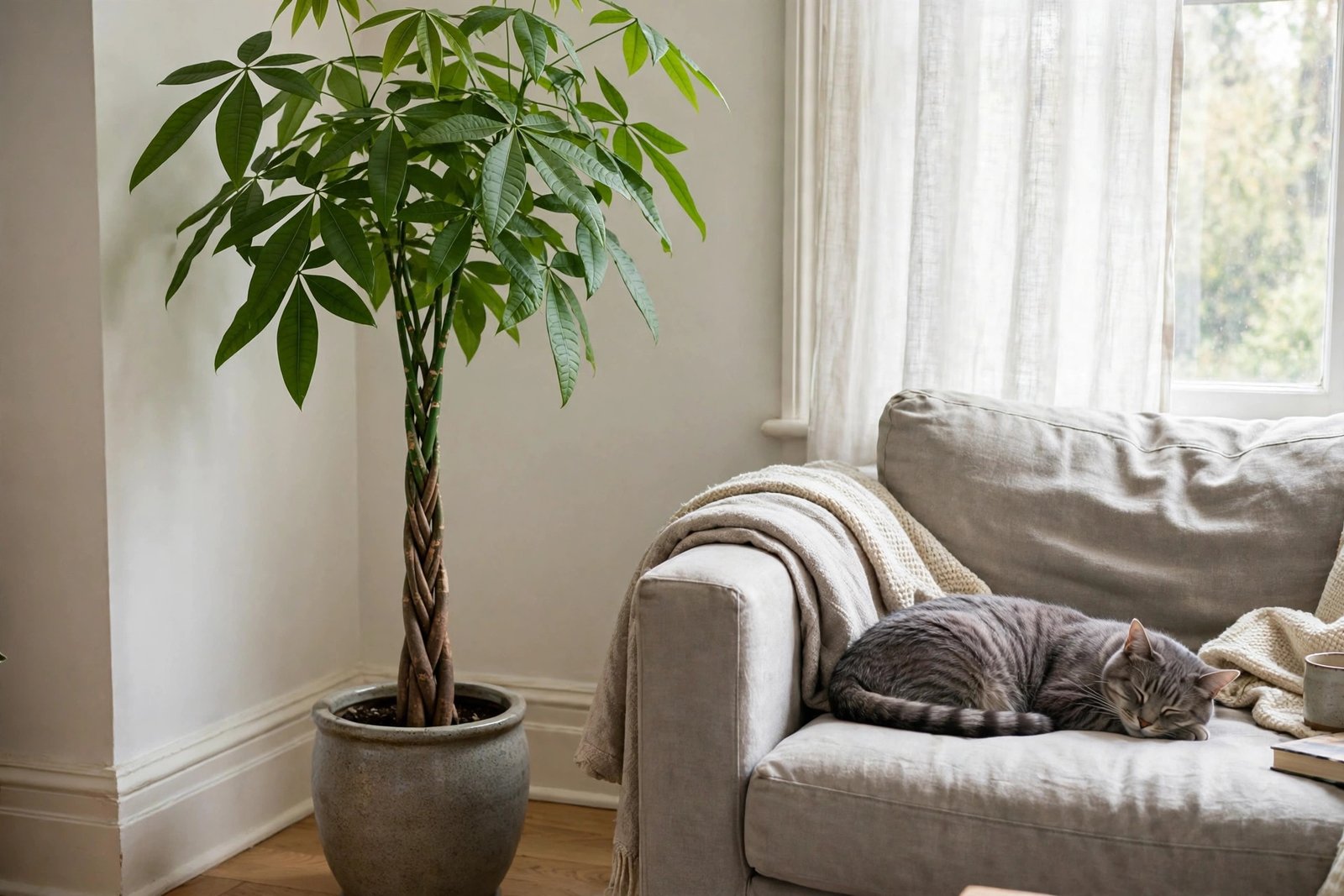
Give your cat something better to chew. A pot of cat grass on the floor gives a curious cat a safe outlet, and many cats stop bothering other plants once they have their own. See our comparison of cat grass versus houseplants and our guide on how to stop cats chewing houseplant leaves.
Money Tree Care Basics for Beginners
Give a money tree bright indirect light. An east-facing window is ideal, and a spot a few feet from a south- or west-facing window works too; direct sun can scorch the leaves, while too little light makes the plant drop leaves and grow leggy. The plant also needs warmth, ideally between 65°F and 80°F — keep it above 55°F and away from cold drafts and heating vents.
Humidity is helpful but not critical. Money trees come from humid wetlands and enjoy humidity around 50 percent or higher, but they tolerate average indoor air better than most tropical plants. If the leaf tips turn brown and crispy, a pebble tray with water under the pot or a small humidifier nearby will help.
Water when the top inch or two of soil feels dry, and water thoroughly until it drains from the bottom — then empty the saucer so the roots never sit in water. Money trees hate wet feet: overwatering is the most common cause of yellow leaves and root rot. Water less in winter when growth slows. Feed lightly at half strength once a month in spring and summer, and skip feeding in winter.
A healthy money tree grows fast in warm, bright conditions and may need repotting every two to three years in spring, in a loose, well-draining mix. Prune leggy stems in spring to keep the shape full, and rotate the pot every few weeks so the plant grows evenly toward the light.
Safer Alternatives If Your Cat Will Not Stop Chewing
If your cat chews the same money tree every day, replace it with a plant your cat can chew without worry. Cat grass is the obvious first choice, since it is grown to be eaten. Spider plants are another good option: non-toxic, forgiving, and their arching leaves satisfy the same chewing urge.
A wider collection also spreads the risk: when a home has several safe plants, no single plant takes all of the attention. Start with our list of 15 cat-safe houseplants and our guide to cat-safe flowering houseplants.
Frequently Asked Questions
Are money trees safe for cats if my cat eats the leaves?
Yes — are money trees safe for cats is a yes in the toxicology sense. Eating money tree leaves can still cause vomiting or loose stools if a cat eats a lot, because any plant material can upset a cat’s stomach.
Are all money tree varieties safe for cats?
Yes — are money trees safe for cats is a yes for every form of Pachira aquatica, including braided, single-trunk, variegated, and mini money trees, which are all covered by the same ASPCA listing. The confusion comes from other plants sharing the “money tree” nickname, especially jade, which is toxic.
Is a braided money tree safe for cats?
Yes. Braiding is a growing technique, not a different plant — a braided money tree is still Pachira aquatica, so are money trees safe for cats is a yes for braided plants too.
Can I keep a money tree in my bedroom if my cat sleeps there?
Yes — are money trees safe for cats in a bedroom comes down to placement: keep the money tree in a heavy, stable pot and out of your cat’s favorite climbing path. Keep the plant away from the bed itself, since a cat that sleeps on the bed can reach anything on a nightstand.
What should I do if my cat eats a lot of money tree?
Remove the plant and watch your cat. Contact your veterinarian or an animal poison control service promptly if your cat vomits repeatedly, has ongoing diarrhea, refuses food or water, becomes lethargic, or seems in pain. Do not try a home remedy.
Why are my money tree’s leaves turning yellow?
Yellow leaves are usually a watering problem, not a sign the plant is unsafe. Overwatering is the most common cause, followed by cold drafts and too little light. Let the soil dry out between waterings and move the plant away from cold windows — and remember, are money trees safe for cats stays yes even when the leaves look unhappy.
Conclusion
So, are money trees safe for cats? Yes — the ASPCA lists Pachira aquatica as non-toxic to cats and dogs, and no poison has been identified in any part of the plant. That makes the money tree one of the lowest-risk large houseplants for a home with cats.
Before you buy, confirm the botanical name, Pachira aquatica, and watch out for the nickname trap: jade plants and golden pothos are also sold as money trees or money plants, and both are toxic to cats. Place it in a heavy, stable pot, give it bright indirect light, and water only when the top inch or two of soil feels dry. If a friend asks are money trees safe for cats, you can now answer yes — and explain the chewing caveat. To build a wider collection, continue with our list of 15 cat-safe houseplants.
Disclaimer: This article is for general information only and does not replace advice from a veterinarian. Plant safety can depend on the exact species, the amount eaten, and the individual cat. If your cat is unwell after chewing or eating any plant, contact your veterinarian or an animal poison control service promptly.