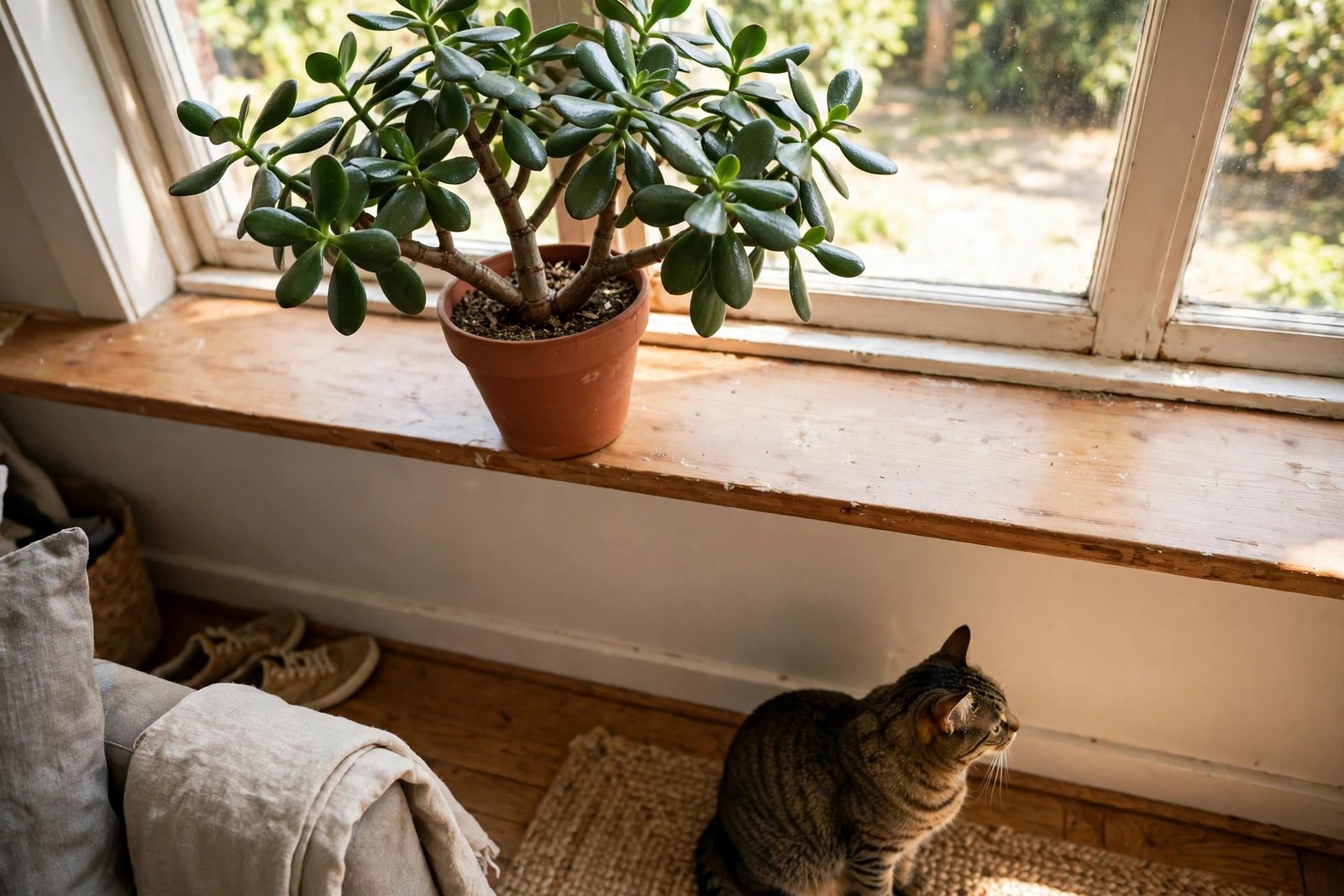
Yes — jade plants are toxic to cats. The jade plant, Crassula ovata, is listed by the ASPCA Animal Poison Control Center as toxic to cats, dogs, and horses. A cat that chews a leaf usually develops vomiting, depression, and incoordination.
That surprises many owners, because jade plants look harmless: thick, glossy, coin-shaped leaves on a woody stem, sitting quietly on a sunny windowsill. They are also sold under friendly names, which makes them sound safe. They are not. If you are asking, “Are jade plants toxic to cats?” the answer is a firm yes — this guide explains the symptoms, what to do, and which safer succulents give you the same look.
Jade plants are one of the most common houseplants in the United States, which is why the question “are jade plants toxic to cats” comes up so often.
The Short Answer
If your cat has just bitten a jade plant leaf, do not wait for symptoms. Move the plant out of reach and contact your veterinarian or poison control promptly: the ASPCA Animal Poison Control Center at (888) 426-4435 or Pet Poison Helpline at (855) 764-7661. A consultation fee may apply.
The ASPCA entry names the toxic principle as unknown and lists vomiting, depression, and incoordination as the clinical signs. Pet Poison Helpline adds that ingestion typically causes no more than mild gastrointestinal distress — vomiting, diarrhea, loss of appetite, lethargy, and a wobbly gait — and that signs are usually mild and self-limiting. For a fuller emergency guide, see What to Do If Your Cat Eats a Toxic Plant.
The question “are jade plants toxic to cats” is worth asking before you buy one, not after your cat has chewed it.
What Is a Jade Plant?
A jade plant is one of the easiest succulents to recognize: a small, tree-like shrub with a thick, woody, branching stem and plump, oval leaves. The leaves are dark green, often edged in red in strong sun, and they store water.
The botanical name is Crassula ovata. The ASPCA lists the plant under the older scientific name Crassula argentea, a former name for the same species — so search the ASPCA database for “Jade Plant” or Crassula argentea.

Jade plants live for decades, which is one reason the question “are jade plants toxic to cats” matters in a cat home: the plant often sits on a low windowsill or coffee table, where a curious cat investigates first.
Common Names and Varieties
The ASPCA also lists it as Baby Jade, Dwarf rubber plant, Jade tree, Chinese rubber plant, and Japanese rubber plant. Shops may also sell it as lucky plant, money plant, money tree, or friendship tree.
Common forms such as ‘Hummel’s Sunset’, ‘Gollum’, and ‘Hobbit’ are varieties of the same species, so the toxicity listing covers them all.
None of those friendly names answers the question “are jade plants toxic to cats” — only the botanical name does.
Which Jade Plants Are Toxic?
The ASPCA entry most owners need is for the common jade plant, Crassula ovata (listed as Crassula argentea), but the silver jade plant is also listed as toxic to cats, dogs, and horses.
So are jade plants toxic to cats across every variety? Yes — the listing covers the whole species.
The silver jade plant, Crassula arborescens, is listed by the ASPCA under the name Chinese Jade, with the additional common names Silver Jade Plant and Silver Dollar. Its toxic principle is also unknown, and its signs are vomiting, drunkenness in cats, and tremors in rare cases.
Are jade plants toxic to cats when the label says ‘Gollum’ or ‘Hobbit’ instead of jade? Yes — those are varieties of the same species. Silver jade has rounder, grey-green leaves, but the two are easy to confuse in a shop — and both are toxic.
The safest rule is simple: treat every plant in the Crassula genus as toxic to cats unless you have checked that exact species in the ASPCA database.
Why Jade Plants Are Toxic
Are jade plants toxic to cats because of a known poison? No — nobody knows exactly which compound causes the poisoning. The ASPCA, Pet Poison Helpline, and university extension sources all list the toxic principle as “unknown,” though the symptoms are well documented from real cases.
What is known is that the whole plant is considered toxic: leaves, stems, and sap. There is no nibble-safe part of a jade plant, and a few bites of a fleshy leaf are enough. Unlike calcium oxalate plants such as pothos and monstera, jade poisoning works more slowly, mainly affecting the stomach and nervous system, so a cat may look fine right after a bite and only start vomiting or walking unsteadily later — which is what makes the question “are jade plants toxic to cats” so tricky.
Symptoms to Watch For
The ASPCA lists three clinical signs for jade plants: vomiting, depression, and incoordination. Pet Poison Helpline adds diarrhea, loss of appetite, lethargy, and ataxia — a wobbly gait.
Are jade plants toxic to cats enough to cause a wobbly walk? Yes — incoordination is one of the three signs the ASPCA lists. Early signs include vomiting, drooling, loss of appetite, and lethargy.
Incoordination is the sign that most worries owners: a cat that staggers, sways, or trips over its own paws, or seems drunk when it walks.
A slowed heart rate has also been reported in some cases, more often in dogs, and tremors are rare. If you find chewed leaves and are not sure how much your cat ate, treat it as an exposure.

When people ask “are jade plants toxic to cats,” they usually picture vomiting — but the unsteady walking is the sign that should worry you most. A normally sure-footed cat that suddenly sways or will not get up needs a vet call.
How Serious Is Jade Plant Poisoning?
In most cases, jade plant poisoning is limited to stomach upset and a short period of lethargy. Pet Poison Helpline states that signs are typically mild and self-limiting, and the ASPCA’s sign list does not include kidney failure or organ damage — unlike true lilies, which can cause sudden, life-threatening kidney failure in cats. For the lily comparison, see Are Lilies Toxic to Cats? Types, Exposure Risks, and Urgent Steps.
Are jade plants toxic to cats in the same way lilies are? No — jade plants do not carry the kidney-failure risk of true lilies. Even so, a jade exposure still needs a vet call: mild and self-limiting means most cats recover, not that every cat will. That is why “are jade plants toxic to cats” is not a question to answer by waiting to see what happens.
How bad the reaction is depends on how much was eaten and the cat’s size and health, and there is no published safe bite size. Kittens, older cats, and cats with other health conditions are more vulnerable, because repeated vomiting and dehydration hit a small or unwell cat harder. There is no antidote: care is supportive.
What to Do If Your Cat Chews a Jade Plant
Are jade plants toxic to cats badly enough to need a call even when the cat looks fine? Yes — act promptly, even if your cat seems normal. Signs can develop after the first bite.
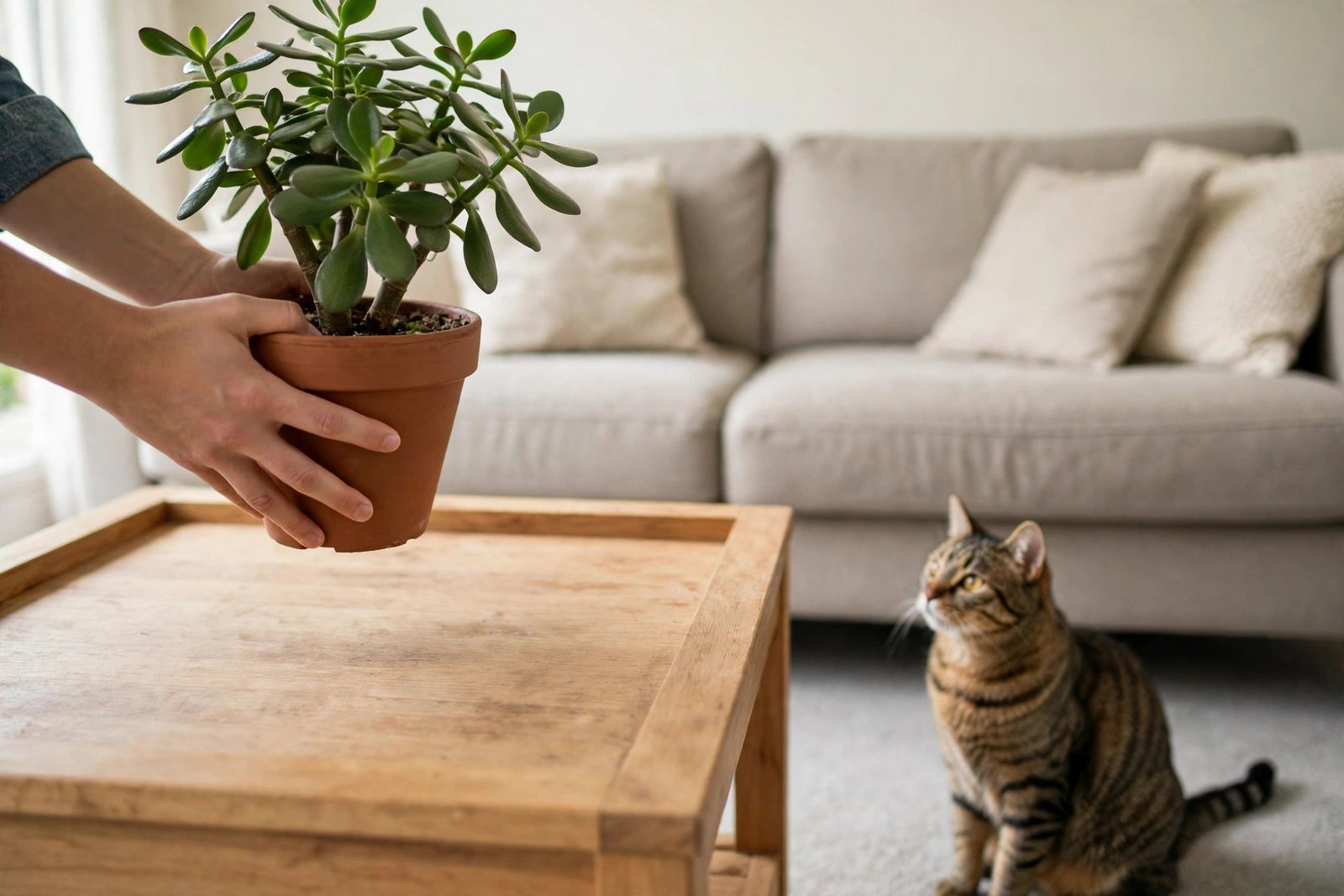
First, remove the plant and prevent more chewing: pick up the plant, any fallen leaves, and any trimmed pieces, and put them out of your cat’s reach. Jade leaves that drop are still toxic, so check the floor and the saucer.
Second, call your veterinarian or poison control promptly — the ASPCA Animal Poison Control Center at (888) 426-4435, or Pet Poison Helpline at (855) 764-7661; a consultation fee may apply. Be ready to share the plant name or a photo of its label, which part your cat chewed, how much was eaten and when, and your cat’s age.
Third, watch your cat closely for the next few hours. Keep the cat indoors, in a quiet room. If signs return or get worse, call your veterinarian again. Knowing “are jade plants toxic to cats” is only half the job — acting fast is the other half.
What NOT to Do
Do not induce vomiting. Never try to make your cat vomit at home unless a veterinarian specifically tells you to — it can cause more harm, and a cat that is already nauseous can choke. Cornell University’s Feline Health Center gives the same warning.
Are jade plants toxic to cats enough that milk or oil helps? No — do not give home remedies such as milk, oil, food, or activated charcoal: none of these treat jade plant poisoning. Do not wait for symptoms before calling, and do not rinse your cat’s mouth forcefully.
Finally, do not assume a small bite is always harmless. Every exposure is different — which is why “are jade plants toxic to cats” stays a yes even after a mild first episode.
Can You Keep a Jade Plant With a Cat?
Are jade plants toxic to cats if the plant lives on a high shelf? Yes — a jade plant is not made safe by putting it on a high shelf: cats climb, and a fallen leaf can land on the floor where a cat finds it.
If your cat has ever chewed a houseplant, can reach the plant from nearby furniture, or can enter the room when you are not home, rehome the jade plant or move it to a room your cat cannot enter. A closed door is the only reliable barrier.
That is the honest answer to “are jade plants toxic to cats” in a real home: the plant is only as safe as the barrier between it and your cat. If you do keep one, use a closed room where possible, check below it daily, and use a sturdy, heavy pot so it cannot tip over. Bin cuttings and pruned leaves straight away. For more ideas, see How to Keep Cats Out of Houseplants Without Harming Them.
Safer Alternatives With a Similar Look
Once you know “are jade plants toxic to cats,” the next question is what to grow instead — and you do not have to give up a succulent on the windowsill. These alternatives are listed by the ASPCA as non-toxic to cats, which does not mean the plant is food.
Haworthia is the closest swap: it forms the same rosette of thick, fleshy leaves, needs the same bright light and infrequent watering, and the ASPCA lists Haworthia species as non-toxic to cats and dogs. Echeveria is another rosette succulent with the same sculptural look, also listed as non-toxic to cats.

A spider plant (Chlorophytum comosum) is a different shape but an easy, forgiving swap, listed as non-toxic to cats and dogs and tolerant of the same bright light. See Are Spider Plants Safe for Cats? Benefits, Risks, and Care Tips. A Boston fern (Nephrolepis exaltata) gives you full, arching fronds and a lush look, and it is listed as non-toxic to cats, though it needs more water.
Swapping the plant is simpler than guarding it, and it ends the question “are jade plants toxic to cats” for your home for good.
Frequently Asked Questions
Are jade plants toxic to cats?
Yes. Jade plants (Crassula ovata, listed by the ASPCA as Crassula argentea) are listed by the ASPCA as toxic to cats, dogs, and horses. The toxic principle is unknown, and the listed signs are vomiting, depression, and incoordination.
What happens if a cat eats a jade plant?
A cat that chews a jade plant usually develops vomiting, lethargy, loss of appetite, or an unsteady, wobbly walk within a few hours. If “are jade plants toxic to cats” is no longer a hypothetical question in your home, call your veterinarian or poison control promptly.
Can a jade plant kill a cat?
Death from jade plant poisoning is not the usual outcome, and the ASPCA lists only vomiting, depression, and incoordination. That does not make the plant safe: a large amount, or a small, older, or unwell cat, can turn a mild exposure serious.
Is a small bite of jade plant dangerous for a cat?
A small bite often causes only brief vomiting or lethargy, but that is not a guarantee: the ASPCA does not publish a safe bite size, so “are jade plants toxic to cats” stays yes even for a single nibbled leaf. Treat any bite as an exposure and call for advice.
Is the money tree the same as a jade plant?
No, and the names cause real confusion. Jade plants are often sold as “money plant” or “money tree,” but the true money tree, Pachira aquatica, is a different species. Always check the botanical name.
What is a safe succulent alternative to a jade plant?
Haworthia is the closest swap: it looks like a small jade, needs the same bright light and infrequent watering, and the ASPCA lists Haworthia species as non-toxic to cats and dogs. Echeveria is another non-toxic rosette succulent.
If you are still weighing “are jade plants toxic to cats” against keeping your jade, the swap is the safer choice.
Conclusion
So, are jade plants toxic to cats? Yes — Crassula ovata, listed by the ASPCA as Crassula argentea, is toxic to cats, dogs, and horses, and its close relative the silver jade, Crassula arborescens, is listed the same way. The exact compound responsible has not been identified, but the symptoms are well documented.
Most cases are limited to stomach upset and a short period of lethargy, and jade plants do not carry the kidney-failure risk of true lilies — but there is no safe bite size. If your cat has chewed a jade plant, move the plant out of reach and call your veterinarian or poison control now.
Disclaimer: This article is for general information only and does not replace advice from a veterinarian. If your cat has chewed or eaten a jade plant, contact your veterinarian or an animal poison control service promptly. Do not use home remedies, induce vomiting, or give medication without veterinary advice.
Sources and References
- ASPCA Animal Poison Control Center — Jade Plant (Crassula argentea). Toxic to cats, dogs, and horses; toxic principle unknown; signs are vomiting, depression, and incoordination. https://www.aspca.org/pet-care/aspca-poison-control/toxic-and-non-toxic-plants/jade-plant
- ASPCA Animal Poison Control Center — Chinese Jade (Crassula arborescens). Toxic to cats, dogs, and horses; toxic principle unknown; signs are vomiting, drunkenness in cats, and tremors in rare cases. https://www.aspca.org/pet-care/aspca-poison-control/toxic-and-non-toxic-plants/chinese-jade
- Pet Poison Helpline — Jade Plant. Ingestion typically causes no more than mild gastrointestinal distress, less commonly lethargy and ataxia. https://www.petpoisonhelpline.com/poison/jade-plant/
- ASPCA Animal Poison Control Center — Toxic and Non-Toxic Plant List, Cats. https://www.aspca.org/pet-care/animal-poison-control/cats-plant-list
- Cornell University College of Veterinary Medicine, Cornell Feline Health Center — Common Cat Hazards. https://www.vet.cornell.edu/departments-centers-and-institutes/cornell-feline-health-center/health-information/feline-health-topics/common-cat-hazards
1 thought on “Are Jade Plants Toxic to Cats? Symptoms and Safer Alternatives”