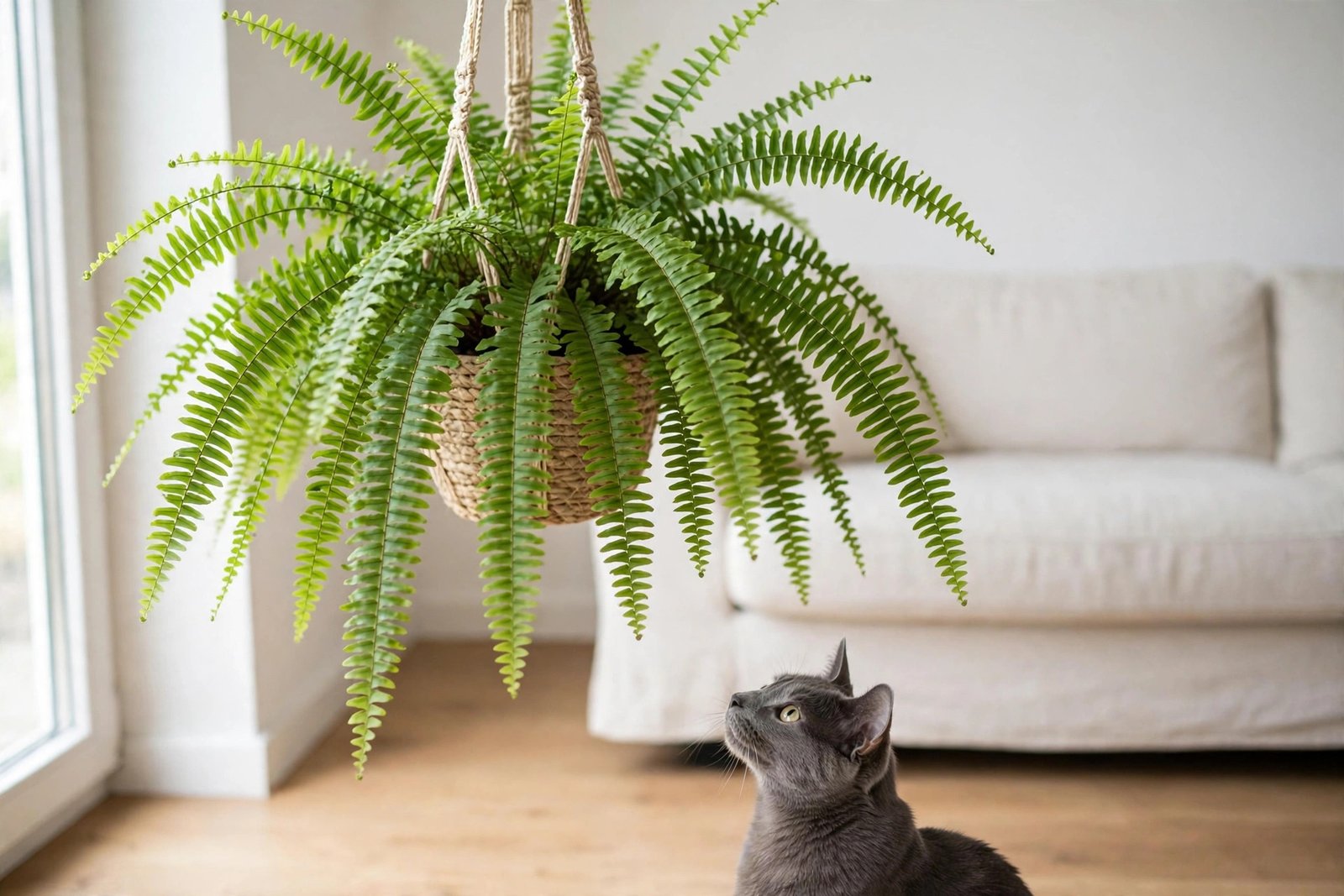
If you are asking are Boston ferns safe for cats, the short answer is yes — with one honest caveat. The ASPCA Animal Poison Control Center lists the Boston fern, Nephrolepis exaltata, as non-toxic to cats, dogs, and horses. That makes it one of the most popular cat-friendly houseplants.
So are Boston ferns safe for cats in every situation? Mostly yes, but the details matter — especially if your cat is a determined chewer, and especially because not every plant sold as a “fern” is a true fern. This guide covers the ASPCA listing, how to identify a real Boston fern, the two toxic look-alikes, and the care that keeps the plant alive.
Are Boston Ferns Safe for Cats? The Short Answer
When people ask are Boston ferns safe for cats, the ASPCA entry is the first place to check: it lists the Boston fern as non-toxic to cats, dogs, and horses, filed under the older form Nephrolepis exaltata bostoniensis. The entry lists no toxic principle, so no poison has been identified in the plant.
The short answer to are Boston ferns safe for cats is yes in the toxicology sense. No part of the plant — fronds, stems, or roots — is known to poison a cat. The ASPCA also notes that eating any plant material may cause mild stomach upset, so a cat that eats a large amount of fibrous frond can still vomit or have a soft stool. That is a stomach reaction to fiber, not poisoning.
The contrast with truly dangerous plants is worth knowing: true lilies and daylilies are in a different league, and even a small exposure — including pollen or vase water — can cause kidney failure in cats. For a direct comparison, read our guide to common houseplants that are toxic to cats.
What Is a Boston Fern? Identification
The Boston fern is the classic houseplant fern: a fountain of long, arching fronds covered in small, bright green leaflets. Its botanical name is Nephrolepis exaltata, usually sold as Nephrolepis exaltata ‘Bostoniensis’. Indoors, fronds are usually 40 to 90 cm long. It has no flowers, seeds, or berries, and it reproduces by spores, runners, and crown division.
Once you can spot those arching fronds, are Boston ferns safe for cats is a question you can answer about the right plant. Look for fronds that arch outward and downward from a central crown, each one lined with many small, soft leaflets along a thin central stem.

Cultivars such as ‘Bostoniensis’, ‘Fluffy Ruffles’, ‘Dallas’, and ‘Whitmanii’ differ in frond shape, but they are all the same species, Nephrolepis exaltata. It is one of the plants in our list of 15 cat-safe houseplants.
Check the botanical name before you buy: a plant may be sold as a Boston fern, sword fern, or tuber ladder fern, and those names usually point to Nephrolepis exaltata. A nickname alone is not a safety check — look for Nephrolepis exaltata on the label.
Why “Non-Toxic” Is Not “Risk-Free”
A Boston fern is a good choice for a home with cats, but it is not a guarantee that nothing will go wrong. A cat could knock a hanging basket down, chew a long frond, or eat enough foliage to vomit. A very young, elderly, or unwell cat may react more strongly to any stomach upset.
The honest answer to are Boston ferns safe for cats is yes, with limits — chewing can damage the plant itself, and a cat that chews the same plant every day can strip it bare over a few weeks. A cat that chews a lot of fern can still vomit, which is why are Boston ferns safe for cats is a yes with a chewing limit, not a yes to unlimited eating.
Chemicals on the plant are a separate risk. Fertilizer, pesticide, and leaf-shine products can be harmful even when the plant underneath is non-toxic. Ask whether a new plant has been treated, and keep fertilizer out of your cat’s reach.
Look-Alikes to Avoid: Asparagus Fern and Sago Palm
Two common look-alikes cause most of the confusion, and both are toxic to cats.
Asparagus fern is the classic trap. It has fine, feathery foliage and is sold near real ferns, but it is not a fern at all. Its botanical name is Asparagus densiflorus, often sold as ‘Sprengeri’ or ‘Meyersii’. The ASPCA lists it as toxic to cats and dogs.
Eating the berries can cause vomiting, abdominal pain, and diarrhea, and repeated skin contact can cause allergic dermatitis.
Sago palm, Cycas revoluta, is sometimes sold as “fern palm” because of its stiff, feathery fronds. It is not a palm and not a fern. It is a cycad, and the ASPCA lists it as toxic to cats, dogs, and horses. All parts are poisonous, and the seeds are the most dangerous part.
If a cat may have chewed a sago palm, contact a veterinarian or an animal poison control service promptly — do not wait for symptoms to appear.
The question are Boston ferns safe for cats covers only the true fern, Nephrolepis exaltata. Before you buy, check the label — are Boston ferns safe for cats is only the right question when the label says Nephrolepis exaltata.

Light: Bright and Indirect
Boston ferns want bright, indirect light. An east-facing window is often ideal, with gentle morning light and no harsh afternoon sun. A south- or west-facing window can work if the plant sits back from the glass or behind a sheer curtain.
Direct sun scorches the leaflets, leaving pale or browned fronds that do not recover. The answer to are Boston ferns safe for cats stays a yes whether the plant sits in an east window or a bright bathroom — light affects the plant’s health, not its toxicity. And because are Boston ferns safe for cats has a clear yes from the ASPCA, you can focus on care instead of worry.
Water: Evenly Moist, Never Soggy
The goal is soil that stays evenly moist, like a wrung-out sponge. It should never dry out completely, and it should never sit in standing water. When the surface just begins to feel dry, water thoroughly until water runs from the drainage holes, then empty the saucer.
In a warm, bright room in summer, a Boston fern may need water every few days. In winter, it will need less, because growth slows and the soil stays damp longer. The watering routine does not change the answer to are Boston ferns safe for cats.
Humidity: The Care That Matters Most
Humidity is the most important part of Boston fern care. Boston ferns come from humid, tropical places, and most homes are far drier than they prefer, especially in winter. Dry air is the most common reason for brown leaf tips, curling fronds, and leaf drop. Aim for relative humidity above 50%, and ideally around 60 to 70%.
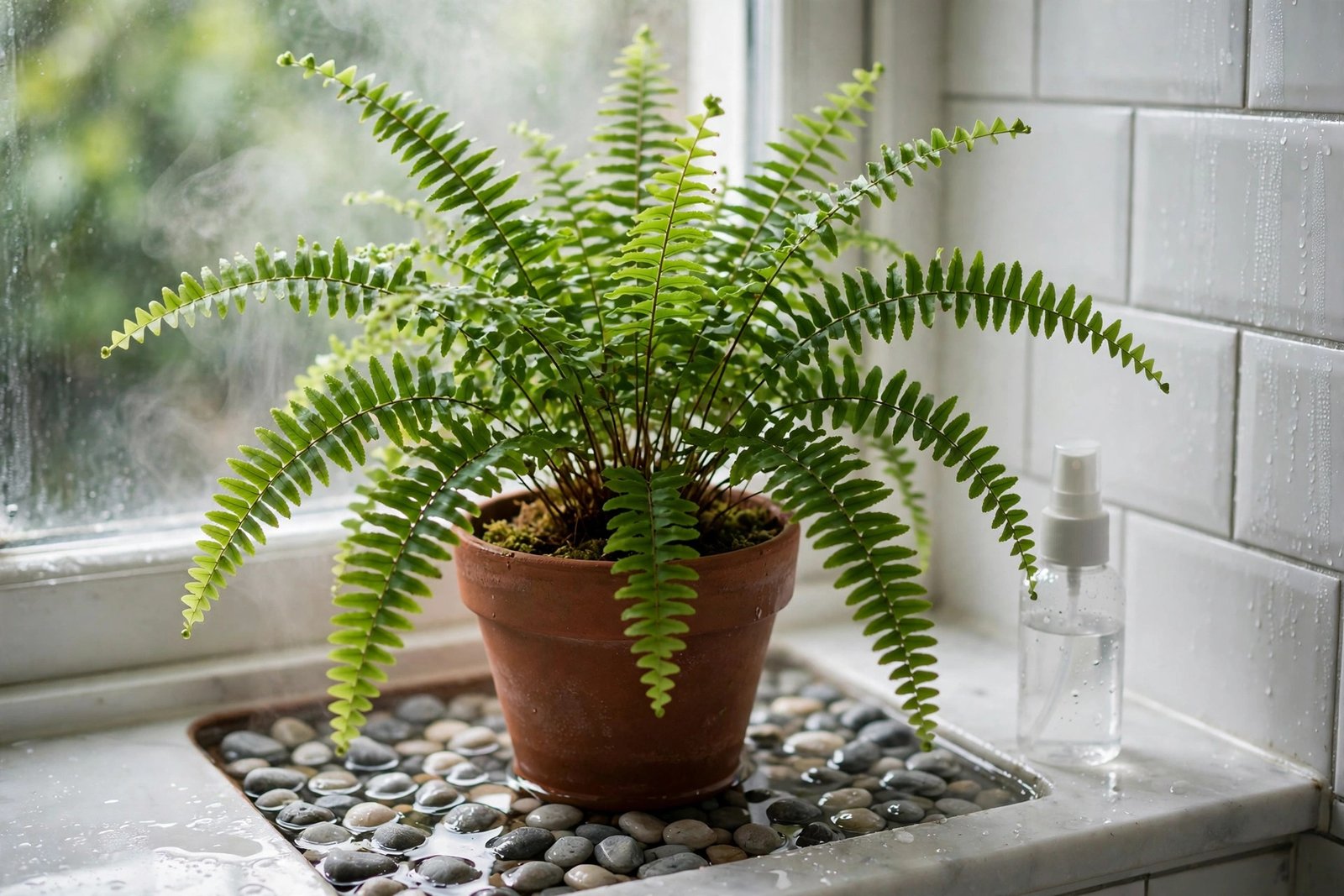
The most reliable methods are a humidifier nearby, a pebble tray under the pot, or a bright bathroom with a window, where shower steam helps. Humidity is the care detail that decides whether a Boston fern thrives, though it never changes the answer to are Boston ferns safe for cats — the plant stays non-toxic in dry air too, it just looks worse.
Temperature, Soil, Feeding, and Repotting
Boston ferns prefer normal room temperatures, roughly 60 to 75°F (15 to 24°C). Temperature does not change the answer to are Boston ferns safe for cats either — it only decides whether the plant stays lush or starts shedding.
Use a rich, loose potting mix that holds moisture without staying soggy — a standard houseplant mix with added coir or perlite works well. The pot must have drainage holes. Feed lightly and only in spring and summer: a balanced liquid fertilizer at half strength, once a month, is enough. Repot in spring, moving up only one pot size.
Pruning, Cleaning, and Common Problems
Boston ferns shed a little, even when healthy. Remove dead or fully brown fronds at the base with clean scissors. If only the tip is brown, trim the brown part and leave the rest.
Brown, crispy leaf tips usually mean dry air or salts from fertilizer or tap water, while yellow fronds can mean too much sun or overwatering. Brown tips do not change the answer to are Boston ferns safe for cats — the plant stays non-toxic even when the tips brown.
Where to Place a Boston Fern With Cats
A Boston fern is non-toxic, so the question is not whether it will poison your cat. It is whether your cat will chew it to pieces, knock it over, or dig in the pot. Good spots include a securely hung basket, a tall and stable plant stand, or a bright bathroom with a window.
Placement is where are Boston ferns safe for cats meets a determined chewer. A hanging basket solves most of the problem in one move, and it shows off the trailing fronds at their best. Hang it high enough that a cat cannot reach it from furniture, and use a secure hook. Check the hook and cord regularly, because a falling basket can injure a cat.

Avoid a low coffee table, a windowsill your cat already claims, and any surface where the pot can be pushed off with one paw. If your cat keeps chewing the fern, move the plant first. For more ideas, see our guide to keeping cats out of houseplants.
What to Do If Your Cat Chews a Boston Fern
This is a much calmer situation than chewing a lily or a sago palm. First, stay calm and check what happened. Check whether the plant is really a Boston fern.
If the tag is missing or says something else, treat the situation as uncertain and call your veterinarian.
A small nibble is not an emergency, but the question are Boston ferns safe for cats still deserves a careful check of the label.
Most cats need no treatment after chewing a Boston fern. Offer fresh water and watch the cat for the next few hours. Do not give food, medicine, or a home remedy unless your veterinarian tells you to.
If your cat chews a large amount, the question are Boston ferns safe for cats comes up again — and the answer stays yes for the plant itself, but your cat still needs watching. Contact your veterinarian or the ASPCA Animal Poison Control Center at (888) 426-4435 promptly if your cat vomits repeatedly, refuses food or water, or becomes lethargic. Never try to make your cat vomit at home.
The ASPCA Animal Poison Control Center is at (888) 426-4435, and the Pet Poison Helpline is at (855) 764-7661 (a fee may apply). Tell them the plant is Nephrolepis exaltata, how much was eaten, and when it happened. Do not give milk, oil, or any home remedy, and do not give medicine meant for people. Our guide on what to do if your cat eats a toxic plant walks through the first steps, and most of them apply here too.
Propagation and Seasonal Care
Division is the easiest way to propagate a Boston fern. In spring, when you repot, look for separate crowns. Using a clean, sharp knife, cut the root ball into halves or quarters, making sure each piece has roots and fronds. Pot each division in fresh mix and water well.
New divisions raise the same question in a smaller form: are Boston ferns safe for cats when the new plants are involved? The divisions are part of the same plant, Nephrolepis exaltata, so the same ASPCA listing applies. Keep new divisions out of reach until they are established.
Frequently Asked Questions
Are Boston ferns safe for cats?
Yes. Boston ferns (Nephrolepis exaltata) are listed as non-toxic to cats by the ASPCA. A cat that nibbles a frond is not expected to be poisoned. Eating a large amount can still cause mild vomiting or a soft stool from plant fiber.
That is why are Boston ferns safe for cats is a yes even when a cat nibbles a few leaves — the risk is stomach upset, not poisoning.
Are Boston ferns safe for dogs as well?
Yes. The ASPCA lists the Boston fern as non-toxic to dogs as well as cats and horses. The same caution applies: non-toxic does not mean edible.
Can cats eat Boston fern leaves?
Cats can nibble Boston fern leaves without being poisoned, but they should not be encouraged to eat them. The leaves are fibrous and can cause mild stomach upset if a cat eats a lot. Move the plant out of reach and offer cat grass instead.
Is asparagus fern the same as Boston fern?
No. Asparagus fern (Asparagus densiflorus) is not a true fern, even though it looks feathery. The ASPCA lists it as toxic to cats and dogs. A Boston fern is a true fern, Nephrolepis exaltata, and is listed as non-toxic.
Why are the tips of my Boston fern turning brown?
Usually dry air, especially in winter. Raise the humidity and trim the brown tips.
Where should I put a Boston fern with a cat in the house?
A securely hung basket, a tall, stable plant stand, or a bright bathroom with a window.
Conclusion
So, are Boston ferns safe for cats? Yes — the ASPCA lists Nephrolepis exaltata as non-toxic to cats. The main question is care: can you give it bright indirect light, steady moisture, and high humidity? If you can, start with one healthy plant.
If a friend asks are Boston ferns safe for cats, you can now answer yes — and explain the chewing caveat. To build a wider collection, continue with our list of 15 cat-safe houseplants.
Disclaimer: This article is for general information only and does not replace advice from a veterinarian. Plant toxicity listings can change, and individual cats can react differently. If your cat eats a plant and you are worried, contact your veterinarian or the ASPCA Animal Poison Control Center at (888) 426-4435.
Sources and References
- ASPCA Animal Poison Control Center — Toxic and Non-Toxic Plant List, Dogs (includes the Boston Fern entry, Nephrolepis exaltata bostoniensis, listed as non-toxic): https://www.aspca.org/pet-care/animal-poison-control/dogs-plant-list
- ASPCA — Do You Know Which Flowers and Plants Are Toxic to Pets? Our Experts Explain! (lists Boston Fern, Nephrolepis exaltata, among non-toxic plants; notes that any plant can cause mild stomach upset): https://www.aspca.org/news/do-you-know-which-flowers-and-plants-are-toxic-pets-our-experts-explain
- New York Botanical Garden, Mertz Library — How do I care for my Boston fern? (light, water, humidity, temperature, soil, and feeding for Nephrolepis exaltata ‘Bostoniensis’): https://libanswers.nybg.org/faq/222598
- UK Houseplants — Growing Healthy Indoor Boston Ferns, Nephrolepis exaltata (light, water, humidity, and fertilizing): https://www.ukhouseplants.com/plants/boston-fern-nephrolepis-exaltata
- Houseplants Nook — Boston Fern Care: Soil, Watering & Common Problems Solved (humidity, temperature, soil, and common problems): https://houseplantsnook.com/ultimate-boston-fern-care-guide
- Verdejar — How to care for a Boston fern (light, watering, humidity, soil, repotting, and propagation by division and runners): https://www.verdejarapp.com/journal/how-to-care-for-a-boston-fern/
7 thoughts on “Are Boston Ferns Safe for Cats? A Complete Plant Guide”