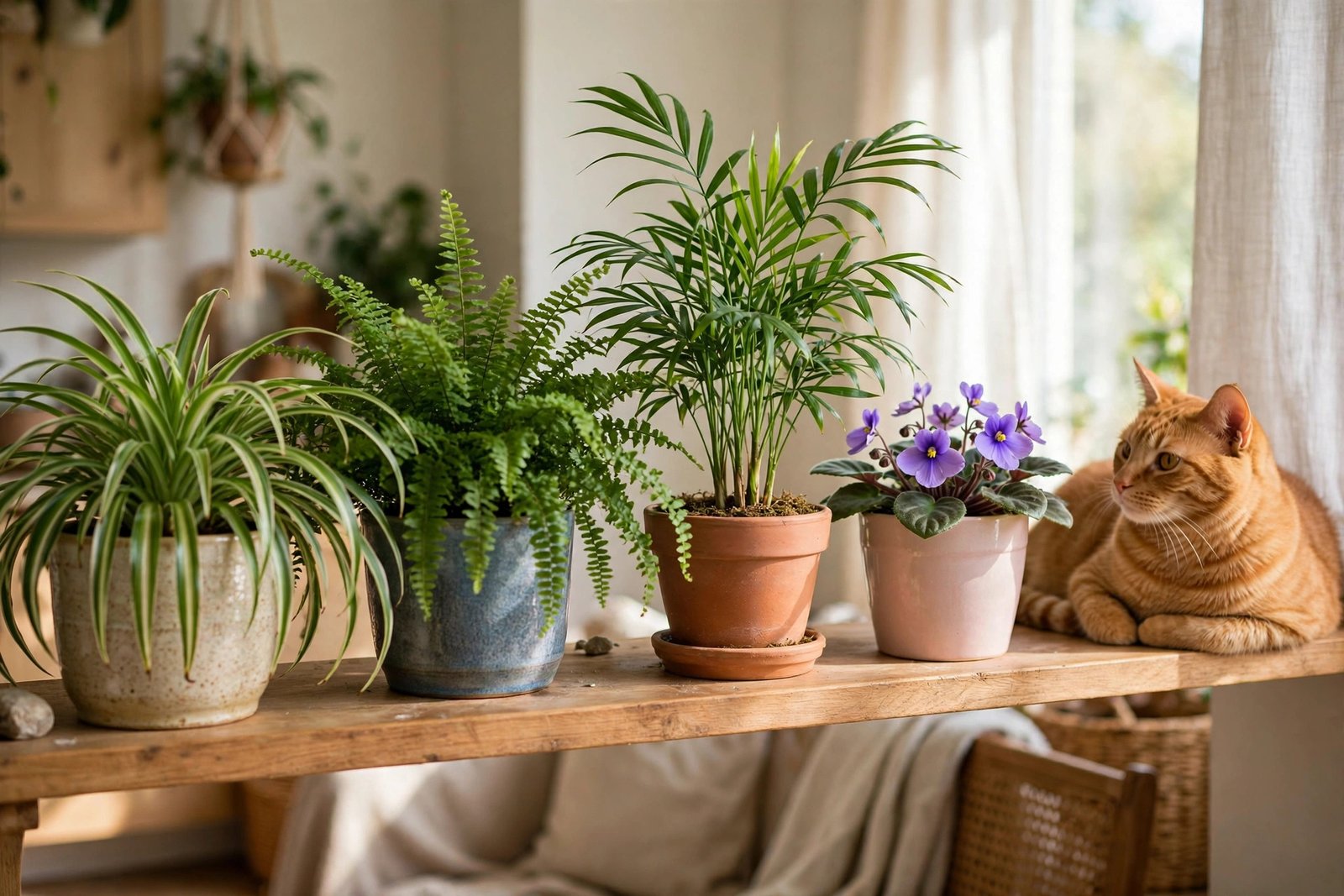
Cat-safe houseplants let you fill your home with green without putting your cat at risk. Many popular indoor plants are toxic to cats, but the ASPCA Animal Poison Control Center lists plenty of attractive options as non-toxic. This guide covers 15 cat-safe houseplants, with common and botanical names, light and water needs, and notes on how each one holds up around a curious cat.
Every plant below appears on the ASPCA’s Toxic and Non-Toxic Plants list as non-toxic to cats. Each entry names the exact species to check on the label, because common names alone can mislead. If you are new to checking labels, our guide on how to choose cat-safe plants walks through the process step by step.
What “Non-Toxic” Really Means (and What It Does Not)
An ASPCA non-toxic listing means the plant is not expected to cause poisoning or be life-threatening if a cat nibbles it. The ASPCA also warns that eating any plant material may cause vomiting and stomach upset, even from plants on the non-toxic list. “Non-toxic” is not the same as “safe to chew or eat” — a cat that eats a lot of any leaf can still get a mildly upset stomach from the fiber alone.
The ASPCA list covers plants people commonly keep indoors, not every plant in existence. A plant missing from the database may simply be unassessed, and absence is not proof of safety. These 15 cat-safe houseplants are lower-risk choices, not plants to let your cat graze on. Keep that distinction in mind as you shop, and you will avoid the most common mistake cat owners make.
The 15 Cat-Safe Houseplants at a Glance
| Plant | Botanical Name | Light | Water |
|---|---|---|---|
| Spider Plant | Chlorophytum comosum | Bright–medium indirect | Top inch dry |
| Boston Fern | Nephrolepis exaltata | Bright indirect | Keep soil moist |
| Areca Palm | Dypsis lutescens | Bright indirect | Moist, not soggy |
| Parlor Palm | Chamaedorea elegans | Low–medium indirect | Top inch dry |
| African Violet | Saintpaulia ionantha | Bright indirect | Water from below |
| Calathea | Calathea spp. | Medium indirect | Moist; prefers humidity |
| Peperomia | Peperomia obtusifolia | Medium–bright indirect | Let dry between waterings |
| Zebra Haworthia | Haworthiopsis fasciata | Bright indirect, some sun | Water sparingly |
| Echeveria | Echeveria elegans | Bright light, some sun | Very infrequently |
| Moth Orchid | Phalaenopsis spp. | Bright indirect | Weekly; bark mix |
| Cast Iron Plant | Aspidistra elatior | Low–bright indirect | When soil is dry |
| Polka Dot Plant | Hypoestes phyllostachya | Bright indirect | Keep soil moist |
| Christmas Cactus | Schlumbergera bridgesii | Bright indirect | Water regularly |
| Blushing Bromeliad | Neoregelia spp. | Bright indirect | Keep central cup filled |
| Ponytail Palm | Beaucarnea recurvata | Bright light | Water sparingly |
The 15 Cat-Safe Houseplants in Detail
A quick note before the list: the light levels here use plain terms. “Bright indirect” means near a window but out of direct sunbeams, while “low light” means a spot a few feet from a window or a north-facing room. These cat-safe houseplants cover a wide range of rooms and routines, so pick the ones that fit your home rather than forcing a plant into the wrong spot.
1. Spider Plant (Chlorophytum comosum)
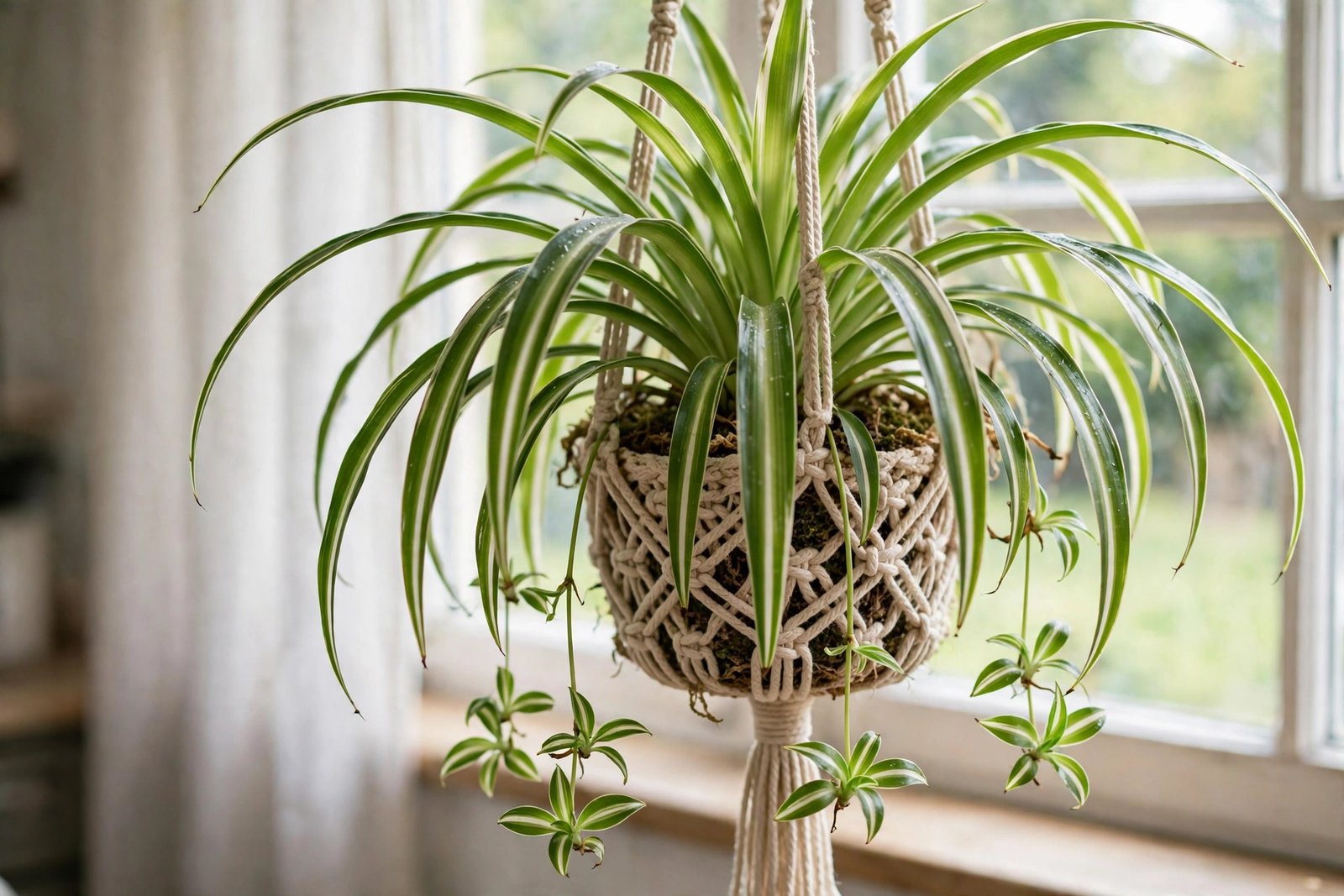
The classic starter choice for cat owners, and one of the easiest cat-safe houseplants to keep alive. The ASPCA lists Chlorophytum comosum as non-toxic to cats and dogs. Its arching leaves and dangling plantlets attract cats, so a hanging basket is often the best spot. Brown leaf tips usually point to chemicals in tap water or dry air.
2. Boston Fern (Nephrolepis exaltata)
One of the few large, lush cat-safe houseplants with a clear ASPCA non-toxic listing, filed under Nephrolepis exaltata (often sold as ‘Bostoniensis’). Its soft fronds are not spiky, and most cats show little interest in them. Do not confuse it with asparagus fern, which is not a true fern and is listed as toxic. Our full guide on are Boston ferns safe for cats covers identification and care in more detail.

3. Areca Palm (Dypsis lutescens)
For a large, airy floor plant, the areca palm is one of the few cat-safe houseplants that fits. The ASPCA lists Dypsis lutescens — also sold as butterfly palm or golden cane palm — as non-toxic to cats, dogs, and horses. It can grow five to seven feet tall indoors, so give it a bright corner with room to spread. See our guide on are areca palms safe for cats for the full care rundown.
4. Parlor Palm (Chamaedorea elegans)
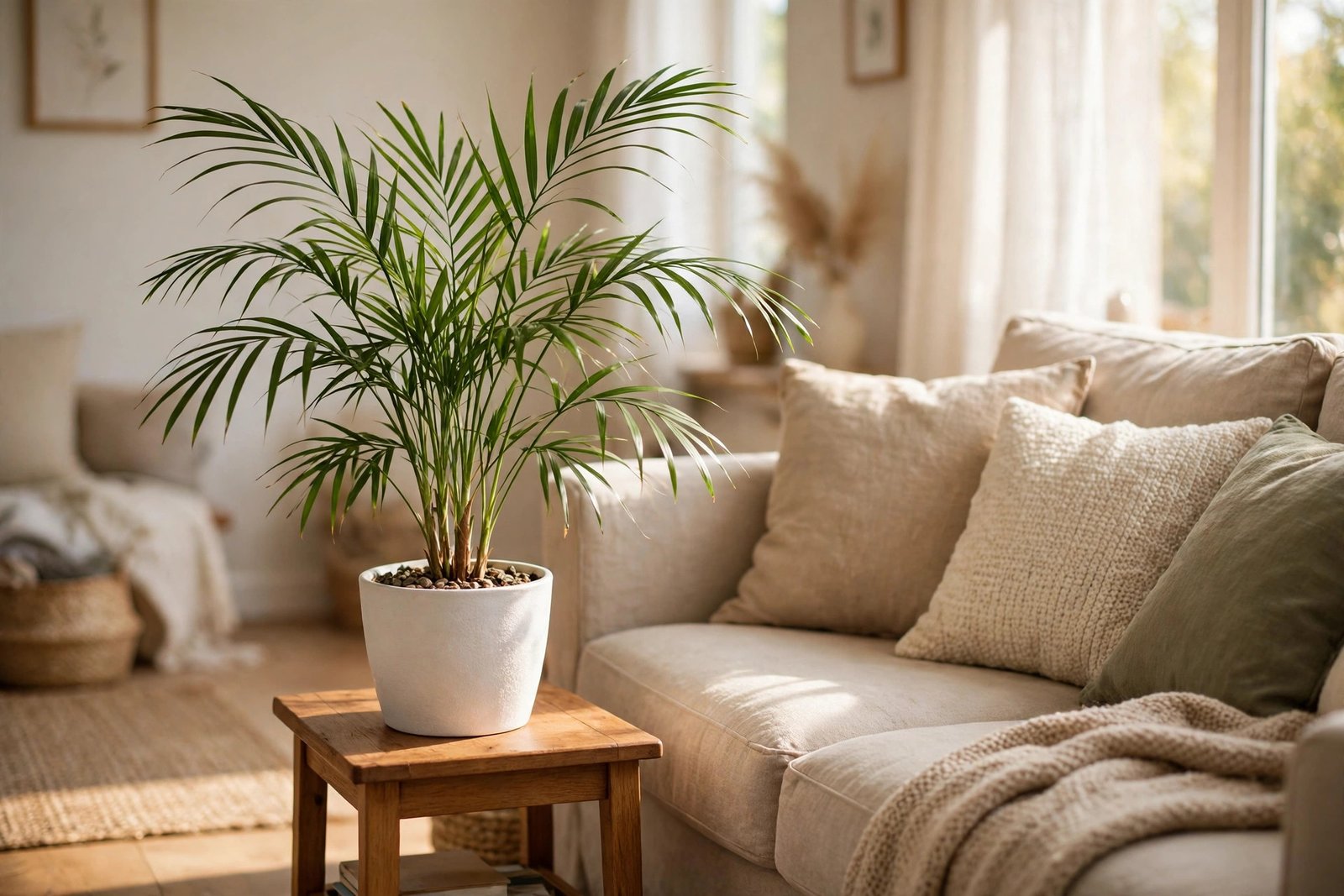
The smaller, calmer cousin of the areca palm and one of the easiest pet-friendly indoor plants to keep. The ASPCA lists Chamaedorea elegans as non-toxic to cats and dogs. It tolerates low to medium indirect light, grows slowly, and usually stays two to four feet tall — fine for a tabletop or small room. Among cat-safe houseplants, it is one of the best picks for a dim apartment corner.
5. African Violet (Saintpaulia ionantha)
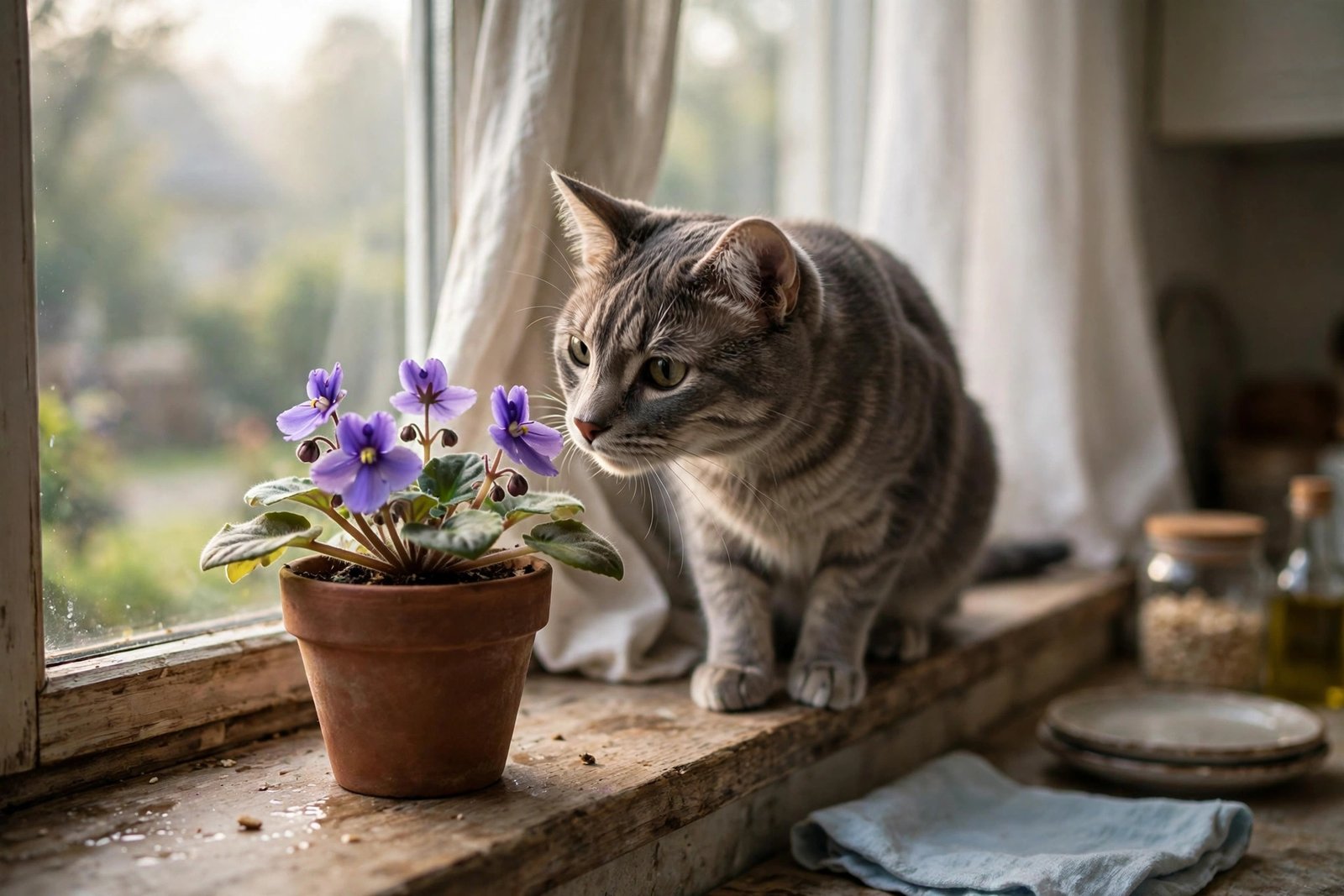
For color in a cat-owning home, the African violet is a reliable pick. The ASPCA lists Saintpaulia species as non-toxic to cats. These compact plants flower for much of the year in purple, pink, blue, and white.
Water from below, since wet fuzzy leaves can spot and rot. A small saucer under the pot makes this easy.
6. Calathea (Calathea spp.)
These cat-safe houseplants are grown for patterned leaves in deep green with cream, pink, or purple markings, and the ASPCA lists the Calathea genus as non-toxic to cats and dogs. Many calatheas have been reclassified into the genus Goeppertia, so a label may read either name. They like humidity, so a bathroom with a window or a pebble tray underneath suits them well.
7. Peperomia — Baby Rubber Plant (Peperomia obtusifolia)
The baby rubber plant is one of the most common peperomias, and the ASPCA lists Peperomia obtusifolia as non-toxic to cats. Its thick, glossy leaves store water, so it dislikes soggy soil and stays compact — a good desk or shelf pick among cat-safe houseplants. Be careful with the name: the rubber tree (Ficus elastica) is a different plant and is toxic to cats.
8. Zebra Haworthia (Haworthiopsis fasciata)
Zebra haworthia is the safe succulent for cat owners who like the look of aloe without the risk. The ASPCA lists Haworthia species as non-toxic to cats, and the plant is now often classed as Haworthiopsis fasciata. True aloe (Aloe vera) looks similar and is toxic, so confirm the name on the tag. Of all the cat-safe houseplants in this guide, this one needs the least water.
9. Echeveria (Echeveria elegans)
Echeveria is the classic rosette succulent, and the ASPCA lists Echeveria elegans (sold as hens and chicks) as non-toxic to cats. Several Echeveria species are on the ASPCA’s non-toxic list, but the listing is by species — check the exact name on the label. Give it the brightest spot you have and water only when the soil is fully dry.
10. Moth Orchid (Phalaenopsis spp.)
The moth orchid is the best flowering alternative to lilies, which are extremely dangerous to cats. The ASPCA lists Phalaenopsis orchids as non-toxic to cats and dogs. Never bring true lilies (Lilium species) or daylilies (Hemerocallis species) into a home with cats, even as cut flowers. If you want the full picture on lilies, read are lilies toxic to cats.
11. Cast Iron Plant (Aspidistra elatior)
The cast iron plant lives up to its name. The ASPCA lists Aspidistra elatior as non-toxic to cats, dogs, and horses. It tolerates low light, irregular watering, and dry air better than almost any plant here. Among cat-safe houseplants, its tough leaves are less tempting to chew than soft, grassy ones, which makes it a smart pick for a dedicated chewer.
12. Polka Dot Plant (Hypoestes phyllostachya)
The polka dot plant adds pink, white, or red speckles, and the ASPCA lists Hypoestes phyllostachya as non-toxic to cats. One honest caveat: the ASPCA entry notes it can cause mild vomiting or diarrhea if eaten — “non-toxic” does not mean “fine to eat.” Keep it where your cat can look but not graze, and it will stay colorful for months.
13. Christmas Cactus (Schlumbergera bridgesii)
The Christmas cactus is a winter-flowering plant with no spines, and the ASPCA lists Schlumbergera bridgesii as non-toxic to cats, dogs, and horses. Despite the name, it is not a desert cactus: it comes from humid forests and flowers in winter as the days shorten. This is one of the cat-safe houseplants that rewards a little patience with months of blooms.
14. Blushing Bromeliad (Neoregelia spp.)
The blushing bromeliad brings bold, lasting color. The ASPCA lists Neoregelia bromeliads as non-toxic to cats; the database files them under the older name Aregelia, so search by the botanical name if you are checking the entry yourself. Refill the central cup regularly, and keep the soil itself only lightly moist.
15. Ponytail Palm (Beaucarnea recurvata)
The ponytail palm is not a true palm — it stores water in its swollen trunk — and the ASPCA lists Beaucarnea recurvata as non-toxic to cats, dogs, and horses. Like several other cat-safe houseplants here, its long, strap-like leaves attract cats, so expect chewing and frayed tips. Use a heavy pot so a tugging cat cannot topple it, and water sparingly.
How to Check a Plant Before You Buy It
Start with the label: find the botanical name in italics. A label that only says “palm,” “fern,” “succulent,” or “tropical foliage” is not enough — those words cover plants with very different toxicity records. Search the botanical name in the ASPCA’s Toxic and Non-Toxic Plants database, and read the entry for cats specifically.
Watch for look-alikes. Asparagus fern is not a true fern and is toxic, while the Boston fern is a true fern and is not. Aloe vera resembles haworthia but is toxic.
The rubber tree is not the baby rubber plant. Sago palm is not a palm at all and is highly toxic, while parlor, areca, and ponytail palms are non-toxic.
If you cannot find the exact species, treat the plant as unverified.
Before buying any of these cat-safe houseplants, check the exact species on the label against the ASPCA database — a listing covers the plant, not pesticides on it, so rinse new plants before they come inside. If a shop cannot tell you the botanical name, skip the plant. For the plants you should steer clear of, see our list of houseplants toxic to cats.
Simple Habits That Keep Plants and Cats Happy Together
Choosing cat-safe houseplants is the first step, not the whole job. Give your cat something it is allowed to chew, such as indoor cat grass, so the houseplants are less interesting. Place delicate or trailing plants where your cat cannot easily reach them, and use heavy, stable pots for floor plants.
Keep the soil covered if your cat likes to dig — a layer of large, smooth stones over the soil surface often helps. Rotate your plants now and then so no single plant takes all the attention, and check leaves weekly for chew marks. Cat-safe houseplants still need basic care to stay healthy, so stick to a simple watering routine and keep pots in the light each plant prefers.
What to Do If Your Cat Chews a Plant
If your cat only took a small nibble of a non-toxic plant here, watch for mild stomach upset such as vomiting or a soft stool, and keep the plant out of reach. If your cat ate a large amount, seems unwell, or the plant is unknown, contact your veterinarian or the ASPCA Animal Poison Control Center at (888) 426-4435 promptly. Do not wait for symptoms, and never try home remedies or making your cat vomit — that can cause more harm.
Keep the plant’s label or a photo of it handy when you call, so the vet can confirm the species fast. If you are unsure what your cat ate, our guide on what to do if your cat eats a toxic plant walks through the first steps in order.
Frequently Asked Questions
Are spider plants safe for cats?
Yes. The ASPCA lists the spider plant (Chlorophytum comosum) as non-toxic to cats and dogs. Cats love its dangling plantlets, so hanging it out of reach protects the plant. For the full rundown, see are spider plants safe for cats.
What is the easiest cat-safe houseplant for a beginner?
The spider plant and the parlor palm are the easiest starting points. Both are ASPCA-listed as non-toxic, tolerate varied indoor light, and forgive the occasional missed watering. Cat-safe houseplants like these two are the best way to start a pet-friendly collection without much fuss.
Are all ferns safe for cats?
No. True ferns such as the Boston fern (Nephrolepis exaltata) are ASPCA-listed as non-toxic, but not every plant called a fern is one. Asparagus fern is not a true fern and is listed as toxic, and the sago palm is sometimes called a fern palm but is highly toxic. Always confirm the botanical name.
Can my cat eat a non-toxic plant?
It is best not to let them. “Non-toxic” means the plant is not expected to cause poisoning; it does not mean the leaves are food. Eating plant material can still cause vomiting or stomach upset — the ASPCA’s polka dot plant entry mentions mild vomiting or diarrhea as a possible result. Offer cat grass instead.
Are succulents safe for cats?
Among cat-safe houseplants, haworthia and echeveria are the succulents listed as non-toxic by the ASPCA, while aloe vera, jade plant, and kalanchoe are listed as toxic. Check the botanical name on the label and in the ASPCA database before bringing one home.
Which flowering houseplants are safe for cats?
African violets, moth orchids (Phalaenopsis), Christmas cactus, and blushing bromeliads are all ASPCA-listed as non-toxic and all flower indoors. True lilies (Lilium species) and daylilies (Hemerocallis species) are extremely dangerous to cats — never bring them home, even as a bouquet. For more flowering picks, see cat-safe flowering houseplants.
Conclusion
A greener home and a cat can go together well, as long as plants are chosen by botanical name and checked against a reliable source. The 15 cat-safe houseplants in this guide — from the forgiving spider plant and parlor palm to the flowering African violet and moth orchid — are all ASPCA-listed as non-toxic to cats. Pick one that fits your light and your routine, check the label before you buy, and place it where your cat can admire it without making a meal of it.
Disclaimer: This article is for general information only and does not replace advice from a veterinarian. Plant toxicity listings can change, and individual cats may react differently. If your cat shows signs of illness after contact with any plant, contact your veterinarian or the ASPCA Animal Poison Control Center at (888) 426-4435 promptly.
Sources and References
- ASPCA Animal Poison Control Center — Toxic and Non-Toxic Plants list (main database; includes the ASPCA’s note that eating any plant material may cause vomiting and stomach upset, and that non-toxic plants are not expected to be life-threatening). https://www.aspca.org/pet-care/animal-poison-control/toxic-and-non-toxic-plants
- WebVet — “Plants Safe for Cats: The Vet-Checked List” (ASPCA verdicts by species, including spider plant, Boston fern, parlor palm, areca palm, African violet, prayer plant, calathea, peperomia, bromeliad, Christmas cactus, money tree, cast iron plant, polka dot plant, and ponytail palm). https://www.webvet.com/plants-safe-for-cats/
- PlantBlueprint — “Cat Safe Plants: 24 Non-Toxic Houseplants (ASPCA-Checked)” (species-level table checked against the ASPCA list for cats). https://www.plantblueprint.com/the-infirmary/cat-safe-plants/
- Houseplant Care HQ — “Which Houseplants Are Safe for Pets? The ASPCA-Verified List” (individual ASPCA entries for calathea, orchid, prayer plant, parlor palm, and areca palm). https://houseplantcarehq.com/pet-safe-plants/
- GetPlantLens — “House Plants Safe for Cats: 17 ASPCA Non-Toxic Picks” (ASPCA entries by species, including ponytail palm, cast iron plant, polka dot plant, Christmas cactus, and blushing bromeliad). https://getplantlens.app/lookup/plants-and-pets/house-plants-safe-for-cats
- PlantVale — “Houseplants Safe for Cats and Dogs” (ASPCA-checked list, including the polka dot plant entry note on mild stomach upset and the bromeliad genera listed). https://plantvale.com/blog/pet-safe-houseplants/
19 thoughts on “15 Cat-Safe Houseplants for a Greener, Pet-Friendly Home”